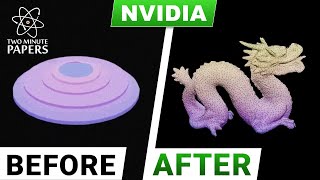
NVIDIA's new method converts point clouds into detailed 3D meshes with 40× more detail and 50% less memory than prior techniques. The neural network produces cleaner geometry with fewer artifacts and lets you choose between triangles or quads for different rendering needs.
Questions this video answers
March 9, 2025.
Point cloud.
Up to 40× more detailed.
Requires 50% less memory (approximately).
About 2.5× faster (two and a half times faster).
Chapters
I present to you a stunning piece of research work. Today, in most computer games and animated movies, whenever we see a scene, what lies under is hours and hours of work from a skilled artist creating these meshes, often done by hand using a Muddler program like Blender. But in the age of AI, we can write a text prompt and get an image, even a piece of video. So what about 3D geometry? Can we create virtual worlds from thin air? You would think that it is possible, and there is research on that. So let's have a look. Oh my, yes, you can get a mesh, but it's not a really good one, is it? You still have to work on this one to be able to use it, and that almost defeats the purpose because you need a skilled artist for that. What about the rest of us? But it gets worse. Even if you get an object that is poorly constructed, we like to say that it is poorly tessellated. So even if you wanted to do something with it, you can't move and edit the parts intuitively. And that is why I was so super excited for this paper that promises something better. Now, let's see together. Oh, that is so much better. Tessellation. This camera can be taken apart and edited easily. And it requires fewer elements, a sparser mesh to do that. But you might not even need that because look, you needed to perform surgery on this poor little penguin with the previous method and with the new one. Ha. Not so much loving this, but I am still a bit skeptical. You see, previous methods can sometimes generate you something that you don't need surgery for. However, look, the surfaces are uneven. They have these weird artifacts that make them look like as if they took a beating. So what about this new one? Oh my. That is not perfect. But this geometry is so much cleaner. And you see, every paper in this area says that they create high quality geometry. And. And I got to say, this is the first time ever in a paper where I think I have to agree. And here comes my favorite part. You can even have a look at the AI building the 3D geometry. It really feels like the whole thing is being born from thin air. Absolutely amazing. Dear fellow scholars, this is two minute papers with Dr. Zsolnai. Now, wait a second. You see this bluish thing on the left? So. So is this geometry coming from thin air? I mean, from just a text prompt? No, but almost, yes. You see, the input is a point cloud, and to that I say, thank goodness. You see, during my years as a PhD student, I sat through hundreds and hundreds of research presentations on how to take a point cloud and create a nice mesh from it. I'll give you the summary. In short, it seems impossible and every single technique brings its own issues. But. But this new one can take a point cloud and create relatively high quality geometry that we might not even need to touch. That is fantastic. Bravo. But it is still not a text prompt. No matter, because generating a proper point cloud with an AI from a text prompt is very easy to do. It is just generating coordinates in space. But generating the mesh geometry itself would be harder because it has to have proper surface connectivity. Has topological constraints too. It also has to be easily editable. So here is the genius part. Instead of doing the hard thing geometry, we do the easy task point clouds and then use this AI to do the hard part for us. So good. And on occasion it doesn't just reconstruct the point cloud into a mesh, it can even fix the problems with the point cloud itself. So I am already delighted by this paper. But it turns out it gets even better. Look. Oh my. You can even choose to have a lower or a higher polygon count, more cores or more detailed models. That is perfect because for a real time game you might want to get geometry that is a bit quicker to render. Or if you are rendering an animated movie and you have all the time in the world for rendering, just get a denser, more detailed one. In fact, hold on to your papers fellow SK colors because this can generate a mesh that is up to 40 times more detailed than previous techniques. Wow. And the results are absolutely sublime. So much better than anything many of us could put together by hand. And you can also choose whether the mesh should be built from triangles or quads. And it does all this while requiring 50% less memory and runs two and a half times faster than previous methods. What an absolute blockbuster paper. Wow. And you can also play and rotate around these nice shaded results on their website in the description. Now a little criticism. Not even this technique is perfect. If you want a super detailed model, you still have to wait for a while. Missing parts and holes can still occur and you still can't just use a text prompt directly. You would need a separate tool to create a point cloud. I say it is a fantastic deal and I can't even imagine what we will be capable of. Two more papers down the line and we are fellow scholars here, we love the papers and I recommend having a look at this one. It shows you how they reimagine these token based AI assistant models to be able to create geometry, which is amazing. And they use this thing that they call an hourglass. Neural architecture. I first thought okay but this looks like an autoencoder and I idea that dates back almost 40 years now. However, this is not the case. Nope, this is new exciting stuff, not just an AI thrown at the problem. Loving it. Now one more thing, I don't do real life appearances very often. Last time I saw you fellow scholars in London and San Francisco and I am coming over again. I will be at the GTC conference. Look for a fellow scholar marked with a two minute papers badge. I can assure you that it is not an AI, it is me. If you come say hi, I will give you a small gift limited edition while supplies last. See you there Fellow scholars, if you are like me, it takes you a while to truly understand the paper, especially when it's not right in your area. Macro.com is a new AI document reader that gives you superpowers. Click on any term or figure and it explains it to you without leaving your page. You can even talk to the paper or ask questions too. Try it for free@macro.com papers and get $5 with the code papers.