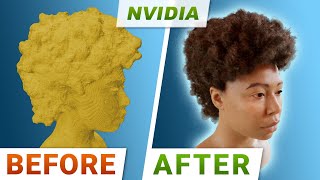
A short YouTube commentary (Dr. Zsolnai / Two Minute Papers) reviewing recent advances that make NeRF-based virtual world reconstruction both faster and higher-quality. The video contrasts Instant Neural Graphics (very fast but lower quality) with new "shells" techniques that build triangle meshes from colored 3D points to recover thin structures (hair, fabric) and enable use of standard rendering and physics pipelines. A separate paper adds real-time elastodynamic (physics) simulation for these worlds. The video also highlights Gaussian splatting as an alternative fast reconstruction approach and contrasts these AI-driven methods with older handcrafted simulation work that required hours of compute per second of footage.
Chapters
I can't believe that this is happening. And this. And this. And this too. Yes. Games and virtual worlds are about to get a heck of a lot better in terms of visual quality. So what just happened? First, this paper took nerfs to the next level. What are nerfs? Well, nerfs are neural radiance fields. A tool for us to create photos or video footage of something in the real world and then make a copy of it as a virtual world that we can play in. But through an amazing paper called Instant Neurographics, we can do this in a matter of minutes, often even seconds. So what's new here? Why write another paper on it? Are we done here? Dear fellow scholars, this is two minute papers with Dr. Zsolnai the answer. Nope. No, sir, we are not even close to being done. You see, the speed is satisfactory with instant neural graphics, but the quality, hmm, not so much. Look. And here is the new technique. Wow, look at the hair. The hair is now not a blurry blob, but it is a crisp piece of geometry. Loving it. So this new technique finally gives us higher quality virtual worlds. Worlds that are worth playing in. So, high quality, what does that mean? Being slower. That's what it means. Well, most of the time, yes. But does it also mean this is slow too? Let's have a look. And. Oh, my goodness. Are you seeing what I am seeing? This is easily twice as fast as instant neural graphics. And at the same time, it is also of much higher quality. And it gets better. Now hold on to your papers, fellow scholars. And look, in some cases it is up to 20x faster. Wow. That is absolutely incredible. This kind of improvement. Just one more paper down the line. I can hardly believe it. Yes, fellow scholars, this is the corner of the Internet where we look at research papers. Black ink on a white table and flip out together. And did you notice it? Have you found it? Look again. These scenes have tons of hairy things and fabric and even more hair. And then even more hair. Wait a minute. That, dear fellow scholars, is impossible. Nerfs are not good at modeling thin structures at all. Right. But this one is excellent. How is that even possible? Well, here is where shells come into the picture. Let's pop the hood. And oh, yes, first, this technique works very much like a nerve based technique would. But then, here is where the magic happens. From a set of colorful points in 3D space, it constructs a shell. And from that shell, we get a triangle mesh. Oh, boy. Are you thinking what I am thinking? Oh, yes. Using triangle meshes means that we can use our amazing computer graphics and physics simulation algorithms to deform it. Yes, so. So from now on, from your cameras, we get not only a virtual world that we can play in, but we can even run our physics simulations in it. I absolutely love this idea. Yummy. But wait, this is AI research we are talking about and. Oh my, what is this? Can it be that. Yes, a separate specialized paper for physics simulations within NERF based worlds is already available. And this one is a real treat. We can simulate elastodynamic motion within these worlds. And all this happens in real time. And we are still not done yet. Here is another really cool innovation on improving neural radiance fields. If these are virtual worlds, that means that we likely wish to move around in them. When we get close to these objects, the quality is still not quite there from close by. However, with this new technique, we can get closer and just zoom and zoom and zoom and the quality is still there. Now there is also a new, different school of thought for creating virtual worlds, and that happens through Gaussian splatting. This is a technique where you can cheaply store a few of these lumps that we call Gaussians. But that's not what you see on the screen. What you see here is a reconstruction of these lamps which looks like this. And this representation also lends itself to physics simulations. This one is going to be an absolute treat. We can spread these questionable materials on a piece of virtual bread and my favorite, even tear it. Oh, yeah. OG fellow scholars, remember this legendary paper. You might soon be able to have this kind of quality with any object in a virtual world that you create by recording your own home or anywhere on the planet. Wow. This work used to be a simulation paper that took a long time to compute. Up to about one hour for every second of footage that you see here for the baking paper. And fellow scholars, about four hours for every second of footage here for the tearing paper. Yes, these are measured not in frames per second, but in seconds per frame. And we haven't even talked about all the integral calculus and human ingenuity that is required for this. Yes, these were handcrafted techniques. No AI anywhere to be seen by just the ingenuity of computer graphics researchers. And in the future, they might run in our virtual worlds and video games in real time. I would absolutely love that. I wanted to make sure here that we honor the great works out there and compare to them. So these four papers truly are a dream come true for virtual worlds. And as good fellow scholars who we should always invoke the First Law of Papers the first Law of Papers says that research is a process. Do not look at where we are, look at where we will be. Two more papers down the line and just imagine what we will be capable of. Two more papers down the line. My goodness. If you have some ideas, let me know in the comments below. What a time to be alive. If you are looking for inexpensive cloud GPUs for AI, Lambda now offers the best prices in the world for GPU cloud compute. No commitments or negotiation required. Just sign up and launch an instance and hold on to your papers. Because with the Lambda GPU cloud you can now get on demand H100 instances for just 1.99per hour. Yes, 199 and they are one of the first cloud providers to offer publicly available on demand H100 access. Did I mention they also offer persistent storage? So join researchers at organizations like Apple, MIT and Caltech in using Lambda Cloud instances, workstations or servers. Make sure to go to lambdalabs.compapers to sign up for one of their amazing GPU instances today.