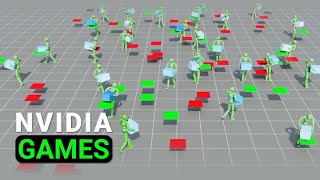
A Two Minute Papers YouTube explainer (by Dr. Zsolnai) presenting a recent NVIDIA-related paper that extends Adversarial Motion Priors (AMP, SIGGRAPH 2021) to produce high-quality, stylized character motions that also generalize to novel objects and environments. The narrator emphasizes that the new technique achieves both motion quality and generalization simultaneously, reports robustness testing (success rates typically above 90%, falling 3–10% under strong perturbations), and includes a short sponsor segment for Weights & Biases.
Chapters
Dear fellow scholars, this is Two Minute Papers with Dr. Zsolnai. Today we are going to talk about the unfortunate fortunate situation of computer animation in video games. Now I hear you asking, Doctor, what do you mean by unfortunate fortunate? Well, let's start with the unfortunate part. If we have created a beautiful virtual world and we have populated it with a bunch of characters, who are we now wish to see the two interact? And therein lies the problem. With previous techniques, either the quality of the motion is lacking or generality. In other words, if the motions are of high quality, they don't transfer to new scenes. Or if they do transfer to new scenes, they are typically not high quality. So that is the unfortunate situation. Now, what about the fortunate part? What is so fortunate? Well, I feel very fortunate today. Get this. I seem to be the fourth person to have read this paper. And I am very excited to say that I think I have found a little gem to share with you that might just solve the problem we have at hand. Look, this one builds on top of the adversarial motion priors amp paper from Siggraph 2021. This paper could place a charact in a virtual environment. And it looked at a dataset of real clips of movements like running, jumping and rolling and even punching. And it was able to learn to use those motions in these video game worlds to its advantage to finish a level. Now, what about this new technique? Does it do what we really want it to do? Yes, yes it does. Fantastic. It builds on top of AMP and and generalizes it so that these characters will not just run around in the scene, but it teaches them to interact with the scene as well. So what does this mean? Why is this new? Well, because one, this is finally able to create motions that are both high quality as the one you can see here, as it is encouraged to solve these tasks with style. And two, this one also generalizes to new objects and environments at the same time. An absolute miracle. This was trained with a lot of different object types, orientations and locations. And when I say that they can do this with style, I mean that they can do this with style. Look at this jolly chap. He is fabulous. Love it. And these objects are newly designed objects that the AI hasn't seen yet. And it can still use them just fine. High quality motion is being created in a way that finally generalizes so good. And this AI has undergone strict testing and the scientists found that we can put any kind of box anywhere and this little AI will be able to bring it back. I also love this scene which Shows a variety of different motions for walking towards this object and sitting on it. If only they had a musical chairs version of it where one of these poor little characters will be eliminated each round. May the best AI win. And are you thinking what I am thinking? Do you know what is coming up now? Of course. Testing against external perturbations. Oh yes, the favorite pastime of the computer graphics researcher. Look, these folks are not only robust, but super patient as well. Look at these nasty tricks the scientist tried to pull on them. Not a single one worked so good. Loving it. Look. Whoop. Whoop. Alright, you get to sit down now. Whoop. Ha ha. Sorry, I had to. Ok, you can sit now. Good job. A for patience little AI. Now not even this technique is perfect. The success rates are not 100% but it's it is typically above 90%. And I am fairly sure this can be improved or at the very least be filtered in a way that approaches nearly 100% for real applications. If we start messing with them like throwing boxes at them or tripping them up, this success rate falls by about 3 to 10%. That is very respectable, especially given by how badly we have treated them. Sorry about that, but we got to proceed with the testing. So in a new paper that only four people had seen yet, we finally get this age old problem in computer animation solved. I can't believe it. What a time to be alive.
Weights and Biases provides tools to track your experiments in your deep learning projects.
What you see here is their artifacts.
Feature which speeds up the most common machine learning steps like uploading raw data, splitting it into training, validation and test sets. And of course the best part, starting to train a neural network. It is used by many prestigious labs including OpenAI, Toyota Research, GitHub and more. And the best part is that Weights and Biases is free for all individuals, academics and open source projects. Make sure to Visit them through wnb.com papers or just click the link in the video description and you can get a free demo today. Our thanks to Weights and Biases for their long standing support and for helping us make better videos for you.
Thanks for watching and for your generous support and I'll see you next time.