In this Two Minute Papers episode, Dr. Károly Zsolnai‑Fehér walks through a newly released open‑source self‑driving system that uniquely provides human‑readable reasoning for every action. The video explains the 42‑page research paper behind the system, highlighting its core technical contributions: (1) a consistency‑reward reinforcement‑learning loop that forces the model’s spoken explanations to match its wheel commands, (2) a conditional flow‑matching loss that smooths the vehicle’s motion, (3) a synthetic hyper‑realistic simulator called AlphaSim built with 3D Gaussian splatting for training on rare, long‑tail scenarios, and (4) a “video‑diary” data‑generation pipeline where the model watches 700 k clips and writes a caption describing the cause of each maneuver. The author emphasizes that the system’s explicit reasoning reduces close‑encounter rates by roughly 25 % and makes debugging failures transparent. The researchers have released model weights, inference code, and a small slice of the training data, enabling anyone with a modest GPU to experiment with a state‑of‑the‑art driving brain. Limitations are noted: the consistency‑reward RL supervision is computationally expensive, and the model sometimes hallucinates explanations that do not match its actions. The video briefly mentions related work (DeepSeq) that avoids a teacher model, and includes promotional plugs for the upcoming GTC conference and Lambda’s GPU cloud service.
Chapters
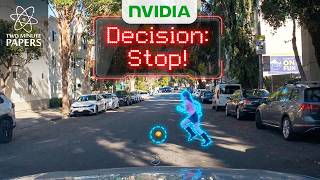
Self-driving cars are on the rise. As of today, Waymo is providing hundreds of thousands of paid trips per week across cities like San Francisco and LA. Crazy! They are already designing what the cars of the future would look like if they were like little study rooms for us while we travel. So, how does it work? I don't know. Almost nobody knows. Why? Because all of these solutions are proprietary technology. It's a secret. And now, finally, something incredible happened. We are getting what I think is the first completely open reasoning system to do self-driving that we can all use right now. There are other open systems, I think not as good as this, and most not reasoning. This is the key. Okay, let me try to explain. We have a 42-page research paper on how it works, and I will now try to explain it in the simplest words possible. And surprisingly, it teaches us not only about self-driving cars, but it teaches us about life itself. You'll see. Now imagine sitting in the passenger seat in a car next to a teenager. So you are sitting there, minding your own papers, and then suddenly, they smash that gas pedal. Whoa! You ask, why did you do that? And they say, I don't know, Hormones! You see, that's the problem with current self-driving systems. They are a bit like a teenager. They just do stuff. You ask why, and they just shrug. They look through the cameras, they output steering commands, but we have absolutely no clue why they do what they do. Now, this one is not like that. Look! Oh my, that is incredible. It says exactly what it is about to do and why. It says we are nudging to the left because there is a car stopped on the right. Now we keep left to follow the temporary corridor. And now we keep a bit of distance. This is excellent. I love it. Now, there is a reason why this is excellent. And it is not that when we die, we also get a nice little message why. Hooray! No, this is excellent because, hold on to your papers, Fellow Scholars, Because if it reasons, it actually drives better. Its close encounter rate is reduced by 25% just by thinking out loud. Which is kind of insane. Also, if it made a mistake, we now exactly know why and can improve the system accordingly. But it gets better. You see, it focuses on the heart of the self-driving problem—the long tail. Oh yes. The long tail refers to those rare, bizarre situations. Like a crazy unicycle person on the highway, or a confusing hand signal. These are trouble. Why? Because the AI never sees enough of these to learn properly. And here, preparing for the long tail means that it even understands that there is a construction worker ahead, and it should listen to his instructions. Absolutely incredible. I'll tell you how it works in a moment. At least I'll try my best. So here is the best part. The keys to the kingdom are being handed to us. They released the model weights and the inference code. And a small subset of the training data. This is not everything, but this is incredible. This means a student in a dorm room can now download a state-of-the-art self-driving brain to run and evaluate. Just think about how insane that is. We don't have to be at the mercy of closed proprietary systems. So, huge thank you for that. What a time to be alive! Now, there is a small problem. And by small, I mean a big problem. The AI says stuff, and then the AI does completely different stuff. So, it just basically makes things up. How do we fix that? How is that even possible? Dear Fellow Scholars, this is Two Minute Papers with Dr. Károly Zsolnai-Fehér. Well, They didn't just teach the teenager to drive. No! They hired a strict driving instructor. This is where things get crazy. They use a technique called reinforcement learning with a consistency reward. This is a lie detector. Love it. Imagine the teenager says, "When I see a red light, I will stop." Got it? Then, the red light appears, and it just keeps driving. So, what do we do now? Well, the instructor, the reward model, smacks the dashboard and says, zero points! Next time, make sure your actions match your words. Something many humans could learn from, I shall add. So, the AI cannot just make stuff up, it actually has to live by it. But it doesn't end there. This just keeps getting better. They also added something they call the conditional flow matching loss. Now, our teenager knows what to do, but oh my, its hands are quite shaky. This piece of math helps smooth the shakiness out into nice continuous motions. Okay, let's continue to understand how it works. To teach this teenager, they didn't just show them hours of driving footage. No, they had this AI look at 700,000 video clips and write a diary entry for each one. Why? To explain exactly what caused the car to move. Something you can only do well with reasoning systems. Genius! Now, training. Did they just let out this teenager onto the highway? No, of course not. So, they built a hyper-realistic video game called AlphaSim. It uses 3D Gaussian splatting to reconstruct the real world inside a computer, so it looks almost like real life. In this video game, you can crash all you want, as long as you are learning. Here, it can practice those rare and dangerous scenarios, and only if it proves that it is really good, only then is it allowed on the streets. Now wait, wait, wait. There is so much to learn from this paper, and not just about self-driving cars, but about ourselves too. You see, we said the AI performs better when it explains the cause before the action. That is excellent life advice. Don't just react to anger or stress. Force yourself to say the cause out loud. I am angry because I am hungry. And only act after this. It works, remember, the AI had a much higher success rate doing this. Also, the AI is penalized if its words don't match its wheel movements. Say out loud what is important to you. Now, look at your calendar. Does it really reflect what is important? Are you really doing what you just said matters the most? Now, of course, not even this technique is perfect. The limitation here is that our driving instructor, the reinforcement learning process, is expensive. Just imagine how tiring it is to grade every single decision the teenager makes. Oh my. It's like paying for a private tutor 24/7. Effective, but costly. Now, scientists at DeepSeq in a different paper got around this limitation by eliminating the teacher and having the teenager create 16 different plans and grade those against each other. Maybe something that could be done here too in the future. By the way, I will be at the GTC conference this year in San Jose, talking to amazing scientists about recent AI breakthroughs, including this one. It takes place on March 17th, and I am already getting pretty nervous about it. Anyway, if you like this, subscribe, hit the bell, leave a really kind comment, and of course, look for the man in the lab coat at GTC, and I'll give you a gift. I probably won't have the guitar on me though. Here you see me running the full Deepseek AI model through Lambda GPU cloud. 671 1 billion parameters, running super fast and super reliably. This is insane. I love it. And I use it on a regular basis. Lambda provides you with powerful NVIDIA GPUs to run your own chatbots and experiments. Seriously, try it out now at lambda.ai/papers or click the link in the description.