NVIDIA’s New AI Robots SHOCK The World: They Think and Learn Faster Than Humans!
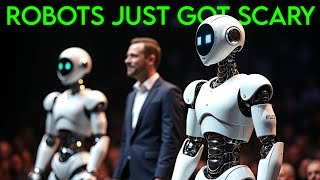
NVIDIA announced Isaac Groot, a foundation model that teaches humanoid robots to learn and adapt faster than humans. The company released a physics engine built with Google DeepMind and Disney Research, plus new robots from Dobot, Noetics, Kepler and Engine AI that can handle complex tasks with minimal training.
Questions this video answers
2025-03-20
780,000 synthetic trajectories in 11 hours
About 40% improvement
28 degrees of freedom
Up to 42% energy savings
Chapters
The age of general purpose humanoid robots is officially here and things are moving fast. Nvidia just announced a wave of breakthroughs at their 2025 GTC conference, including a powerful AI model called Groot N1 that's designed to make robots think, plan and perform complex tasks with surprising precision. They've also teamed up with Google DeepMind and Disney Research to develop Newton, a physics engine that's set to revolutionize how robots learn and interact with the world. On top of that, new humanoid robots from Dobot, Noetics, Kepler and Engine AI are pushing boundaries, moving beyond basic tasks to think, plan and even tidy up your home. So let's talk about it all right now. During his keynote at the San Jose based event, Nvidia CEO Jensen Huang laid out a series of major breakthroughs that promised to supercharge humanoid robot development development. One of the headliners is The Isaac Groot N1 model, touted as the world's first open, fully customizable foundation model for generalized humanoid reasoning and skills. Huang was emphatic when he proclaimed the age of generalist robotics is here and showcased exactly why. By demonstrating a humanoid robot from 1X performing domestic tidying tasks, it deftly picked up household objects and set them where they needed to go. The really cool part was that all these movements were guided by a post trained policy built upon Groot N1. Now, Groot N1 is a game changer in humanoid robotics, and here's why. It's built on a powerful dual system design that mimics how humans think and act. A part called System 2 handles slower, more deliberate thinking, carefully planning actions and working through complex tasks. The other part, System One takes those plans and turns them into fast, precise movements, almost like a reflex. Nvidia Fed Groot N1 an enormous amount of data, combining real human demonstration data with massive amounts of synthetic motion trajectories generated in Omniverse. This gave the model a remarkable ability to handle everyday tasks like grasping, passing objects between arms or managing multi step chores, all without needing to be retrained from scratch. Nvidia also announced a Collaboration with Google DeepMind and Disney Research to develop Newton, an open source physics engine built on the Nvidia Warp framework. Newton is specifically tailored to help robots learn increasingly complicated tasks with improved realism and accuracy. It's going to be compatible with Google DeepMind's Mujo Ko and Nvidia Isaac Lynn Lab, and there's talk of hooking it into Disney's physics engine as well. This is especially intriguing because it could help developers replicate the Intricacies of the physical world, things like how objects bounce, tilt or slide, enabling robots to practice and refine their skills in virtual environments before stepping into the real world. See, Disney Research is one of the early adopters and they've got big plans for Newton. They're already experimenting with next generation robotic character platforms such as their Star wars inspired BDX droids, which actually joined Jensen Huang on stage at gtc. Kyle Laughlin, Senior VP at Walt Disney Imagineering Research and Development, explained that these BDX droids are only the beginning. The Mouse House wants to bring more animated characters to life in completely new ways, making them more expressive and engaging than anything you'd see from a typical animatronic. The combination of Disney's unique Flair for storytelling plus the advanced AI and physics simulation from Nvidia and Google DeepMind suggests we're entering a new era of theme park experiences. As exciting as these developments are, the world of AI isn't just about robots. It's also opening up powerful opportunities for a anyone willing to learn. That's why we've partnered with Growth School to bring you something valuable. 2024 and early 2025 have been unpredictable. Jobs come and go and financial security is never guaranteed. That's why multiple income streams aren't just smart, they're essential. AI can help, and with the right skills, you could earn an extra $10,000 a month. Now, if you're wondering how to get started, Growth School has something really cool. They're offering a three hour hands on AI training where you'll learn to use over 25 powerful AI tools. Normally it's paid, but the first 1000 AI revolution viewers can join for free using the link in the description. On top of that, you'll get $500 worth of bonus resources just for signing up. The training covers everything job hunting, tips, salary negotiation, mastering Excel, even content creation. And it's not just for tech experts. Whether you're in finance, sales, marketing, hr, or even still studying, this can work for you. Growth School has already helped millions of people level up and this could be your turn to stay ahead in an AI driven world. So if this sounds like your kind of thing, hit the link below to grab your free spot. Plus, don't miss joining Growth School's WhatsApp community. It's a great place to connect with others diving into AI too All right, now Nvidia has already also taken the wraps off something called the Isaac Groot Blueprint, which is a system for generating synthetic data for robot training. To put it in perspective, when Robots learn from real human demonstration data alone. There's only so much you can capture in, say, a single day. But with the Groot blueprint for synthetic manipulation motion generation, Nvidia was able to produce 780,000 synthetic trajectories in just a 11 hours. That roughly translates to 6,500 hours, about nine consecutive months of real human labor captured overnight. And by mixing that synthetic data with a smaller amount of real data, the performance of the Groot N1 model improved by about 40%. It's a mind boggling jump in efficiency, and it points to a future where robotic systems can be trained to do complex tasks much faster than ever before. In case you want to adapt the model for your own robot or Environment, Groot N1's dataset is available for download on Hugging Face. Nvidia basically wants developers around the world to get their hands on this technology, customize it and push the envelope. Another resource for that is the newly revealed Nvidia DGX Spark personal AI supercomputer, which provides a turnkey system for running all these advanced AI workloads with without hiring an entire data center's worth of specialized infrastructure. The Newton physics engine isn't out quite yet, but the word is that it'll be available later this year. Meanwhile, Nvidia, Google, DeepMind, Disney Research and even a company called Intrinsic are building open standards, pipelines and best practices around open USD to make robotic data workflows easier to manage. The end goal is to reduce the friction for robotics developers everywhere, letting them spin up simulations, generate data train models and test them in real or synthetic scenarios without huge overhead. On top of all that, we're seeing new players from around the globe building their own humanoid robots spurred on by these Nvidia breakthroughs. One example is the Dobot humanoid from China, which features a whopping 28 degrees of freedom for ultra precise dexterous manipulation. Dobot claims it can pick up something as delicate as a cherry, all while walking with a straight knee design that saves up to 42% of its energy usage. Then there's the Noetics N2 humanoid robot, which comes with about 40 tops tera operations per second of AI computing power and a relatively modest 15 watt power consumption. It's got 8 gigabytes of video memory, courtesy of an Nvidia Jetson module inside. Despite only having 18 degrees of freedom, the N2 apparently can hit speeds of 3.2 meters per second, about 7.1 miles per hour, avoiding obstacles using deep reinforcement learning. It stands just about 110cm tall around 43 inches and weighs around 20kg, giving it a lightweight form factor perfect for weaving through tight spaces that might be too cramped or for a larger machine or even a person. Another newcomer is the Kepler K2 humanoid robot, standing at 178 cm tall, about 70 inches and weighing 85 kg with 52 degrees of freedom. Overall. It's got 12 dedicated to ultra dexterous hands and the rest spread across its body for smooth human like motion. Its Nebula system handles vision, mapping, multimodal interaction and precise hand eye coordination, while also allowing the K2 to lift heavy objects and handle rough terrain. Kepler is doubling down on the concept of pairing a big cloud based language model with a smaller, faster, specialized model running locally on the robot. They've also built something called Kepler Op Source, a global developer platform that gives remote pro programmers the tools to code, debug and manage multiple robots all at once. Finally, we have engine AI's PM01 robot, which was shown dancing in a video that had some people questioning if it was CGI. It stands at about 138 centimeters tall, about 54 inches, weighs 40 kilograms, about 88 pounds and uses 23 degrees of freedom, including five in each arm plus plus one in the neck to bust out surprisingly fluid moves. The waist can twist 320 degrees and the joint torque can climb to 330 newton meters, letting it do dynamic turns without tipping over. It walks around 2 meters per second, about 4.5 miles per hour. Powered by a dual chip system with an Intel N97 and an Nvidia Jetson, the battery apparently clocks in at 10,000 mAh, lasting about two hours with typical usage. Engine AI says it's aiming for a price around US$113,000, though whether or not that price sticks remains to be seen. Seeing how all these machines are emerging in the same year that Nvidia, Google, DeepMind, Disney and others are collaborating on open source frameworks suggests we're entering a pivotal moment. Previously there might have been a handful of well known robotics companies, Boston Dynamics, Agility Robotics, maybe a few others showing off impressive demos. But now the technology to simulate, train and deploy humanoids is trickling down to more and more creators, thanks to things like Groot N1 being open and fully customizable, plus the Newton physics engine that's on its way. The barrier to entry is dropping fast. There's no doubt challenges remain. Real world tasks are messy, unpredictable and often demanding. Yet with Nvidia's Groot blueprint generating massive amounts of training data, Disney's animation expertise pushing robotic characters forward and startups building specialized humanoid robots, progress is accelerating fast. The Nvidia DGX Spark personal AI supercomputer is lowering the entry barrier even further, giving developers the tools to refine these models without costly setups. For once, the hype seems to match reality. So what are your thoughts on Nvidia's new breakthroughs and the rapid rise of humanoid robots? Are we closer than ever to seeing them in our daily lives, or is there still a long road ahead? Feel free to share your thoughts below. And if you enjoyed this, don't forget to like and subscribe for more. Thanks so much for watching and I'll catch you all in the next video.










