Nvidia's NEW Humanoid Robots STUNS The ENITRE INDUSTRY! (Nvidia Project GROOT)
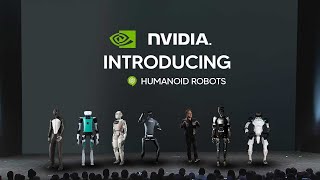
Nvidia announced Project Groot, a foundation model that teaches humanoid robots to learn from video and simulation. The model trains in Nvidia's Omniverse and runs on Jetson Thor hardware. Apptronic, Agility Robotics, and Figure are already building robots on Nvidia's platform.
Chapters
Ladies and gentlemen, boys and girls, the Nvidia GTC event for 2024 was absolutely incredible and they announced something incredible in terms of robotics. There are so many announcements that were made and a few key things and a few sneak peeks that people didn't even realize. This video is going to give you the key insights and a few things that you perhaps missed if you weren't completely eagle eyed. So let's take a look at the first Nvidia announcement in which they are announcing a new foundation model, something called Groot, that is going to enable the wild scale application of these humanoid robots and further development. So take a look, because this is pretty incredible.
We are starting to do some really great work in the next generation of robotics. The next generation of robotics will likely be a humanoid robotics. We now have the necessary technology and as I was describing earlier, the necessary technology to imagine generalized human robotics. In a way, human robotics is likely easier. And the reason for that is because we have a lot more imitation training data that we can provide the robots. Because we are constructed in a very similar way. It is very likely that the human robotics will be much more useful in our world because we created the world to be something that we can interoperate in and work well in. And the way that we set up our workstations and manufacturing and logistics, they were designed for humans, they were designed for people. And so these humanoid robotics will likely be much more productive to deploy while we're creating, just like we're doing with the others, the entire stack, starting from the top, a foundation model that learns from watching video. Human image, human examples. It could be in video form, it could be in virtual reality form. We then created a gym for it called Isaac Reinforcement Learning Gym, which allows the humanoid robot to learn how to adapt to the physical world. And then an incredible computer, the same computer that's going to go into our robotic car. This computer will run inside a humanoid robot called called Thor. It's designed for transformer engines. We've combined several of these into one video. This is something that you're going to really love. Take a look.
It's not enough for humans to imagine. We have to invent and explore and push beyond what's been done. We teach it, then help it teach itself. We broaden its understanding to take on new challenges with absolute precision and succeed. We make it perceive and move. This is where inspiration leads us, the next frontier. This is Nvidia Project Groot, A general purpose foundation model for humanoid robot learning. The group model takes multimodal instructions and past interactions as input and produces the next action for the robot to execute. We developed Isaac Lab, a robot learning application to train Groot on Omniverse Isaac sim. And we scale out with osmo, a new compute orchestration service that coordinates workflows across DGX systems for training and OVX systems for simulation. With these tools, we can train Groot in physically based simulation and transfer zero shot to the real world. The Groot model will enable a robot to learn from a handful of human demonstrations, so it can help with everyday tasks and emulate human movement just by observing us. This is made possible with Nvidia's technologies that can understand humans from videos, train models and simulation and ultimately deploy them directly to physical robots. Connecting Groot to a large language model even allows it to generate motions by following natural language instructions.
Hi Jia Wan, can you give me a high five? Sure thing.
Let's high five.
Can you give us some cool moves, Dirk?
Check this out.
All this incredible intelligence is powered by the new Jetson Thor robotics chips designed for Groot. Built for the future. With Isaac Lab, OSMO and Groot, we're providing the building blocks for the next generation of AI powered robotics.
About the same size. The soul of Nvidia, the intersection of computer graphics, physics, artificial intelligence, it all came to bear at this moment. The name of that project, General Robotics 003 I know now the next one here was Apptronic.
Now Apptronic is I would say a rather underrated humanoid robot because it is really, really good. Now of course, the recent humanoid robot that has been breaking the industry was figures new humanoid robot. But Apptronic's new demo here is genuinely very, very impressive. You can see that Apollo is showcasing the Dextera's capabilities taught via human demonstrations. And the task is fully autonomous. One increasing trend that we've been seeing amongst humanoid robotics is that things have been getting more and more autonomous as time has progressed. I think we're starting to move away from the teleoperated era. Of course we do need that to gather more data. But I do think that it is rather fascinating to see real world robotics at a humanoid performing actions in one time speed that is of course fully autonomous on an end to end neural net. And with Nvidia's new Groot system, I think we're going to be seeing the rapid development of these humanoids faster than we have anticipated. As many have pointed out, this year is going to be the year of the humanoids in which we get a rather big boost in terms of the software Development that will help them perform tasks in a very great way and in terms of what they're able to do long term. So I think what we're seeing here with Apptronic, which is an actual humanoid robot that can not only also walk very impressive, it can also do a variety of other things. I think this is something that is very, very impressive as it makes its, you know, kind of juice or whatever it is there. And then of course, something rather fascinating. Now, there's another thing that I want to talk about later that I'm literally so excited about. There was another thing which is of course Agility Robotics. Now, if you don't know about Agility Robotics, they are a robotics company that have actually been around for quite some time. And recently they've done something that I think is rather impressive. I mean, take a look at this demo. The most interesting thing about this demo that you can all see and is that this is a humanoid robot that has an internal monologue. So I guess you could call it a scratch bag, I guess you could call it its thought pad. But this is where the robot is using an LLM to develop reasoning steps before it does whatever task it does. And you can see that in the bottom left hand at the start of the clip that it says I should figure out what commands I can use, then I should get a sense of my surroundings. I will acknowledge my co host and inform them about the freshly cooked GPUs. And we've seen demos like this before, but we can see that, you know, the Agility Robotics robot now actually does have an updated gripper arm. This was something I really did want to cover. But this video presents the best opportunity because it now means that these agility robots are getting some major upgrades. Now, I'm actually a super fan of the Agility robot because I think that they are super impressive, considering that they are doing some real world humanoid robot work already. Which means that in their next update, potentially their next iteration, they're going to be even faster and even better than we can imagine. So I think the future for Agility Robotics is one that is going to be rather, rather impressive. Now let's talk about something that most people did miss. As Nvidia's CEO was on the stage gleefully looking at the, you know, of course, pretty adorable Disney humanoid robot, I noticed something rather impressive in the background. Did you all take a look at this? In the back of this image you can see that there is a robot that looks sleek. It looks like it's kind of black and gray and white. But it is an updated version of 1x Robotics Neo Robot. This is the infamous robotics startup that is backed by OpenAI. And this is the first time robot we've seen an updated image on their web page. Well, it's not actually on their web page, but this is the first time we've seen an updated image of their robot since around summer. And since then we've not really seen that updated image. And it seems like this is going to be the new version of their humanoid robot because the face seems a little bit different and I'm wondering if we are about to get a major upgrade. Now of course we know that Nvidia's new AI system where you can train these robots and you are able to effectively train them a lot more effectively. I think that this is going to be super fascinating considering this is a rather, rather effective humanoid robot. And I genuinely cannot wait for some future demos. Now we didn't see this robot actually in the system. We only saw agilities, we only saw Apptronics and I think we saw another system and I wasn't really sure what that one is. But one thing I do want to come to now is of course Disney's humanoid, not actually humanoid, Disney's robotics. Because I honestly have to give Disney's robotics team a major round of applause because what they've been able to do with their animatronics and their robotics team is honestly nothing short of amazing. And when I was watching on stage I tweeted out that Disney Robotics is one of the most underrated teams in the world. And I really do wonder what would happen if they actually took a stab at humanoid robotics for household applications and other industry wide applications like Boston Dynamics 1x Robotics and figure is doing because their movements are genuinely so lifelike. Like when I was watching the robot walk around, I genuinely thought I was watching a movie. It just didn't seem like it was reality. So I think the future is here and I think the future is going to be one of the most fascinating times, especially during this time because it's not like we're being born and these things already exist. We are watching the real time development and the of course, you know, rapid change of these robotics systems and the entire humanoid robot space is truly, truly about to just change completely. And I think that, you know, being able to witness this is truly, truly impressive. So we're going to take a look now at the architecture and how this is essentially a new industrial revolution with Nvidia, Nemo and the AI foundry, the Nims the Black Core platform. And I think this is something that is really, really impressive. Let me know if there's anything that I did miss in this amazing stunning robotics update from Nvidia.
Super good. Super good. Well, I think we have some special guests. Dewey. Hey guys. So I understand you guys are powered by Jetson. They're powered by Jetsons little Jetson robotics computers. Inside they learn to walk in. Isaac Simon. Ladies and gentlemen, this, this is Orange and this is the famous Green. They are the BDX robots of Disney. Amazing Disney research. Come on you guys, let's wrap up. Let's go. Five things. Where are you going? I sit right here. Don't be afraid. Come here. Green, hurry up. What are you saying? No, it's not time to eat. It's not time to eat. I'll give you a snack in a moment. Let me finish up real quick. Come on, Green, hurry up. Stop wasting time. Five things. Five things. First, a new industrial revolution. Every data center should be accelerated. A trillion dollars worth of installed data centers will become modernized over the next several years. Second, because of the computational capability we brought to bear, a new way of doing software has emerged. Generative AI, which is going to create new infrastructure dedicated to doing one thing and one thing only. Not for multi user data centers, but AI generators. These AI generation will create incredibly valuable software. A new industrial revolution. Second, the computer of this revolution. The computer of this generation. Generative AI. Trillion parameters. Blackwell insane amounts of computers and computing. Third, I'm trying to concentrate. Good job. Third, new computer. New computer creates new types of software. New type of software should be distributed in a new way. So that it can on the one hand, be an endpoint in the cloud and easy to use, but still allow you to take it with you. Because it is your intelligence. Your intelligence should be packaged up in a way that allows you to take it with you. We call them NIMs. And third, these NIMs are going to help you create a new type of application for the future. Not one that you wrote completely from scratch, but you're going to integrate them like teams create these applications. We have a fantastic capability between nims, the AI technology, the tools NEMO and the infrastructure DGX cloud in our AI foundry to help you create proprietary applications, proprietary chatbots. And then lastly, everything that moves in the future will be robotic. You're not going to be the only one. And these robotic systems, whether they are humanoid amrs, self driving cars, forklifts, manipulating arms, they will all need one thing. Giant stadiums, warehouses, factories. There can be factories that are robotic, orchestrating factories, manufacturing lines that are robotics, building cars that are robotics. These systems all need one thing. They need a platform, a digital platform, a digital twin platform, and we call that Omniverse, the operating system of the robotics world. These are the five things that we talked about today.










