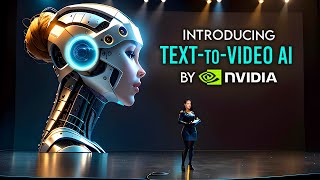
A single-speaker YouTube commentary (by LARRUZ) describing Nvidia's new text-to-video AI. The video explains at a high level how the system converts text prompts into videos using deep learning: specifically generative adversarial networks (generator vs discriminator), temporal layers for frame-to-frame continuity, and neural network stacks that map text to images then stitch frames into video. The presenter highlights potential applications (low-cost movie-making, AI-generated soundtracks, broader content creation) while warning about ethical risks—notably deepfakes and misuse—arguing the technology is likely to augment rather than replace human filmmakers.
Chapters
So you might have heard some whispers about Nvidia's text to video, but trust me, it's crazier than you think. This AI is seriously cool and it's got the potential to change the way we consume video content forever. So let's dive in and see what all the fuss is about, shall we? Before we dive into the nitty gritty, let's take a moment to understand what we're dealing with here. Nvidia's video AI is a powerful tool that uses AI and machine learning to generate videos based on text descriptions. Meaning you type in a description and this AI creates a video for you. Sounds almost too good, right? Well, this isn't just some futuristic fantasy. It's happening right now. Nvidia's video AI is built on their very own generative adversarial networks. Which basically means they've got two neural networks duking it out to create the best possible video content. So if you're not impressed yet, get ready, because it's about to get better. Now let's take a closer look at how Nvidia's video AI turns text descriptions into mind blowing videos. It all starts with a text prompt, which the AI then processes through layers of neural networks that generate images based on the input. The AI then stitches these images together into a video sequence and voila, you've got a hyper realistic video. The kicker here is that the AI can create these videos on the fly. So every time you give it a new text prompt, you get a brand new never before seen video. And for those of you who aren't in the know about generative adversarial networks, let me break it down real quick. They're basically made up of two neural networks, a generator and a discriminator. The generator's job is to create realistic images based on the text input, while the discriminator's job is to evaluate the images and tell the generator if they're good enough. It's like an ongoing game of cat and mouse, with the generator constantly trying to outsmart the discriminator. This friendly competition leads to higher quality, more realistic video generation. Alright, so there's one more thing I gotta clear up for you guys. Temporal layers. It's what make Nvidia's video AI videos look so smooth and natural. These layers help the AI understand the passage of time, allowing it to generate videos where objects and characters move seamlessly from one frame to the next. Without temporal layers, the videos would look choppy and disjointed, and nobody wants that. So props to Temporal layers for making AI generated videos. An absolute treat to watch. And if you are wondering how deep learning fits into all this. Well, deep learning algorithms are the backbone of Nvidia's video AI as they help the AI understand and interpret text prompts. These algorithms analyze the text input, extract relevant information, and then generate a visual representation of the scene described. Now, you might be wondering what the practical applications of this video AI are. I mean, sure, it's cool and all, but what can it actually do? Well, my friends, the possibilities are virtually endless. From entertainment to education, this AI has the potential to revolutionize the way we create and consume video content. And the first thing that pops into my head is movies. You know, just picture films made with this tech. And get this, you wouldn't need any fancy equipment, cameras or a whole crew, like anyone could make movies based on their creativity and storytelling chops. That means we might get to watch more intriguing flicks and fewer cookie cutter movies that Netflix keeps shoving down our throats. Right now, honestly, I can't wait for this technology to go public, if only for this reason. I mean, now I spend more time hunting for a movie than actually watching it right now. Imagine AI generated videos with their very own AI generated soundtracks. Wouldn't that be epic? This next frontier in AI generated content would involve training algorithms to create audio that perfectly matches the visuals. There would be technical challenges, of course, like synchronizing the audio with the video and creating realistic sound effects. But hey, with the pace of AI development, who knows what the future holds? Alright, it's time to get real for a second. Every coin has two sides, and Nvidia's video AI is no exception. While this technology has some amazing potential, it also got its potentially dark side. There are some ethical concerns that we need to address, and one of the biggest ones is deepfakes. So you must have heard about deepfakes, right? You know those creepy videos where someone's face gets swapped onto another person's body, making it look scarily real? Yeah, they've been causing quite a commotion lately, and for a good reason. Deepfakes can be used for some sketchy stuff like spreading fake news or messing with people's opinions. And believe it or not, a lot of folks actually use it for porn. Shocking, I know. Now, with this AI making it a breeze to whip up realistic videos, we might be staring at an even bigger deep fake problem. But you know, as with any technology, it's all about how we use it. If we can find ways to harness the power of Nvidia's Video AI for good. We might just be able to mitigate the risks and enjoy the benefits of this groundbreaking technology. So, yes, this is some impressing stuff here. And these AI generated videos are impressive, but they still lack that human touch, you know, that emotional depth and nuance that only a human creator can bring to the table. So while AI might help streamline the video production process and make it more efficient, it's unlikely to replace human filmmakers entirely. Instead, we should view this technology as a tool that can enhance human creativity rather than replace it. Filmmakers can use Nvidia's video AI to bring their visions to life more easily, while still maintaining that personal touch that makes their work unique. It's a win win situation, really. So where do we go from here? The future of Nvidia's video AI is still a bit hazy and there are plenty of challenges and opportunities on the horizon. As with any new technology, there will be hurdles to overcome, like addressing ethical concerns and ensuring the responsible use of AI generated videos. It's an exciting time to be alive, guys, and we're lucky to be witnessing the dawn of a new era in video technology. So there you have it. The world of Nvidia's new video AI. Is it a game changer? Well, it certainly has the potential to be. With its ability to generate high quality, realistic videos based on text descriptions, it's easy to see how this technology could disrupt some industries and reshape the way we create and consume content. And you know, I think what's super important is to look at this AI technology with a healthy pinch of skepticism and a solid dose of critical thinking. We've got to take a step back and remember that AI generated content, while impressive, still can't quite know nail that human touch. In the end, it's all about balance. Finding the sweet spot where we can harness the power of Nvidia's video AI to enhance human creativity and elevate our storytelling capabilities without losing sight of the importance of authentic human driven art and content. It's going to be interesting to see how Nvidia's video AI evolves. And hey, who knows, maybe one day we'll be able to sit back and enjoy AI generated movies that rival even the best Hollywood blockbusters. But until then, let's keep our feet on the ground and remember that while Nvidia's video AI is undoubtedly impressive, it's still just one piece of the puzzle in the ever evolving landscape of AI and technology. So what you guys think? Feel free to share your thoughts, questions and witty sarcasm. In the comments below. And hey, if you had a good time watching this video, go ahead and give it a thumbs up and maybe even consider subscribing to our channel. Subscribe. Alright, thanks for sticking around and until next time, keep your eyes on the horizon and your mind open to the possibilities that the future holds.