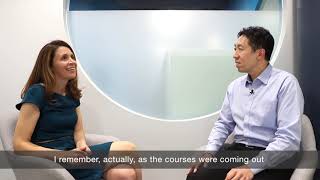
A short interview (YouTube) featuring Christine Payne discussing her path from physics and music into machine learning, her work at OpenAI creating MuseNet (a transformer-based music-generation system), her experience in the OpenAI Scholars Program, and practical advice for people wanting to enter AI. The conversation explains how MuseNet tokenizes sheet music, leverages transformer self-attention to capture long-range musical structure, and emphasizes learning by doing small projects tied to one’s background.
Chapters
I'm here with Christine Payne, who created MuseNet, a neural network that wrote the music that is playing in the background over here, which I think was one of the coolest neural network projects in recent memory. Christine has an amazing journey. She initially studied physics and then attended Juliet, which studied music, and then took the deeplearning AI deep learning specialization and wound up working full time at OpenAI, where she created. So how did you first get interested in machine learning?
It's sort of funny. As I would do different piano concerts, I always had the trouble of needing to find someone to come turn my pages, which. You mean in chamber music. And I figured maybe a better way to do it would be to find a computer program that could do it. And I played around with trying to get an eye tracker that would figure out where I was looking on the page and turn pages automatically. And I learned that probably to do this really well, I would have to learn about this thing called machine learning, which I knew nothing about at that point.
And now you're working at OpenAI. Tell me about your work there.
So actually I've been really excited to be able to tie together both my musical interests and my interest now in AI. I've been working on a project called musenet, which tries to take all these recent advances that we've had in natural language work and apply them instead to music. So I went through the process of trying to turn regular sheet music into tokens that I could then feed into a model. And it's been great fun. It means I get to debug by like listening to music, trying to be ROMs.
A core part of Musenet was the all the transformer network work that's gone on at OpenAI. Can you explain to our listeners what is that about?
Yes. So transformer architecture is very powerful architecture based on self attention. So the. The model can learn how far in the past it might need to look in order to find the relevant information. So it makes it much easier to. When you're dealing with a long sequence, you can equally well look at the beginning of the sequence, which you might need in music, when you might need to return to a theme that you haven't heard for a couple minutes.
Yeah. So give a piece of music, you can look way back at the last time this chorus was played and then do the right thing when synthesizing the new piece of music.
Exactly.
You're also part of the OpenAI Scholars Program. How was that?
Yeah, that was an amazing opportunity for me. It's a program that OpenAI has that is specifically looking for people from more unusual backgrounds. And it was really great to be paired with a mentor who helped me kind of weave through. And it's such a big field. And to have someone help you navigate which research to pay attention to, which problems to do.
I think it's so great that you took the deep learning specialization and that was part of your journey for. For others wanting to follow your footsteps or build a similar career. Would you have any advice for them?
Sure, yeah. I mean, I do feel that the deep learning sequence was a huge part of the way I started into this. I remember actually, as the courses were coming out and we would wait for each new course to come out, and I realized at that point I could look anywhere. Probably the material is all mine. But it was only as your videos came out and you explained things in such a good, clear way that then I felt like I had this intuition and I kind of understood what was going on. And then actually the other thing that happened is you guys invited me to stay on as a mentor in the forums. And that for me was huge because it meant that rather than just watching the videos, I actually had to think through and be able to explain these things to other people. Kind of think about problems that I, you know, side cases that hadn't thought about as carefully. Um, and then after that, I went on. I did also the fast AI sequence, which I love a lot. It's. That was a little bit more diving into the code and working on specific problems. Um, the main thing I'd say is, like, I am a big fan of just finding a toy problem that you're excited about. Find some way that machine learning relates to a field that you know well. And then it. It makes it easier. It's more. It's more fun to work on. And it also means that, you know, maybe you'll find some. You'll have expertise that nobody else has in this area.
Actually. Thank you for having served as mentor and helping to pass on to others as well. I think it's a great point. For a lot of people, it's better to pick a cool, even smaller project than to sit around and wait for the grand opus idea of your life to come along before starting to dive in. So, yeah, thank you, Christine. I think you'll be an inspiration to many others wishing to break into AI and build a career and do exciting work.
Oh, thank you. Thanks so much. It's really an honor to be here.