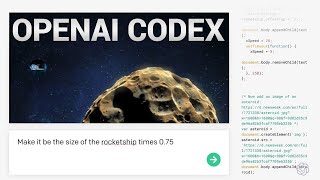
OpenAI Codex writes working code from English descriptions. Dr. Zsolnai shows it building a space game in 9 minutes and Pong in 30 seconds, then explains why the real bottleneck is still what you ask it to build, not the building itself.
Chapters
Dear fellow scholars, this is Two Minute Papers with Dr. Zsolnai. Today we are going to see if an AI can become a good software engineer. Spoiler alert. The answer is yes. Kind of. Let me explain. Just one year ago, scientists at OpenAI published a technique by the name GPT3 and it is an AI that was unleashed to read the Internet with the sole task of finishing your sentences. So what happened then? Well, now we know that of course it learned whatever it needed to learn to perform the sentence completion properly. And to do this it would need to learn English by itself. And that's exactly what it did. It also learned about a lot of topics to be able to discuss them. Well, we gave it a try and I was somewhat surprised when I saw that it was able to continue a two minute paper script, even though it seems to have turned into a history lesson. It also learned how to generate properly formatted plots from a tiny prompt written in plain English. Not just one kind, many kinds. And remember, this happened just about a year ago and this AI was pretty good at many things. But soon after a newer work was published by the name ImageGPT. What did this do? Well, this was a GPT variant that could not finish your sentences, but your images. Yes, really? The problem statement is simple. We give it an incomplete image and we ask the AI to fill in the missing pixels. Have a look at this water droplet example. We humans know that since we see the remnants of some ripples over there too, there must be a splash. But does the AI know? Oh yes, yes it does. Amazing. And this is the true image for reference. So what did they come out with now? Well, the previous GPT was pretty good at many things and this new work, OpenAI codecs, is a GPT language model that was fine tuned to be excellent at one thing and that is writing computer programs or finishing your code. Sounds good. Let's give it a try. First, please write a program that says hello world 5 times. It can do that. And we can also ask it to create a graphical user interface for it. No coding skills required. That's not bad by any means. But this is OpenAI we are talking about, so I am sure it can do even better. Let's try something a tiny bit more challenging. For instance, writing a simple space game. First we we get an image of a spaceship that we like. Then instruct the algorithm to resize and crop it. And here comes one of my favorites. Start animating it. Look, it immediately wrote the appropriate code where it will travel with the prescribed speed. And yes, it should get flipped as soon as it hits the wall. Looks good, but will it work? Let's see. It does. And all this from a written English description. Outstanding. Of course, this is still not quite the physics simulation that you all see and love around here, but I'll take it. But this is still not a game. So please add a moving asteroid, check for collisions, and infuse the game with a scoring system. There we go. So how long did all this take? And now hold on to your papers. Because this game was written in approximately nine minutes, no coding knowledge is required. Wow, what a time to be alive. Now, in this 9ish minutes, most of the time was not spent by the AI thinking, but the human typing. So still the human is the bottleneck. But today, with all the amazing voice recognition systems that we have, we don't even need to type these instructions. Just say what you want and it will be able to do it. So what else can it do? For instance, it can also deal with similar requests to what software engineers are asked in interviews. And I have to say the results indicate that this AI would get hired to some places. But that's not all. It can also nail a first grade math test. An AI food for thought. Now this OpenAI codecs work has been out there for a few days now and I decided not to cover it immediately, but wait a little and see where the users take it. This is of course not great for views, but no matter. We are not maximizing views, we are maximizing meaning in return. There are some examples out there in the wild. Let's look at three of them. One, it can be asked to explain a piece of code, even if it is written in assembly. Two, it can create a pong game in 30 seconds. Remember this used to be a blockbuster Atari game and now an AI can write it in half a minute. And yes again, most of the half minute is taken by waiting for the human for instructions. Wow. It can also create a plugin for Blender, an amazing free 3D modeler program. These things used to take several hours of work at the very least. And with that I feel that what I said for GPT3 rings even more true. Today I am replacing GPT3 with codecs and quoting. The main point is that working with codecs is a really peculiar process where we know that a vast body of knowledge lies within, but it only emerges if we can bring it out with properly written prompts. It almost feels like a new kind of programming that is open to everyone, even people without any programming or technical knowledge. If a computer is a bicycle for the mind, then Codex is a fighter jet. And all this progress in just one year. I cannot wait to see where you fellow scholars will take it and what OpenAI has in mind for just one more paper down the line. And until then, software coding might soon be a thing anyone can do. What a time to be alive. Perceptilabs is a visual API for TensorFlow, carefully designed to make machine learning as intuitive as possible. This gives you a faster way to build out models with more transparency into how your model is architected, how it performs, and how to debug it. Look, it lets you toggle between the visual modeler and the code editor. It even generates visualizations for all the model variables and gives you recommendations both during modeling and training, and does all this automatically. I only wish I had a tool like this when I was working on my neural networks during my PhD years. Visit perceptilabs.com papers to easily install the free local version of their system today. Our thanks to Perceptilabs for their support and for helping us make better videos for you. Thanks for watching and for your generous support and I'll see you next time.