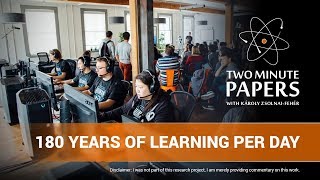
YouTube commentary (Two Minute Papers) by Károly Zsolnai-Fehér summarizing OpenAI's Dota 2 project: the AI was trained to play full 5v5 Dota 2 by self-play and rapid simulation, reportedly achieving the equivalent of “180 years” of gameplay per day and mastering team-fight tactics, ganking, and long-term planning. The video cites specific training details (80% self-play vs. 20% against past selves), performance milestones (May 15 version matched OpenAI’s in-house team; a later version beat that team and semi-professional squads), and operational metrics (≈150–170 actions per minute). The uploader links to an OpenAI blog post and full demo video and notes an upcoming event on July 28 where the bots will face top players.
Questions this video answers
July 25, 2018.
The video states the AI played the equivalent of 180 years of gameplay per day.
80% against itself (self-play) and 20% against its past self.
About 150 to 170 actions per minute.
Over $40 million.
Chapters
Dear fellow scholars, this is Two Minute Papers with know that I am always excited to tell you about news where AI players manage to beat humans at more and more complex games. Today we are going to talk about Dota 2, which is a multiplayer online battle arena game with a huge cult following and world championship events with a prize pool of over $40 million. This is not just some game and just to demonstrate how competitive it is and how quickly it is growing. Last time we talked about this in two minute papers episode 180 where an AI beat some of the best players of the game in a limited one versus one setting and the prize pool was $20 million. Back then this was a huge milestone as this game requires long term strategic planning, has incomplete information and a high dimensional continuous action space which is a classical nightmare situation for any AI. Then the next milestone was to defeat a human team in the full five versus five game and I promise to report back when there is something new on this project. So here we go. If you look through the forums and our YouTube comments, it is generally believed that this is so complex that it would never ever happen. I would agree that the search space is indeed stupendously large and the problem is notoriously difficult, but whoever thinks that this will never be solved has clearly not been watching enough Two Minute Papers. Now you better hold on to your papers right away because this video dropped 10 months ago in August 2017 and since then the AI has played 180 years worth of gameplay against itself every single day. 80% of these games it played against itself and 20% against its past self. And even though five of these bots are supposed to work together as a team, the is no explicit communication channel between them and now it is ready to play five versus five matches. Some limitations still apply, but since then the AI was able to get a firm understanding of the importance of team fighting, predicting the outcome of future actions and encounters, ganking or in other words ambushing unsuspecting opponents, and many other important pieces of the game. The May 15 version of the AI was evenly matched against OpenAI's in house team which is a formidable result and I find it really amusing that these scientists were beaten by their own algorithm. This is however not a world class Dota 2 team and the crazy part is that the next version of the AI was tested three weeks later and it not only beat the in house team easily, but also defeated several other teams and a semi professional team as well. As it is often incorrectly said on several forums that these algorithms defeat humans because they can click faster. So I will note that these bots perform about 150 to 170 actions per minute, which is approximately in line with an intermediate human player. And it is also to be noted that Dota 2 is not that sensitive to this metric. More clicking does not really mean more winning here at all. The human players were also able to train with an earlier version of this AI. There will be an upcoming event on July 28th which is where these bots will challenge a team of top players. So stay tuned for some more updates on this. There is no paper yet, but I've put a link to a blog post and a full video in the description and it is a goldmine of information and was such a joy to read through. So what do you think? Who will win? And is a 5 vs 5 game in Dota 2 more complex than playing Starcraft 2? If you wish to hear more about this, please consider helping us tell this story to more people and convert them into fellow scholars by supporting the series through Patreon. And as always, we also accept Bitcoin, Ethereum and Litecoin. The addresses are in the video description. And if you are now in the mood to learn some more about Dota 2, I recommend taking a look at Daynight's channel. I've put a link to a relevant series in the video description. Highly recommended. So there you go. A fresh two minute Papers episode that's not two minutes and it's not about the paper yet. Love it. Thanks for watching and for your generous support. I'll see you next time.