OpenAI Want Deepseek BANNED!
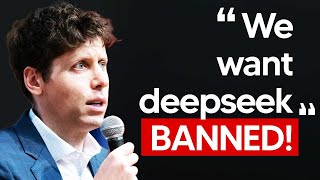
OpenAI is pushing the U.S. to ban Deepseek, claiming the Chinese AI lab is state-controlled and poses security risks. The debate hinges on whether open models like Deepseek's R1 actually steal data, and whether device bans make sense when Microsoft and Amazon host similar models.
Chapters
So OpenAI are in the news again and it's not for something great this time. OpenAI are essentially calling for Deepseek to be banned as they believe that those are PRC produced models, essentially models that are controlled, owned and operated by China. Now this is the article that we do see where it says OpenAI calls deep seek state controlled, calls for bans on PRC produced models. And this was something that actually had the twittersphere in array due to the fact that many people believe that OpenAI AI are simply trying to stifle out competition. You can see here that it says in a new policy proposal, OpenAI describes Chinese AI lab Deepseek as state subsidized and state controlled and recommends that the United States government consider banning models from the outfit and similar People's Republic of China supported operations. Deepsea being state controlled isn't the first time we've heard this allegation as there have been many other claims to this which I will discuss later on in the the video. But OpenAI saying this is truly interesting considering their position to Deep Seek, basically essentially being their rival. Now, essentially the reason they've wanted to ban Deepseek is because they think that Deepseek is sending data back to China. So it says the proposal is a submission for The Trump administration's AI Action Plan initiative that claims DeepSeek's models, including the R1 reasoning model, are insecure because DeepSeq faces requirements under Chinese law to comply with demands for user data. And banning the use of PRC produced models in all countries considered Tier 1 under the Biden administration's export rules would prevent piracy and security risks is what OpenAI are saying, including the risk of IP theft. Now if you aren't familiar with Trump's AI Action Plan initiative, this is essentially something that has four things. Number one is its regulatory framework where it basically just aims to prevent over burdensome regulations that could hinder innovation in the AI sector. And companies like OpenAI are actually proposing a regulatory strategy that ensures the freedom to innovate. And they emphasize voluntary partnerships between the federal government and private sector. In this AI Action Plan. They also talk about export controls, basically limiting China's access to advanced AI and semiconductor technologies, basically trying to ensure America's lead while promoting the global adoption of American AI systems. And there's also IP and copyright, where they're basically looking at a balanced framework for copyright laws and there is investment in infrastructure where companies are addressing the energy needs for the future. So the AI Action Plan is something that is huge and of course it's going to shape the future of the AI landscape. And essentially OpenAI within that AI action plan are suggesting that models like DeepSeek should be banned. Now, of course it is debatable because I came across a few articles where it says different things. Like in this article it talks about about how Deep Seek's open models don't contain mechanisms that would allow the Chinese government to siphon user data, since companies including Microsoft, Perplexity and Amazon actually host them on their infrastructure. So essentially what they mean by this is the fact that if you have an open model, what these companies like Microsoft, Perplexity and Amazon will do is they will host them on their servers and serve them to you and me so that we can use them. And essentially we just use Microsoft for inference. And considering we don't have a home setup where we can host the models ourselves. And if you do have an open model, open models can't really send data back. But later on you'll see that there is some other information that basically goes against this. And this is actually referring to China's deepseek.com website. Now, of course, if you do remember, OpenAI actually accused DeepSeek of the distillation allegations, which is where you distill knowledge from a larger model into a smaller model. Basically what they're stating that Deepseek did was that they trained deepseek through the knowledge of GPT01 or 03, and that's how Deep Seek is so good. And distillation is an actual thing that they use. So this is definitely something that you know is possible. And it's not like China doesn't have a history of copying Western things and making them cheaper for a fraction of the cost. But of course, we don't know if this is true or not. Now, the elephant in the room is whether or not OpenAI has some grounds to stand on. And I think this one is 50 50. The only problem is that OpenAI have a clear incentive to reduce any kind of competition from competing companies, especially deepseek. You have to understand that deepseek, at the time when it was really popular, managed to surpass ChatGPT on the app Store. And that was something that was truly incredible because I was hearing people that I've tried to get into AI for some time talking about the Deep SEQ model and it was an eye opener to see just how much of the AI mindshare deepseek managed to capture. So this is of course an incentive for OpenAI to say, look, we really don't want this app out there. Because of course there could be this issue and that issue and half the time it might be true that those issues could exist, but at the same time they do have a clear incentive to wipe out that competition. As one of the most interesting things is that people know Deep Seek more than they know things like Google Gemini, more than they know things like Perplexity, and more than they know things like Claude's Anthropic. So Definitely I think OpenAI are pulling a move here where they do want to remove some competition and honestly you kind of can't blame them for that. Now the reason I want to talk about a similar situation is where there's actually been a situation where US lawmakers have already tried to ban DeepSeek from government devices because they were essentially worried about this. And you can see right here that basically a third party analysis did find that the Deep Seq Chatbot app can capture login information and share it with China's largest state owned mobile firm. So there was this article where it said Deepseek coding has the ability to transfer users data directly to the Chinese government. And this is where I'm talking about the actual website where you can use DeepSeek. So it says right here, DeepSeek, the explosive new AI tool that took the world by storm and has code hidden in its programming which has the built in capability to send user data directly to the Chinese government. Experts told the ABC News. And this was the reason why Deepseek was actually banned in some states on certain devices due to this potentially surprising security threat. So it is there where you have this situation where there is the potential for this to be banned on government devices. But I don't know if it's going to be banned entirely. And when looking at this situation, whether or not Deepseek will be banned completely, we can look to a similar situation like TikTok. So basically there was this situation where TikTok, which is created by the parent company ByteDance, you can see this was something that people were worried about in terms of a security issue. So there have been allegations that the CCP accessed TikTok data, particularly through a former ByteDance employee. And he actually claimed that TikTok, you know, allowed backdoor access to monitor Hong Kong protesters. But TikTok maintained that it didn't provide access to Chinese government and would not do so if asked. So this was pretty crazy because a former employee did say that they did. And essentially we can see here that, you know, this was something that was super fascinating because they said the Chinese Communist Party accessed the data of TikTok users on a broad scale and for political purposes. So there was the case of that. And if you remember, with TikTok, that is actually banned on government devices. And so the real thing here as well is that ByteDance, which was the company that owned TikTok, is actually subject to Chinese laws that require it to assist or cooperate with the Chinese government's intelligence work and to ensure that the Chinese government has the power to access and control private data that the company holds. So you can see right here, TikTok confirms that some of the US data is stored in China and that TikTok was banned on government devices like I spoke about. So we could potentially see a situation quite like TikTok, where this is banned on many government devices due to there potentially being a security issue. And this is something that I think is a little bit maybe not concerning, but probably concerning for OpenAI, considering the fact that Deepseek is definitely ramping up competition. Even recently, I spoke about how they are probably most likely going to launch their R2 model very soon. And if that is, you know, nearly as good as O3, that is going to put some serious, serious problems into the offerings that OpenAI has, because currently on many of their tiers, they aren't making money. So it will be interesting to see where things do hold now in the realm and world of Deepseek. There are actually some new articles that came out today that does show us that they are definitely working with the Chinese government. We could see that there was this article where it says, Deepseek, a national treasure in China, is now being closely guarded. And this article is pretty insane. And I think you guys should read this because I think this could change Deepseek, because what they've done now is the Chinese government have essentially forbid some employees from traveling abroad freely. So it says in recent weeks, company executives have forbidden some deep sea employees involved in the research and development of AI models from traveling abroad freely. So this is pretty crazy because it means that these people can't travel freely. And basically to enforce this, what they've done is they've asked some staff to hand in their passports, three people said. And this sudden change in circumstances raises the question whether or not Deepseek will continue to be successful developing new AI products. And they basically is saying that, you know, Deepseek was successful because it was out of the spotlight. They were able to just do what they wanted and they had a different management style. Now, if the government gets involved, things may be slower. If China decides to treat this as, like a state secret, then, of course, things could be slower. There's going to be a lot more security measures and things may change inevitably. And that was one of the reasons that Deepseek was successful in the first place. So, overall, since this is now being closely guarded, I do wonder if Deep Seek is going to change or slow down. I don't think they're going to slow down at all, but definitely the Chinese government are probably working with them and keeping an eye on them. So let me know what you think about OpenAI's ban to close them. And I actually saw one comment that said OpenAI is trying to ban an OpenAI company, which was pretty hilarious. But I do think that definitely the incentives are there for them to try and reduce the competition. But also we do have the risk that, you know, having sensitive data being sent back to other governments, of course, is going to be a national security issue. So I do think that worst case scenario, Deepseek probably will be banned on government devices, but probably won't be banned on many other devices. It will just depend on Trump's AI action plan and how they choose to go forward with certain rules and regulations.










