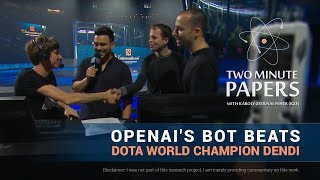
Transcript of a Two Minute Papers YouTube episode describing OpenAI's Dota 2 AI that was trained in a limited 1v1 setting. The speaker (Károly Zsolnai-Fehér) summarizes the game's challenges (incomplete information, long-term planning, technical maneuvers), highlights that the bot learned without human game data in ~24 hours, and recounts matches where the bot defeated world champion Dendi.
Chapters
Dear fellow scholars, this is two minute papers with it is time for some minds to be blown. Dota 2 is a multiplayer online battle arena game with a huge cult following and world championship events with a prize pool of over $20 million. In this game, players form two teams and control a hero each and use their strategy and special abilities to defeat the other team. OpenAI recently created an AI for this game that is so good that they challenged the best players in the world. Now note that this program is not playing the full feature set of the game, but a version that is limited to one versus one encounters with several other elements of the game disabled. Since lots of strategy is involved, we always discuss in these episodes that long term planning is the Achilles heel of these learning algorithms. A small blunder in the early game can often snowball out of control by the end of the match and it is hard for the AI and sometimes to even humans to identify these cases. And this game is a huge challenge because unlike chess and go, it has lots of incomplete information and even the simplified one versus one mode involves a reasonable amount of long term planning. It also involves attacks, trickery and deceiving an opponent and can be imagined as a strategy game that also requires significant technical prowess to pull off the most spectacular moves. This game is also designed in a way that new and unfamiliar situations come up all the time, which require lots of experience and split second decision making to master. This is a true test for any kind of AI and note that this AI wasn't told anything about the game, not even the rules, and was just instructed to try to find a way to win. The algorithm was trained in 24 hours and during this time it not only learned the rules and objectives of the game, but it also pulls off remarkable tactics. For instance, other players were very surprised that the bot didn't take the bait, which typically means a smart tactic involving giving up a smaller battle in favor of winning a bigger objective. The AI has a ton of experience playing the game and typically sees through these shenanigans. In this game there are also neutral units that we call Creep. When killed, they grant precious gold and experience to our opponent, so we typically try to deny that if these units encounter an obstacle, they go around it. So players develop the technique by the name creep blocking, which is the art of holding them up by the hero character to minimize the distance traveled by them in a unit of time. And the AI has not only learned about the existence of this technique by itself, but it also executes it with stunning precision, which is quite remarkable and Again, during the training phase, it had never seen any human play the game and do something like this. The other remarkable thing is that when a player disappears in the darkness, the AI predicts what he could be doing, plans around it and strikes where the player is expected to show up. If you remember, DeepMind's initial GO algorithm contained a bootstrapping step where it was fed a large amount of games by players to grasp the basics. The truly remarkable thing is that none of that happened here. The algorithm was trained for only 24 hours and it only played against itself. When it finally played against Dendy, the reigning world champion, the first match was such a treat and I was shocked to see that the AI has outplayed him. In the second game, the player tried to create a situation that he thought the AI hasn't encountered before by giving up some creep to it. The program ruthlessly took advantage of this mistake and defeated him almost immediately. Openais Bot not only won, but apparently also broke the will of Dandy, who tapped out after two matches.
Oh, no, no, no, no. I can hear you now, Dandy.
We can talk. Okay, I give up.
You're giving up?
Yeah, I. I don't think I'm getting his back, Greg.
Is that something other players have done as well? I've seen this quite a lot this week. Okay, so would you want to do like best two out of five or you're out of it?
I feel like someone being hit by a sledgehammer. I didn't even know this was being worked on. This is such a remarkable achievement. Usually the first argument I hear is that of course the AI can play non stop without bathroom breaks or sleep. While admittedly this is also true for some players, the algorithm was only trained for 24 hours. Note that this still means a stupendous amount of games played. But in terms of training time, given that these algorithms typically take from weeks to months to train properly, 24 hours is nothing. The second argument that I often hear is that the AI should of course win every time because it has close to zero reaction time and can perform thousands of actions every second. For instance, if we would play a game where the goal is to perform the most amount of actions per minute, clearly humans with biological limitations would stand no chance against a computer program. However, in this case, the number of actions that this algorithm performs in a minute is comparable to that of a human player. This means that these results stem from superior technical abilities and planning, and not from the fact that we are talking about the computer. We can look at this result from two different directions. One could be saying, well, no big deal because this is only a highly limited and hamstrung version of the game, which is way less complex than a fully fledged five versus five team match or two. We could say that the algorithm had shown a remarkable aptitude for learning highly sophisticated technical maneuvers and longer term strategy in a difficult game, and the rest is only a matter of time. In fact, in 5 versus 5 there is even more room for a highly intelligent program to shine and create new tactics that we've never thought of. I would bet that if anything, we are going to be even more surprised by the 5 versus 5 results later. We are still lacking in details a bit, but I have contacted the OpenAI guys who noted that there will be more information available in the next few days. Whenever something new appears, I'll be here to cover it for you fellow scholars. If you're new to the series and enjoyed this episode, make sure to subscribe and click the Bell icon for two super fun science videos a week. And if you find yourself interested in Dota 2 and admittedly it's hard not to and would like to catch up a bit on the basics, make sure to visit Day 9's channel, who has a really nice playlist about the fundamentals of the game. There's a link in the description for it. Check it out. If you go to his channel, make sure to leave him a kind scholarly comment. Let the world see how courteous the two Minute Papers listeners are. Thanks for watching and for your generous support and I'll see you next time.