OpenAI's "FULLY AUTONOMOUS" Robot Just SURPRISED The ENTIRE INDUSTRY!
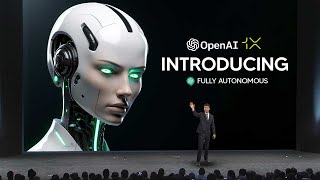
1X Robotics' Eve robot uses a single neural network running at 10 Hz to handle tasks from vision alone, trained by human operators. It can self-charge, open doors, and avoid obstacles. OpenAI and others are backing the company as it prepares Neo, aimed at logistics and home assistance.
Chapters
So what you're looking at is a fully autonomous robot that was just released in a video produced by a company called 1X Robotics. The OpenAI backed robotics company has produced the first videos in which we do see humanoid robotics performing a range of different tasks that are fully autonomous. Now, many people truly, and I mean truly, cannot understand the ramifications for this video. But because they are staggering, we are witnessing the first kinds of developments that will lead to the creation of physical AGI. And it's right here for you guys on this channel. Now, I'm really glad that I'm able to document and see this because this process to me is fascinating. We're witnessing robots doing things using end to end neural nets, fully autonomously. Now, one of the things that I did see that many people didn't realize was, was the fact, and is the fact that this is one times speed. Now essentially why that is so crazy is because many of you who've seen robot demos before have known that one time speed is not something that they usually do. And this is because the autonomous modes in robots is usually very, very slow. For example, in Google's robot demo they had this robot, and in the top left hand side you can see that it says four, four times speed. And of course it does this because of course right now it is very hard to get robots to move quickly in real time. And that's why this demo from One X Robotics is so impressive. I mean, if we do take a look at the range of tasks being done here, there is so much to uncover, including some very, very new things from their blog posts that we are going to dive into. So one of the things I wanted to dive into was one of the key actions that these robots were actually doing. And if you didn't pay attention, I'm going to rewind the video. So, you know, and that's for this section right here. We can see that these robotics, the robots are actually called eves. That's the make of this robot. And essentially they're plugging themselves in and I'm assuming that they are charging themselves, which is a very, very good thing to be able to do autonomously, because if you have a robot, you don't want to have to be able to charge it all the time you want to. You're going to want it to be able to autonomously be able to detect when its battery level is low, and then of course plug itself in and continue doing whatever tasks it may do. Now that doesn't of course spell the end or the start of The Terminator era. But it does show us that things are really rapidly improving. Now, many other robotics companies have shown us their demos, but to my surprise, this is one of the first companies that is really doing some autonomous stuff. That, and based on their history, this is also no surprise too. Now, one of the things that is really, really cool about these robots is that their hands are much different than some of the other humanoid robots that we've seen. They're using a different approach that was quite similar to what we saw in the mobile Aloha demo. So essentially, when these robots are gripping things, for example, the doors and of course plugging themselves in, we're seeing them do it with these grippers. Okay. And I find that this is quite fascinating as well, because it shows us that there's a lot you can do with things that aren't human hands. What was also quite shocking as well was just the staggering amount of EVE robots that these guys do have on site, which are clearly ready to be deployed. But I'm sure that they're probably going to be undergoing even more training to be general purpose, to cover a wide range of tasks. So if we do take a look at the video, I find additionally as well, the first, first section of the clip where we're seeing these robots pack things to be a very bold statement because it shows us where some of these humanoid robots are going to be in the future. And that is of course, no surprise, because if you've seen some of the demo videos of this robot, you'll know that these robots are essentially designed for that use purpose. Now, essentially, what they do talk about in their blog post is the fact that this is based on a vision based neural network. So it says every behavior you see in the previous video is controlled by a single vision based neural network that emits actions at 10 hertz per second. So essentially this indicates that a singular AI system, specifically a neural network that relies on visual data, likely from cameras or sensors that simulate eyes, is responsible for deciding and guiding all of these actions. And neural networks are a type of AI that mimic the way human brains operate, allowing the robot to, to learn and adapt from its surroundings. And being vision based means that it uses these visual inputs to make decisions. Now, the 10 Hz part means that the neural network updates the robot's actions 10 times per second. And Hertz is a unit of frequency. And in this context, it signifies how frequently the neural network sends commands to the robot. And emitting actions at 10 Hz allows the robot to respond to its environment relatively quickly. Making adjustments to its behavior based on the neural network calculations at a rate of 10 times every second. Now, later on in the video, I'm going to be showing you guys some other clips that they did tease. But for right now, I do want to talk about one thing that did pique my interest, which was Software Engineers 2.0. So they said all of the capabilities shown in the video were trained by our Android operators. They represent a new Generation of Software 2.0 Engineers who express robot capabilities through data instead of writing code. And essentially what that means is that this introduces the concept of software 2.0 and it contrasts with software 1.0, essentially where engineers write lines of explicit code to tell a robot exactly what to do in every possible situation. For example, if you see a red ball, move towards it, if you see a blue cube, turn left, etc. And so on. Now, essentially in software 2.0, the robot learns by example and operators provide lots of data, like images or videos demonstrating the desired skill. And the robot's neural network analyzes this data to find patterns and learn how to do the skill on its own. Now, I find that to be really fascinating because this is going to be a growing sector. Now, in addition, there were many different comments about this that I found rather interesting also. And this is Dr. Jim Fan, a senior AI research scientist at Nvidia AI and he said that the first skill that any robot should learn is, is to plug and unplug themselves from power. Roomba is able to do it, and now humanoids too. One fewer task that the human babysitters need to worry about. Congrats to Eric Zhang and the One X team. Now, if you don't know who Eric Zhang is, this is of course the guy who is the VP of AI at 1x Technologies. Now, essentially he said every behavior you see in this video is controlled from pixels to actions with a single neural net architecture. No teleop, no scripted replay or task specific code, no cgi, all in one continuous video shot. Now, if you don't know why he's stating those things, it's because, number one, no teleop essentially means that there's no tele operated controller, meaning that this video, the one you're seeing here, where they're doing all of these crazy actions, means that it's the robot doing it by itself and there isn't a human operator behind it. We actually did see a lot of teleop last time when we looked at things like Mobile Aloha. And of course, whilst there were autonomous cases, many people were commenting on the fact that some of it was teleoperated. In addition, he stated that it is not scripted replay or task specific code and it's not cgi, because of course, there are some companies out there that do have demos in which it is a scripted replay, which essentially means that it's like it's all set up just for the video, or there is task specific code which essentially means that it's just for that task. This is a neural net that knows exactly what to do. Now, I did find one of these comments rather hilarious, but I did want to add it into the video because Eric Zhang did actually make a comment on it too. So he said this is humans in costumes. And of course someone responded to that statement saying they look so real, but trust me, there's no humans inside. And I think this is the first inkling which shows us that in the future some of these humanoid robots might be so realistic that some people can't tell and don't believe that it is completely AI that is doing the work. Now, essentially what was also rather interesting was, was that Eric Zhang did decide to release another bunch of videos on Eve, their autonomous robot, doing some other tasks. One of those videos was of course, this right here. So essentially he said, we can also train our neural networks to be shy by avoiding eye contact with people. And you can see right here that this is of course one of their employees or someone working at the company trying to look at the robot and it looks completely away. And I think this kind of human interaction with the robot is rather fascinating as there are going to be certain dynamics with robots that we simply haven't had yet or explored yet. And this is one of the interesting things that we are going to be seeing develop as we move into an era where robots are going to be commonplace. Now, there was also another one in which he demonstrates some more autonomy. And this is where we have Eve, the robot at home picking up something and then placing it on a desk. And now, like I said, whilst some people might not find this remarkably impressive, I completely do, because I understand how hard robotics is and just how crazy these feats are. And trust me when I say things are definitely moving pretty, pretty rapidly. Now, there were also some other videos and before this, and of course there were also some other videos that were released on their channel that were very, very good in terms of demonstrating the autonomous capabilities of this robot. Here you can see this robot roaming around in its fully autonomous mode and it's completely avoiding all the obstacles. Something that is quite hard to do. And I would state that if you are going to be, you know, looking at robotics videos because you are someone who is interested in AI and the future, I would always recommend you take a look at the description or, you know, in the bottom left hand corner because a lot of the times when they do achieve autonomy, it is always, always stated so. So we can assume that when they don't state that it's autonomous, it's usually VR operated or it's like a task specific code. Now there's also this video right here in which they showed us how this robot is able to autonomously go to a door and open a door. Something that of course humans do find to be very easy. But as we do know, robotics will be the last sector of AGI to based on how technology is going to be advancing. Now, like I stated before, these robots are going to be general purpose robots. And of course with the reference to the first clip where we saw them packing certain things in a warehouse style, they also did release this video in which they showcase their robots working in a warehouse. Now, I'm not sure if this is entirely autonomous. It really didn't state it was more so like an advert style video. So I assume that it is partially both and partially not. So this does show us that in the future when these robots are fully autonomous, I can imagine them being a lot faster and doing a lot of the work that you see here in potentially some of the factories that we do know, like Amazon, because Amazon have been quietly deploying loads and loads and loads of robots into their factories. And we can all agree that robots are going to be much more efficient and largely going to be wanting to work hours and hours and hours on end with no rest. And that's something that traditional humans really just can't do. Now, one of the most important things about this company is that it is actually backed by OpenAI. So in early 2023, 1X actually announced it has closed its funding round of $23.5 million led by OpenAI. And the company plans to use the funds to advance manufacturing of EVE in Norway and North America and increase the efforts of building the upcoming bipedal Android model, neo. Now, if you don't know what NEO is, I'm going to get into that later. But it's a super, super advanced robot and I genuinely didn't expect the autonomous capabilities of EVE to be where it is right now. But this is something that is of course good. Now, essentially they stated that by partnering with OpenAI, 1x wants to combine robotics with artificial intelligence to create embodied AI. And this is a serious, serious partnerships because. Because other companies have been partnering together like Figure and Microsoft. So the humanoid robot's future with artificial intelligence is clearly laid out. There is a clear plan that is going on and OpenAI have a clear strategic investment in this company and a partnership. And it seems like this is going to be the platform where future AI systems, whether it be AGI or agentic systems, are going to be embodied in a physical nature. Now, what they recently did as well, they recently actually announced another funding round. So it says here that 1x secures a hundred million dollars in a Series B funding. So after the initial $23.5 million funding round, they did another $100 million in funding because they needed more money to support this new model NIO. Now, of course, essentially it says here they've raised $100 million in Series B funding with participation from EQT Ventures and other notable global investors. It says the company intends to utilize the new capital to bring to market its second generation Android, Neo. Designed as a bipedal humanoid, Neo is tailored for the everyday home assistants, offering versatile support for a wide range of domestic tasks in the consumer market. And the funds will also support 1X existing enterprise clients in logistics and guarding. So essentially, with the $100 million that they just got, they're going to be using that to build the next level robots that are going to be combined with AI, backed by OpenAI. And of course they also do additionally see here that the funding will support their mission to produce safe and advanced androids at a commercial scale, aiming to meet global label demand and build an abundant society. Now, they also tweeted this, which states that we are now standing at the cusp of launching our second generation biped Android, Neo. The standing at 1.65 meters tall, Neo weighs 30 kilograms and its exterior will be soft and made of meticulously crafted components, making a new era in robotics. Now, essentially, if you don't know what NEO is, because I know that I've talked about Neo and in the main part of the video we did see something called eve. Essentially what you need to understand is these two models. So what we have here on the left hand side is we do have eve, which is of course the robot that we do see, this one is not really going to be an AI embodied robot, but essentially it's available now. And on the right hand side we have the future Robotics, which is of course neo, which is currently in development. And they described it as your intelligent Android Assistant, currently in development. And Neo is a bipedal Android with humanoid hands designed for general applications. So now I want to talk a little bit about Neo, because this is the robot that most people are waiting for in terms of what it's going to be, because this is likely to compete with Tesla's Optimus robot, which already has made significant progress. Now, essentially, I did a video on this robot six months ago and I talked about OpenAI's first physical robot. You know, just shocking the entire industry because it was a giant shock to see this robot being developed. Now, the problem is, is that there were severe delays because during the time when I released that video, they actually spoke about NIO being announced and there being some kind of video presentation in the summer. However, there were delays because in that video and there were delays because robotics is very, very hard. Don't think that the company is not doing their job, they're doing an amazing job. But robotics is really, really hard. And essentially on the webpage, what they did have was, they did have, which is now removed. How do I purchase Neo? Nio will be open for pre orders at the end of 2023. And. And as far as I can tell, it's actually not what they've now replaced it with. Is that safe, balanced and smart. Neo is your intelligent Android assistant, which is going to be coming soon. Now, like I said, they did, of course, have some delays. Now, maybe it's some internal company stuff, but I'm pretty sure it's just because of the fact that robotics is really, really, really hard. And one of the things that you might not understand is that robotics is so hard that OpenAI initially gave up on robotics. And here is Ilya Sutskeva actually talking about why OpenAI decided to give up on robotics, because it was just a monumental task and they wanted to focus on the software instead.
Back then, it really wasn't possible to continue working in robotics because there was so little data. Like back then, if you wanted to do on robotics, if you wanted to work on robotics, you needed to become a robotics company. You needed to really have a giant group of people working on building robots and maintaining them and having. And even then, like, if you. Only if you're going to have a hundred robots, it's a giant operation already, but you're not going to get that much data out of it. So in a world where most of the progress comes from the combination of compute and data. Right, that's where we've been, where it was the combination of compute and data that drove the progress, There was no path to data from robotic. Back in the day, when you made a decision to stop working on robotic, there was no path forward.
Is there one now?
So I'd say that now it is possible to create a path forward, but one needs to really commit to the task of robotics. You really need to say, I'm going to build like many thousands, tens of thousands, hundreds of thousands of robots and somehow collect data from them and find a gradual path where the robots are doing something slightly more useful. And then the data that they get from these robots and then the data that is obtained and used to train the models and they do something slightly more useful. So you could imagine this kind of gradual path of improvement where you build more robots, they do more things, you collect more data and so on. But you really need to be committed to this path. If you say, I want to make robotics happen, that's what you need to do. I believe that there are companies who are thinking about such doing exactly that. But I think that you need to really love robots and need to be really willing to solve all the physical and logistical problems of dealing with them. It's not the same as software at all. I think one could make progress in robotics today with enough motivation.
So from that clip, you can see that robotics is something that is incredibly hard. But of course, now you know, the technology has developed to the point where that progress can, can be made if you want it to. Now, essentially, this is neo. So they said, NEO moves like us, so they can meet your demands. And 1x engineers Neo for high precision and gentle strength with arms and legs modeled after human muscle movement, so they can do everything in a more natural, intuitive way. So now there is actually quite a lot to NEO that most people need to understand because compared to last time, they actually did update this page. So essentially what they said here is that natural language NEO embodies artificial learning. 1x combines human like bodies with the minds of advanced language and autonomous movement models so you can talk with them naturally and they can do what you ask. And I know that this is completely possible based on the current technology in terms of getting real time interaction with milliseconds of latency with voice to voice interactions with AI. Something that they also did include was of course, that neo's vision and movement can be quickly taken over by a remote human operator if you need support. And, and some people might think that this is if they go rogue. But one thing that I did want to add was that I do think that this will be an interesting career Opportunity and likely a emerging sector that might have a lot of demand. Because if we are going to be moving to a economy where androids are everywhere and they're in our homes, I likely would presume that there's going to be some scenarios in which someone needs a human to take over immediately, and if AGI isn't completely developed by that point, and then of course humans are going to have to be on call somewhere with a VR headset to be able to quickly control that robot remotely. So it will be interesting to see how that field develops and matures as the robotics area expands. Now, something that I also did find a bit strange was that they said this robot can jog. And I know that they said that it can walk, jog, climb stairs and navigate your space naturally, but I, I don't think I've ever genuinely seen a robot jog. So I'm not sure if they're going to remove that or if they're going to keep that. Or maybe the robot's going to be running like we did see with Boston Dynamics, as it just completely shocked everyone. But I think that that is going to be something I really do want to see because I've literally never seen a robot jog just yet. Now, there was some FAQs that I did want to add here and it said, can NEO be my personal assistant? And they said, whilst NEO is still in development, they're being designed to be an all purpose Android assistant to your daily life. And that means that NIO will be able to take on many common tasks, whether helping you around the house, completing chores or running errands. And then of course, we have this FAQ which is how will NIO perform on general purpose? Labeler. And essentially they said 1x embodied learning models combine artificial intelligence with advanced human like robotics to allow NEO to safely do almost anything you can. And they'll serve as an extra set of hands and in any context where you'll need assistance, making them especially useful for the elderly or those with mobility challenges. And as NEO moves, they'll get smarter, making them able to take on increasingly more complex tasks over time. And the last one here, which is of course what most people probably want to know, is how does NEO use AI? And essentially it says NEO will understand its environment deeper thanks to the fusion of their senses and their physical body. NEO continuously learns and improves the becoming smarter and more capable over time. And the more you interact with them, navigating life with NEO will feel natural and intuitive and NEO will understand their own environment and how to handle fragile items, creating seamless collaboration and immersive human Android interaction. Overall, hats off to the 1x team for making this remarkable feat. Because this is something that we haven't really seen just yet in terms of AI human eyed robots. And although many industry leaders are making rapid progress, this is definitely a bold statement. So where do you think the future is? Are you excited for the rise of human eyed robots? Are you afraid? Do you think Terminator is just coming to fruition?










