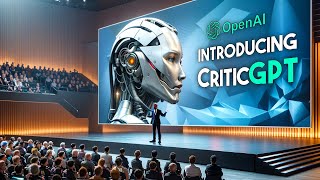
A narrated YouTube explainer (by LARRUZ, July 1, 2024) describing OpenAI's Critic GPT — a GPT‑4‑based model trained to critique other AI outputs (notably ChatGPT code) to improve evaluation in the RLHF pipeline. The video presents empirical results (reviewers aided by Critic GPT outperform unaided reviewers ~60% of the time; critic critiques preferred ~63% on natural bugs), explains the training/evaluation setup (human‑inserted vs. human‑detected bugs) and the Force Sampling Beam Search (FSBS) method used to produce longer, higher‑quality critiques, then shifts to the geopolitical decision by OpenAI to block API access from mainland China and Hong Kong and the likely global impacts.
Questions this video answers
July 1, 2024.
About 60% of the time (a 60% preference for aided reviewers).
63% of cases.
"Human inserted bugs" (manually added by trainers) and "human detected bugs" (naturally occurring errors found during use).
Force Sampling Beam Search (FSBS), which generates multiple constrained samples and scores them by critique length plus a reward model score.
Chapters
OpenAI has recently launched a fascinating new model called Kritik GPT, and it's creating quite a buzz in the AI community. Critic GPT is essentially an AI designed to critique other AI models, specifically targeting errors in code produced by ChatGPT. And if you wonder why OpenAI felt the need to create such a tool, the answer lies in the challenges posed by the increasing sophistication and complexity of AI systems like ChatGPT. So ChatGPT, powered by the GPT4 series of models, is already pretty advanced and is continually learning and improving through a process known as reinforcement learning from human feedback, or RLHF. This means that human trainers review ChatGPT's responses and provide feedback, which the model then uses to refine its future outputs. However, as these AI models get better and more nuanced, spotting their mistakes becomes a lot harder for human reviewers. This is where Critic GPT will be very useful, even crucial. So this model, also based on the GPT4 architecture, was created to help identify and highlight inaccuracies in ChatGPT's responses, especially when it comes to coding tasks. The main idea is that Critic GPT acts like a second layer of review, catching errors that might slip past human reviewers. And it's not just theoretical. The results have been impressive. According to OpenAI's research, human reviewers equipped with Critic GPT and outperform those without it 60% of the time when assessing ChatGPT's code output. This means that the model can significantly enhance the accuracy of AI generated code by spotting mistakes more effectively. Training critic GPT involved a process similar to what was used for ChatGPT itself, but with a twist. OpenAI's researchers had AI trainers manually insert errors into code generated by ChatGPT. Then they provided feedback on these inserted mistakes. This helped Critic GPT learn to identify and critique errors more accurately in tests. Critic GPT's critiques were preferred over ChatGPTs in 63% of cases when dealing with naturally occurring bugs. One reason for this is that Critic GPT tends to produce fewer small, unhelpful complaints, often called nitpicks, and is less prone to hallucinate problems that aren't really there. Another interesting finding from the research is that agreement among annotators or the people reviewing the critiques was much higher for questions involving specific predefined bugs compared to more subjective attributes like overall quality or nitpicking. This suggests that identifying clear, objective errors is easier and more consistent than evaluating more subjective aspects of code quality. OpenAI's research paper discusses two types of evaluation data human inserted bugs and Human detected bugs. Human inserted bugs are those manually added by the trainers, while human detected bugs are naturally occurring errors that were caught by humans during regular usage. This dual approach provides a comprehensive understanding of critic GPT's performance across different scenarios. Interestingly, agreement among annotators improved significantly when they had a reference bug description to work with. That just highlights the importance of having a clear context for evaluation, which helps in making more consistent judgments. Now, critic GPT's performance is not just limited to spotting errors, it also enhances the quality of critique. Human reviewers often kept or modified the AI generated comments indicating a synergistic relationship between human expertise and AI assistance. This synergy is crucial because while Critic GPT is powerful, it's not infallible. It helps humans write more comprehensive critiques than they would alone, while also producing fewer hallucinated bugs than if the model worked alone. The ultimate goal of Critic GPT is to integrate it into the RLHF labeling pipeline, providing AI trainers with explicit AI assistance. This is a significant step towards evaluating outputs from advanced AI systems, which can be challenging for humans to rate without better tools. By augmenting human capabilities, Kritik GPT helps ensure that the data used to train AI models is more accurate and reliable, leading to better performance of these models in real world applications. Now, OpenAI also implemented a method called Force Sampling Beam Search to balance the trade off between finding real problems and avoiding hallucinations. This method allows Critic GPT to generate longer and more comprehensive critiques by using additional test time search against the critique reward model. Essentially, FSBS helps Critic GPT be more thorough in its critiques without going overboard on imaginary issues. FSBS is actually a fascinating technique. During fsbs, Critic GPT forces the generation of specific highlighted sections of code using constrained sampling to ensure these highlights are accurate. The model then scores these highlighted sections based on a combination of critique length and the reward model score. This balance ensures that the critiques are not just comprehensive but also precise, reducing the likelihood of hallucinations and nitpicks. The FSBS method involves generating multiple samples for each input and selecting the best scoring critiques. This approach enhances critic GPT's ability to identify and articulate significant issues in code, making its feedback more valuable for human reviewers. In practice, Critic GPT has shown that it can help human reviewers write more comprehensive critiques while reducing the number of nitpicks and hallucinated problems. For instance, in the experiments, human reviewers assisted by Critic GPT wrote substantially more comprehensive critiques than those working alone. This was true for both human inserted bugs and naturally occurring bugs. Moreover, critic GPT's performance isn't just limited to code. The researchers also tested its ability to critique general assistant tasks. They found that Critic GPT could successfully identify issues in tasks rated as flawless by a first human reviewer, which were later found to have substantial problems. However, it's important to note that while Critic GPT enhances human capabilities, it can't completely replace human expertise. There are still tasks and responses that are so complex that even experts with AI assistance may struggle to evaluate them correctly. But by working together, human and AI teams can achieve much more than either could alone. So by using AI to help fix AI, OpenAI is addressing one of the fundamental challenges in AI development the difficulty of evaluating and improving increasingly sophisticated models. Critic GPT not only helps catch more errors, but also improves the quality of human reviews, making the entire RLHF process more effective. There's still much work to be done, but Critic GPT is a clear example of how innovative approaches can help tackle some of the most pressing challenges in AI development now. It's no secret that OpenAI is deeply invested in pushing the boundaries of AI, constantly refining its systems, models, and overall vision on a global scale. However, a recent development has caught many by surprise. OpenAI has made the decision to completely sever its ties with China, going as far as blocking access to its API within the country. This week, OpenAI made a big decision to block access to its site from mainland China and Hong Kong. This means developers and companies in those regions can't use some of the most advanced AI technologies anymore. This move by OpenAI isn't too surprising because of the ongoing geopolitical tensions and competition in technology. However, it's a significant moment in the AI world that could intensify the tech cold war. This decision will have major impacts on the future of AI both in China and around the world, setting the stage for even fiercer competition among leading AI powers. OpenAI's decision comes in response to increasing government demands and the rivalry for AI dominance. This choice helps protect the company's intellectual property while navigating the complicated geopolitical landscape. It highlights the growing digital divide between China and Western countries, which is becoming a defining feature of this tech war era. By cutting ties with China, OpenAI is contributing to a broader trend of tech decoupling, where the US and Chinese tech ecosystems are becoming more separate, according to experts. For Chinese AI companies, OpenAI's blockade presents both challenges and opportunities on the Downside, not having access to OpenAI's advanced models like GPT4 could slow the adoption and integration of cutting edge AI technologies. This is especially tough for startups and smaller companies that don't have the resources to develop similar models on their own. However, the move could also spark innovation in China. Without access to OpenAI's technology, Chinese companies might push harder to develop their own. This could lead to a new boom in AI research, making the Chinese tech scene more energetic and self sufficient. Big Chinese companies like Alibaba, Baidu and Tencent are in a good position to take advantage of this situation. They have the money, talent and infrastructure to boost their AI research and development. This could lead to these giants making even more efforts to innovate in AI and build their own alternatives to OpenAI's models. Moreover, the Chinese government has been heavily investing in its tech industry with large amounts of money and supportive regulations. This could lead to a rush of new AI research, increasing competition among Chinese companies and helping China keep up with other countries. OpenAI's move will also affect the global AI landscape. It's likely to lead to a more fragmented AI world where different countries and regions align with either the US or China based on their access to AI technologies. For example, countries in Southeast Asia and Africa which have strong economic ties with China, might favor Chinese AI solutions. On the other hand, Europe and North America might rely more on American based AI technologies. This split could have significant implications for international cooperation, data sharing and the development of global AI standards. By controlling who can use its technology, OpenAI is exercising digital sovereignty. This is part of a broader effort to ensure that AI technologies are developed and used in ways that meet ethical standards and security requirements. I still think that international tech collaboration is vital, but companies viewing China as a crucial market now face complex geopolitical challenges. Apple, for example, is reportedly seeking local partners to provide services compliant with China's strict AI regulations, showing how firms must navigate these delicate waters. In the end, the future of AI depends not only on technological advancements, but also on the geopolitical strategies and policies and that shape its development and use. Alright, don't forget to hit that subscribe button for more updates. Thanks for tuning in and we'll catch you in the next one.