OpenAIs New Statement On GPT-5 Is Surprising!
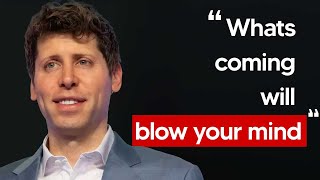
OpenAI executive Sarah Friar told Bloomberg that AGI is closer than most people think. The company holds weekly research meetings on upcoming capabilities, and Sam Altman's recent blog post signals the shift toward what he calls the Intelligence Age. Industry leaders like Ray Kurzweil and Dario Amodei are predicting human-level AI within years, not decades.
Questions this video answers
October 29, 2024.
June 2020.
August 2022.
September 23, 2024.
Around 2029 (Kurzweil described as calling 2029 a conservative estimate).
Chapters
Meetings I get to go to once in a while is the research meeting and it would blow your mind to see what's already coming.
So OpenAI have recently come out with a statement that I think is truly fascinating as it gives an insight to what they are working on behind the scenes at OpenAI. So this interview was done on Bloomberg. It was with OpenAI's CEO Sarah Fryer. She is the chief financial officer of OpenAI since June 2020. And she actually gives her insights with as to what she thinks Sam Altman would say if he was sitting in that chair. And not only that, also about the fact that this is mind blowing.
Meetings I get to go to once in a while is the research meeting and it would blow your mind to see what's already coming.
So one of the key pieces of insights we got from this interview was that every week there is a research meeting in which they discuss what is coming for the future. This was something that I didn't know before, but it's clear that now this is public information. We can now understand that every week OpenAI are having a meeting discussing some of their future capabilities and some of the future model releases. Now, she says that in that meeting the meeting is constantly managing to blow her mind, which does state that whatever she's seeing in those meetings and whatever is being presented and discussed about the future capabilities means that OpenAI are largely still ahead of the competition. So that is something that is probably news to you, as it was news to me. Now, it doesn't surprise me that there is of course a research meeting in which they discuss the future of the company. But it does kind of shock me that they're openly stating that, look, these meetings that we're having about the future technology is really shocking. Now I know most people are going to immediately say that this isn't true, like OpenAI are just funding their own hype train so that they can get more investment from investors. But I would argue that this might not be the truth. Okay, for those of you that think that this is just pure marketing hype, we have to take a little bit of a journey back in time. So if you remember at the time that we had GPT3.5 and a lot of people would have thought at that time that GPT 3.5 was absolutely incredible. Now, of course, when we were looking at GPT 3.5 back then, we were like, wow, this is a mind blowing tool. And this tool completely shot up in terms of the popularity. It was the fastest application to gain 100 million users, surpassing every previous social media platform. Now the crazy thing about this is that, do you remember at that time OpenAI would have already had GPT4. Remember, GPT4 actually finished training in August of 2022, which was before the release of ChatGPT. So you have to think about it like this. GPT4, okay, was finished training even before the release of ChatGPT, which means they were ahead of the public by quite some time. And when GPT4 dropped, you do remember that that model had stayed at the frontier for around two years before any of the labs came anywhere near to the capabilities that OpenAI had. Now, of course you could argue that OpenAI since then has, you know, maybe lost a lead to claw 3.5 sonnet, but even with the O1 preview model, I would argue that this feat is even more impressive. The only problem that I see with the O1 preview model is, is that for most average everyday use cases, there just isn't much use for the average person. The model is tailored to areas like biology, physics, chemistry and mathematics. And unless you're someone that's constantly working with these kinds of problems, it's quite unlikely that you're going to get any value out of the model. Which is why I don't think there has been such a substantial increase in terms of the average person realizing just how smart these models are to come. Now another thing that was said in this interview that I think was quite thought provoking, but a constant reminder to the kinds of future that we're going towards was the fact that she said, okay, that if Sam Altman were sitting on this chair, he would say that, you know, AGI is closer than most people think. Now this is actually quite true.
Like if Sam were sitting on the seat, he would tell you AGI is closer than most think.
And now I think most people, like I said before, would take that statement and say, okay, this is just the AGI hype train. But like I said before, when we look across the industry for any kinds of predictions for the future, we do get a constant theme in terms of the dates of not just super intelligence, but actual human level reasoning that's going to surpass any average human. For example, if we take a look at Sam Altman's blog called the Intelligence Age. This was released on September 23, 2024. This blog actually talks about the next couple of decades, what's coming in the next hundreds of thousands of days. And what we can see here is that it is remarkable to see exactly where things are headed. This was just published by Sam Altman on his Twitter, and he just posted this is my Vision for the Future. And one of the crazy statements that was actually in this, I'm not sure if you guys managed to see this, but one of the most quoted statements that most people took away from this was the fact that he said, this may turn out to be the most consequential fact about all of history so far. It is possible that we will have superintelligence in a few thousand days and it may take longer, but I'm confident that we'll get there. Now, the craziest thing about this is the fact that, like this statement a few years ago would have been ridiculed and taken apart by critics and those who just don't believe in AI's potential. But this statement becomes more and more realistic the more we start to look at how powerful AI is continuing to become. Now, of course, I will state that, saying that it is possible that we'll have superintelligence in a few thousand days. Could be anywhere from a thousand days to 10,000 days, which is, of course, three years to 10 years. But the crazy thing about this is that there are still more predictions from this article and predictions from other industry leaders that share the same idea that those at OpenAI do. And remember, it isn't just random people across the Internet stating this. This is some of the most accomplished AI researchers in their space making these kinds of predictions. One of the best predictions that you could ever look to is Ray Kurzweil. This is someone who's predicted with 84% accuracy a lot of the technological feats that have been recently achieved. And he pioneered pattern recognition technology and many other things. Now, in this recent interview on Moonshots, he actually gives his recent prediction. And his prediction is one that apparently is now considered conservative. And I think it's pretty crazy because this timeline isn't that far away. I mean, five years, because he essentially says it's 2029. When we think about the monumental amount of change coming in that time, that's not a lot of time faster and faster each year. So 2029 for AGI is conservative. So you can see here he actually says that 2029 is pretty conservative for AGI. Like, if AGI happens in five years, that is a conservative estimate, even by someone who's managed to predict a lot of different things in the past. And this is someone, if you actually take a look at his prediction accuracy, which they talk about in the interview.
Documented about when you predict something is going to happen. And within you know, giving a leniency of like 12 to 24 months. I think your accuracy rate is at 86%, not too bad.
You can see that the accuracy is pretty surprising. Now if we do go back to Sam Altman's blog post, you can see that one of the things he also talks about is the fact that AI systems are going to get so good that they help us make better next generation systems and make scientific progress across the board. This is where you're talking about the self improving AI across the board. Not like an individual system that self improves itself, but an entire ecosystem that allows AI exponential growth. For example, if you have an AI system that is really effective, it can write research papers, it can design systems and software that can help speed up the next training cycle. Of course, over time using the AI is going to get to faster and faster cycles. And of course scientific progress is something that they're trying to consistently improve. Now, like I said before, Sam Altman isn't the only person talking about this in his blog post. One of the individuals that actually talks about how much the future is going to increase in terms of intelligence is a CEO of Anthropic. The CEO of Anthropic, if you don't know who that is, that's essentially the company that created Claude, the chatbot that's currently challenging ChatGPT in coding and other areas. And he said essentially when we take a look at things and we account for absolutely the chips, when we take a look at the exponential growth in other areas, we're on a pretty smooth exponential.
We're on this smooth exponential. The models are getting better and better over time. There's no one point where it's like, oh, the models weren't generally intelligent and now, and now they are. I just think, you know, like, like a human child learning and developing, they're getting better and better, smarter and smarter, more and more knowledgeable. And I don't think there will be any single point of note, but I think there's a phenomenon happening where over time these models are getting better, better and better than even the best humans. I do think that if we continue to increase the scale, the amount of funding for the models, if it goes to say, 10 billion.
So now a model would cost 100.
Million right now, 100 million. There are models in training today that are more like a billion, right? I think if we go to 10 or 100 billion, and I think that will happen in 2025, 2026, maybe 2027, and the algorithmic improvements continue apace and the chip improvements continue apace. Then I think there is in my mind a good chance that by that time we'll be able to get models that are better than most humans at most things.
The point I'm trying to make there, guys, is that it isn't just one person stating this. Sam Altman, Dario Amadei, other industry leaders, Reiko as well. They're all predicting that with the things that they're seeing and the amount of time that they spent with this technology, they see this technology just improving at a ridiculous pace. Now, Dario Amodei actually talks about this in his blog post that I recently did an hour long video dissecting and going through everything. But essentially he basically talks about how in terms of pure elegance, what he expects is that when he talks about powerful AI AGI is that it is smarter than a Nobel Prize winner across the most relevant fields, biology, programming, math, engineering and writing, etc. And this means, which is a stark implication, that it can prove unsolved mathematical theorems, write extremely good novels, write difficult code bases from scratch, etc. That would be pretty incredible if it were to be true. So this is a statement that should really drive home the point that I think in the next three years we're going to be receiving ridiculous levels of AI improvement that most people can't fathom. And of course you can see here, he says that in addition to just being a smart thing you talk to, it has all the interfaces available to a human working virtually, including text, audio, video, mouse, keyboard control and Internet access. And it can engage in any actions, communications or remote operations enabled by this interface. And it does all of these tasks, again, a skill exceeding that of most of the most capable humans in the world, basically saying that, look, this system is going to be smarter than most people can imagine. So when we look back at this statement that says, look, this thing is going to blow our minds, do I think that this is a statement that is completely ridiculous? No, I don't. Because every single release from OpenAI has genuinely blown my mind. When we look at OpenAI's Sora, that technology blew my mind. When I saw it, I was like, whoa, I remember the entire world, their minds were blown. When I saw GPT4 what it was able to do that demo, my mind was blown. Then when I saw the GPT Advanced Voice mode, my mind then was also blown as well. So this doesn't surprise me. But I do wonder what OpenAI do have in store for us next, because these models are getting ridiculously smart. So with that being said, let me know what you guys think about the video, and I'll see you in the next one.










