OpenAI's Sam Altman SHOCKINGLY Admits: "OpenAI Must Learn From DeepSeek"
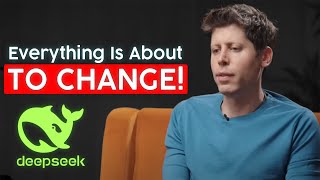
YouTube explainer by LARRUZ (Feb 1, 2025) covering Sam Altman's shift toward openness, the sudden rise of Chinese startup DeepSeek (which claims GPT-level models at low cost), major industry spending by Microsoft and Meta, OpenAI's new O3 Mini model and chatgpt.gov product, Altman's Stargate data-center financing claims, and a personal lawsuit filed by Ann Altman alleging historical abuse.
Chapters
A wild turn of events. OpenAI's CEO rethinks open sourcing, unveils a new mini AI model and faces a personal lawsuit While a half trillion dollar data center project looms and hush hush moves from other tech giants stir even more chaos. The entire industry might be on the verge of a major shakeup. So first off, the big headline. Sam Altman, the CEO of OpenAI, did an ask me anything session on Reddit and made some eyebrow raising comments. He admitted OpenAI might have been on the wrong side of history about Open sourcing its AI technology. If you've followed OpenAI since day one, you know it was initially founded as a non profit that promised to share research openly. Over the years though, they went more closed and proprietary, especially when they launched products like ChatGPT. Altman basically said, yeah, maybe we messed up by keeping everything private. He also gave a shout out to Meta's approach. Meta has open sourced many of its Llama models and even singled out a Chinese startup, Deepseek, that's apparently blowing everyone's minds with its own open source approach. Now, in January, almost nobody had heard of Deepseek. Then out of nowhere, they claim they built a model on par with OpenAI's GPT01 for just $5.58 million using only 2000 Nvidia H800 GPUs. If true, that's crazy cheap, especially when we hear that OpenAI has spent billions on infrastructure and training. Some experts are questioning these cost claims, saying maybe Deepseek is hiding something, like possibly sidestepping US chip export restrictions or even stealing OpenAI's research. In fact, Microsoft is investigating whether deepseek inappropriately used OpenAI's data to speed up its own development. If it turns out Deepseek really just copied or distilled GPT01, that's going to be a massive legal headache. But even if Deep Seek did something shady, it's still making waves. The AI world is freaking out about the possibility of that an upstart can challenge American giants so quickly. Microsoft, for instance, dropped $80 billion on AI infrastructure in just the last quarter of 2024, and Meta coughed up $65 billion. Both companies have said they plan to keep spending big in 2025. Meanwhile, OpenAI is reportedly looking to raise 25 to $40 billion more at valuations as high as 300 or $340 billion. Clearly, these companies believe it takes a massive pile of cash to stay ahead. But Deepseek's claims that you don't need insane budgets to get top tier performance are shaking that assumption to the core. When Business Insider tested deepseek's Deep Think setting, the system spewed out page after page of math before arriving at a final answer. Transparency some users love. In contrast, OpenAI's chain of thought models like O1 and O3 don't show you their intermediate reasoning. Interestingly enough, Sam Altman now says OpenAI will start letting people see a more detailed thinking process, giving credit to Deepseeks R1 for inspiring that change. Another area where Altman says OpenAI might change is in Open sourcing the model weights. Right now, companies like Meta and Deepseek release all the nuts and bolts details behind their AI, letting anyone build on top of them. OpenAI has historically been reluctant to do that, but Altman hinted that internal discussions are happening. Even though not everyone at OpenAI is sold on the idea, he said it's not their top priority, but it's definitely on the table. In other news, OpenAI just launched a new mini reasoning model called O3 Mini. The idea is that it's cheaper and more efficient than their flagship models, good for tasks like science, math and coding. You can toggle the reasoning level between low, medium or high to handle problems of different complexity. If you're a ChatGPT plus team or Pro subscriber, you get it right away, and even free users can check it out via a reason setting. This launch comes hot on the heels of deep seeks R1, overshadowing the entire industry, so it's pretty obvious OpenAI is trying to hit back with something that's both powerful and cost effective. Speaking of cost effectiveness, there's also a big question of whether deepseek is truly original. A service called Originality AI tested deepseek's text outputs and found that it could detect them as AI generated with over 99% accuracy, basically as if they were ChatGPT outputs. That might suggest Deepseek distinct killed or copied ChatGPT's style. Of course, that's not proof positive, but it's definitely fueling Suspicions that Deep Seek's model might have been trained using unauthorized ChatGPT data to add yet another layer of drama. Google apparently tried to sneak out an experimental update to their Gemini AI called Gemini 2.0 pro experimental, then promptly deleted any mention of it. This version was supposed to to handle really complex math and programming tasks, presumably to stay competitive. Right now, though, the world's fixated on Deep Seek. Google is probably doing some serious regrouping to figure out how to keep Gemini in the spotlight now let's shift gears in a big way. Sam Altman's massive data center project called Stargate. So apparently Altman convinced SoftBank, Oracle and an Abu Dhabi fund called MGX to commit to a $500 billion plan to to build the largest private computing infrastructure in history. That's half a trillion dollars, folks. The White House even held a press conference where President Donald Trump appeared with Altman, Oracle's Larry Ellison, and SoftBank's Masayoshi San. They say the name is Inspired by the 1994 sci fi movie Stargate, where the Stargate is some all powerful transportation device. Kind of telling, right? But a bunch of people are super skeptical that half a trillion dollars is actually going to materialize. SoftBank has a spotty history with big hype fueled investments. Remember WeWork? And they're only sitting on about $30 billion in cash. MGX apparently has $100 billion but might be tapped out, especially if they invest in other AI startups. Oracle has about $11 billion. So yeah, the math might not add up. Altman insists they'll find the money. But Elon Musk, who co founded OpenAI before leaving in a bitter dispute, claims they don't actually have anywhere near that. The project would require building tons of data centers, each capable of sucking down power equivalent to a small city all across the country. Many question whether brute force computing is even the right path forward, especially after seeing Deepseek's cheaper approach. Meanwhile, in the background, Sam Altman faces a personal crisis. His sister, Ann Altman, who filed a lawsuit alleging that he sexually abused her from 1997 to 2006. She's seeking $75,000 in damages, a relatively small sum for a figure as high profile as Sam. The family denied these allegations in a joint statement, and Sam hasn't publicly commented beyond that denial. Obviously, if these claims gain traction, it could be a huge problem, not just for Sam personally, but for OpenAI's brand. It's already overshadowing some of the company's announcements. In certain circles, though, the mainstream AI discussion is still mostly about Deep Seek and OpenAI's rivalry. And as if that wasn't enough, OpenAI also introduced something called chatgpt.gov, targeting government agencies that want to run AI behind their own private firewalls. It's basically chatgpt, but isolated in Azure commercial or government cloud, so agencies don't have to worry about their data mingling with public AI training sets. That's a direct response to the fact that lots of organizations have banned ChatGPT or any generative AI for fear that sensitive data could leak out. By letting them host AI in their own secure environment, OpenAI hopes governments and big corporations might relax and adopt their tech all of this unfolds while the major tech players are pouring more money into AI, yet Deepsea claims it built a comparable model on a shoestring budget. Sam Altman admits open source may be the future, but he's also championing Stargate, OpenAI's massive close infrastructure project. Meanwhile, DeepSeek's open sourced code raises questions about whether it was borrowed from OpenAI, and Google is quietly rethinking its Gemini update. Add in the sexual abuse allegations against Altman and you have a major crossroads for AI Will lean, efficient approaches outshine giant data center expansions? Will lawsuits or scandals reshape the playing field? Let me know your take in the comments. Don't forget to hit that like button and subscribe for more AI updates and subscrib, because at this rate, who knows what's going to happen next week, right? Thanks for watching and I'll catch you in the next one.










