OpenAI's Unveils Shocking Plan: Artificial Super Intelligence (ASI) is Coming!
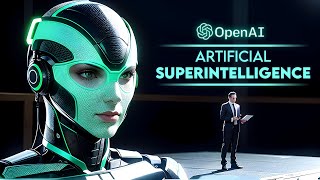
OpenAI created a Super Alignment Team to tackle the risks of superintelligence. Their four-step plan includes scalable oversight, automated interpretability tests, adversarial testing with misaligned models, and an automated alignment researcher. The company faces copyright lawsuits from authors over training data.
Questions this video answers
July 8, 2023.
Ilya Sutskever and Jean Lika.
(1) develop scalable oversight and study generalization; (2) validate models via robustness checks and automated interpretability; (3) adversarial testing by training misaligned models; (4) iterate using an automated alignment researcher to scale further.
Chapters
So apparently OpenAI is working on creating Superintelligence and has formed the Super Alignment Team to ensure that this super intelligent AI is developed with appropriate safety measures, whatever that entails. They're also dealing with some drama from lawsuits alleging copyright infringement and a controversy involving the bing plugin in ChatGPT. In this video, we're going to delve into all of this and more. So stick around and watch the video till the end. Honestly, these are crucial topics that everyone should be aware of. AI is like magic in our modern world. It can change everything from health and education to fun and travel and even arts and science. It can make realistic pictures, write full stories, play tough games and solve tricky problems. But imagine if AI could do even more like being as smart as a human in every way. That's what OpenAI, a research group, is working on. They're trying to make a type of AI that can do anything a human can. And according to them, they want to make sure this super smart AI is good and cares about people. I guess by now just about everyone's heard of OpenAI's ChatGPT. It's the best language model ever, able to write almost anything you can imagine. And it uses OpenAI's transformer tech to learn from heaps of data and give great results. But OpenAI isn't only about language. They've also made great progress in things like computer vision, robots learning methods, language processing and more. They've made Dall? E that generates images from text, clip that learns from any online image, Codex that writes code from normal language, Dactyl that controls a robot hand and Muzero that can learn any game without knowing the rules. The potential is huge when also combined with AI art, which also took the world by storm last year as companies and capitalists invested millions not just in AI art, but in classic physical art, which saw record setting auction totals plastered across headlines throughout 2022. This rush of attention is extra noteworthy coming as most investors just experienced their worst year since the 2008 financial crisis. However, at the same time, art prices rose an average of 29% last year, per the Knight Frank wealth report. An extraordinary result for the companies already quietly at work in the art market for years. Like one that's using innovation to bring the potential of contemporary arts financial power to everyday investors. Today's sponsor Masterworks Masterworks team of experts have created a one of a kind database of art prices over the last 50 years which allows them to find physical works that they believe will appreciate in value from legends like Picasso and banksy Masterworks has a total of 13 exits now, with every exit returning a profit to their investors. Recent sales even netted everyday investors, 10, 30, 13 and 35% returns. Masterworks has now delivered the net proceeds from over $45 million in sales, a historic milestone that they want to celebrate with a new deal exclusive to AI Revolution viewers. So for a limited time, when you click the link in the description, you'll automatically get a no obligation membership account from Masterworks. Okay, now back to OpenAI. Based on their recent announcement, OpenAI's ultimate goal is not just to create AGI, but to create SuperIntellig, which is AI that is vastly smarter than humans in every domain. It could have abilities that we can't even imagine or comprehend. Superintelligence could be the most impactful technology humanity has ever invented. It could help us solve many of the world's most important problems such as poverty, disease and war. It could also unlock new possibilities for exploration, discovery and creativity. But superintelligence could also be very dangerous. It could pose existential risks to humanity and and our civilization. It could have goals and values that are incompatible with ours. It could outsmart us and manipulate us. It could even destroy us. This is why superintelligence alignment is so crucial. It is the problem of ensuring that superintelligence follows human intent and does what we want it to do. This is not an easy problem to solve. In fact, it may be one of the hardest problems ever. Now, OpenAI believes that superintelligence alignment is an urgent problem that needs to be solved as soon as possible. They also believe that superintelligence could arrive within this decade. That's why they have announced a new initiative, the Super Alignment Team. The Super Alignment Team is a new research team within OpenAI that will focus on developing technical approaches to steer and control superintelligent AI systems. The team will be co led by Ilya Sutskever and Jean Lika, two of the world's leading experts in AI research and alignment. Their goal is to create a roughly human level automated alignment researcher which is an AI system that can conduct alignment research itself and use vast amounts of compute to scale its efforts. The idea is to use this system to iteratively align superintelligence. But how will the Super Alignment Team achieve this ambitious goal? They have outlined a plan that involves four main steps. One, develop a scalable training method. The team will leverage AI systems to assist evaluation of other AI systems on difficult tasks that humans can't supervise. This is called scalable oversight. The team will also try to understand and control how their models generalize from easy tasks that humans can supervise to hard tasks that humans can't. This is called generalization. 2. Validate the resulting model. The team will automate search for problematic behavior and problematic internals of their models. This is called robustness and automated interpretability. The team will also test their models in worst case situations and confirm that they are aligned. 3. Stress test the entire alignment pipeline. The team will deliberately train misaligned models and see if their techniques can detect the worst kinds of misalignments. This is called adversarial testing. 4. Repeat the process. The team will use the automated alignment researcher to align more advanced AI systems and so on until they reach superintelligence. Now, this is a very challenging and complex strategy and it may not work as expected and there are many unknowns and uncertainties involved, but the Super Alignment team is determined to try it and see what happens. Of course, superintelligence alignment is not the only issue that needs to be addressed when it comes to AI. We need to consider more than just how smart AI can become, but also how we handle AI. We need rules for how AI is developed and used, plus we need to think about who can use AI and what happens when they do. These are big questions that everyone from governments to experts are trying to answer. Different places have different ideas about how to manage AI. So there's no one size fits all answer. OpenAI is part of these discussions and they've shared their own rules for responsible AI. But not everyone agrees with OpenAI. Some think they're too optimistic about AI and not focused enough on the dangers. Others question if they're being fully transparent, especially since they started mixing non profit and for profit work. One of the most controversial and contentious issues that OpenAI has faced recently is the ChatGPT lawsuit. So ChatGPT ran into legal trouble when two authors, Paul Tremblay and Mona Awad, filed a lawsuit against OpenAI. They claimed that ChatGPT had infringed their copyrights by generating texts that were similar or identical to their published works. The lawsuit sparked a heated debate in the AI and literary communities. Some think that ChatGPT is ripping off author's original work, while others believe it's making new texts without copying anyone. This whole issue has made everyone question who really owns the rights to the texts created by ChatGPT. Is it OpenAI the ones who came up with the technology? Maybe the users who tell it what to write? Could it be the authors whose books were used to teach the AI? Or perhaps nobody, since ChatGPT is doing its own thing. The case is still ongoing, and it could have significant implications for AI and copyright laws. Another issue that OpenAI has faced with ChatGPT is the Bing plugin controversy. It is a plugin that allows users to browse the Internet with ChatGPT, and it was introduced recently as a feature of ChatGPT, which was integrated with Microsoft's Bing search engine. In simple terms, Bing fetches and presents info related to what you're searching for. So if you look up a movie, Bing gives you a rundown of it, its summary, ratings, cast, even the trailer, and chats with you about it. However, Bing has faced backlash for giving away content that's usually paid for. Say, if an article is hidden behind a paywall, Bing shows you the whole piece for free. This upset creators and publishers who rely on subscriptions and ad revenue. They claim Bing breaks their rules, infringes copyright, and harms their business. These developments show that OpenAI is at the forefront of AI research and innovation, but also that they are facing many challenges and controversies along the way. They have to balance their vision of creating superintelligence with their responsibility of ensuring its safety and alignment. And they have to navigate the complex and evolving landscape of AI regulation and ethics, and of course, deal with the legal and social implications of their AI products and services. These are not easy problems to solve, and they have no clear or simple answers. But they are also very important problems to solve because they affect not only open AI, but also the entire AI industry and society at large. How we address these problems will shape the future of AI and humanity. That's why I think it's crucial that we have these discussions and debates and that we stay informed and engaged with what's happening in the world of AI. Because AI is not just a technology, it's a force that can change everything. And that's it for today's video. I hope you enjoyed it and if you did, please give this video a thumbs up. Subscribe to my channel and hit the bell icon to get notified when I post new videos. Also, let me know what you think about OpenAI's Super Alignment Team and super intelligence in general in the comments below. I'd love to hear your thoughts and opinions. Thank you so much for watching and I'll see you next time. RA.










