Pathways in Machine Learning/Data Science
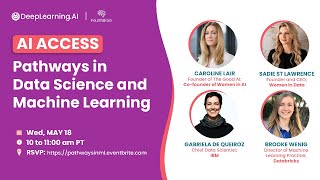
Four ML and data science leaders discuss non-linear career paths into the field. They cover role distinctions between data engineers, scientists, and ML engineers, emphasize soft skills like coachability and communication, and recommend joining communities and doing hands-on projects to break in.
Chapters
Sa.
Hi everyone. Welcome to Pathways in Data Science and Machine Learning. How's everyone doing? It's amazing to see viewers from all over the world joining us. Let's come together in the YouTube chat as a community and share a little bit about ourselves. To kick things off, I'll start. I'm Greg Lochmain, the Director of Product and Curriculum at Fourth Brain and I live in San Francisco, California. What about you? What do you do? Where are all of you from? I love it. Keep the intros coming. Keep smashing that chat and let us know where you're calling in from. Wherever you are. As someone traveling down their own unique path in data science and machine learning, you know that the career pathways that lead us to AI are winding and full of twists and turns. From getting that first job to doing our best to stay up with current trends near the cutting edge, these are not journeys for the faint of heart. Today we'll hear the stories of four trailblazers in the industry who have each walked their own path to success in data science and ML. Before I welcome our speakers, let me give a quick shout out to the event hosts that have put on the event today. First, I want to give a shout out to Deep Learning AI. Our event today is hosted as a partnership between 4th Brain and Deep Learning. As many of you know, DeepLearning AI is an online AI education company for anyone who's ready to learn from or revisit the foundational machine learning courses by Andrew Ng. We have good news for you. The updated machine learning specialization is coming out very soon. You can find the link in the description box on your screen to sign up and learn more. 4th Brain is a sister company of DeepLearning AI and backed by Andrew Ng's AI fund, 4th Brain helps you take your career in ML to the next level. Our cohort based courses are designed to help you fill your ML skills gaps with confidence alongside other practitioners looking to advance their career in AI. I'm excited to share that 4th Brain is offering a discount of $500 off either our machine learning Engineer or our Machine Learning operations program. For anyone registered for this event, check out our website fourthbrain AI to learn more. One last thing during the event, if you hear anything that you want to double click in on or if anything sparks other questions in your mind as any of our guests are talking, please post them directly in the YouTube chat. We'll select questions from there. Now, without further ado, let's welcome our all star panel. Here's the plan. We're going to do Quick introductions all around, then we'll dive into a few questions to help us really understand the truth about our panelists pathways to the stage today. Hopefully we'll pinpoint some similarities across journeys and perhaps we can even codify a few best practices or rules of thumb to help us all get where we're going. The second half of our time together will be spent getting your questions answered directly, so keep them coming. With that, I want to pass the mic to each of our panelists today for them to introduce themselves. First up, Caroline Lehrer.
Hi everyone. Really, really happy to be here today with all of you.
So.
So my name is Caroline Ler. I'm based in Paris and I run the good AI community who is a community of startups and talent and they all have in common the fact that they leverage AI technologies to serve sustainability, especially corporate sustainability. I'm also the co founder of a nonprofit called Women in AI working at increasing the number of women in the field of AI. So it's getting pretty big now. We started this nonprofit four years ago. We have 8,000 members all around the globe in different kind of programs. And I'm going to end with the but I should have started with it, but actually I don't have a technical background myself, so I come from the business side. Before starting the good, I used to work as biz dev sales exec. I also had an experience experience in the VC industry. So yes, business background and also international relations. And funny fact about me is that I've been headhunted to join a startup in the field of voice recognition back in 2018 just because of master thesis I had done around cognitive bias and the impact of it in international relations decision making. So it's just another, another way to show that basically anyone can join the AI ecosystem and that we need all the different kind of expertise to run this revolution for good.
Thanks Caroline. Next up we've got Sadie St. Lawrence.
Thanks Greg. Yeah, and I really love the intro you shared for this session and how so many of these pathways are winding road and I shared a little bit on this slide about all the different types of education and different titles I've had just to highlight what a winding road I have taken myself. So I did not start in the technical field. I started in piano performance, really loved it, but then with GE classes got really interested into how the brain worked, particularly interpreting music. And so that led me into studying psychology and then from there I got really interested in neuroscience and worked in a neuroscience lab for a while. However, when I was working in Neuroscience. I tell people all the time, some of the best ways to find out what you want to do is finding out what you don't want to do. And I realized I didn't want to work with rodents anymore. I didn't want to try and keep my pets alive and then have to run these experiments on them. But what I did love doing was I loved analyzing the data from the experiments and that led me to find data science through a Google search. I started my education journey on Coursera. Like many of you, probably taken a lot of the deep learning classes on there, and that led me to want more and it led me to start a master's in data science. At that same time, I realized I needed experience. And so you can see the plethora of job titles I had to go through just to get to the data science position. All the way from a research analyst to an analytics engineer. And then that finally led me to what was my dream job of being a data scientist and led me to then lead a data science team. From there, though the pivots do not stop even after you reach that point. I really fell in love with AI strategy and that led me to become an AI strategy consultant and consult for a lot of high tech companies and for public government. And at that point I was so amazed at what organizations were doing, but saw how many more people we needed in the field and the diversity of people we needed in the field. And I felt that it was time for me to give my technical knowledge and my ability to teach people. And that led me to starting and founding Women in Data. So today I lead Women in Data full time and it's been an incredible journey just getting to see and help support other people in their learning pathway. At the same time, I can't help but having slash careers. So I also taught a class, SQL for Data Science on Coursera and then also designed the machine learning certification for UC Davis. So definitely a winding road and career pivots for me along the way. And hopefully me sharing a little bit about my story inspires you that keep going and there is always more pivots along the way.
Love it. The pivots never stop. All right, next up, we've got Gabriella.
Hey everybody. Thank you for being here. I've seen in the chat we have people from all over South America, Europe, Asia. It's so great to have everybody here for us, with us here. My name is Gabriela Diqueroz. I currently work at IBM as a chief Data scientist working on AI strategy and innovation and I've been with IBM for the past four years, but before that I worked for several startups here in the Bay Area. But I'm originally, and I see a lot of people in the chat, I'm originally from Brazil, I've been here for almost 10 years. And interesting about my career path is that I was in the industry, sorry in academia before, so I had the whole research kind of like trajectory working on air pollution data and the statistics and my background is in statistics and epidemiology. When I'm not doing my full time job, I'm working on my organizations. So I am the founder of our ladies and gentlemen which is.
A global.
Organization to increase the diversity in the R community. And if you don't know about R, R is a programming language similar to Python and we are all over the world, we have over 100,000 members all over. And then in 2019, because we like Sadie and Caroline, we need to move and Brook as well, we never stop. So we are always learning and doing something different. So in 2019 I started a new organization called AI Inclusive with the idea to bring also diversity into the AI community and field and to increase their representation especially for underrepresented communities. Also I'm very active in the open source community so I am a member of the Art foundation, if I'm not wrong, the only Latina from part of the R Foundation. And I'm also serving the Adversity Council member and NUM focus which is more focused in Python but they also have our kind of like branch and throughout the career, just to summarize here, I don't, I don't call myself a data scientist or a statistician, but it's more like a collection of like all these different roles that Sadie was saying, all the titles that we had throughout our careers. So, so I've been a data scientist, a developer, advocate, open source manager, developer, statistician, epidemiologist, community builder, mentor, speaker, educator and one of my passions is like sharing my knowledge. So through mentorship or even as a manager. Right. So like as you are building, as I'm building my teams, I'm mentoring my folks on the team and also outside my team. So I'm very excited to be here and to take a lot of your questions.
Yeah, thanks so much, Gabrielle. Always on the move, right. I'm seeing like it never stops this game. Never stops this AI and ML game. Last up we've got Brooke Weinig from Databricks.
Hi everyone, my name is Brooke Weinig. I am the director of the Machine learning practice of Databricks. And similar to all of our other amazing panelists, I have a passion for education as well. So when I joined Databricks initially, I was actually still in grad school at ucla. I was working part time there, part time at databricks. And what I was initially focused on was building out our online MOOCs where we had over 100,000 people first learning about Spark back in like 2016. So I gradually grew up the ranks throughout databricks, starting as an IC to a manager, now to a director of our machine learning practice, which is focused on professional services and training for our customers, all within the realm of data science. Throughout my time at Databricks, I've also had the opportunity to co author the Learning Spark book, focused on the fundamentals of Apache Spark for distributed data processing, as well as co host of the Databrew podcast where we talk about all things data science, data engineering related. Prior to joining Databricks, I was at UCLA both for my master's and for my undergrad. Yes, I do not have a BS in computer science. I can talk about that a little bit later how I how actually studying abroad in China encouraged me to get a master's in computer science as opposed to completing my undergraduate in computer science. But my graduate focus was in distributed machine learning. So feel free to ask any and all questions you have about big data and large scale machine learning. And if you can't tell from my background, I'm an avid cyclist.
Amazing. Thanks so much, Brooke. And thanks to everyone on our panel today. I want to start by double clicking in on what we heard. We heard about all these pivots, we heard about all these moves, all these different things that you really are forced to confront in your journey. I want to dig right in and. And let's talk about something that might sort of remind you as being particularly sharp, particularly painful. A pivot that you had to make, that you kind of struggled with what to do before you took that fork in the road to the right or to the left. You know, Sadie, why don't you kick it off for us and tell us about one that kind of sticks out for you along all these bullet points that you showed us.
Yeah, so the first one that comes to mind was when I was working in the neuroscience lab and it was a Friday afternoon and I had just finished an experiment, experiment with my rodents and I had to euthanize them. And that was not something that I enjoyed doing. And I went away that Friday afternoon just thinking like, is this what I Want my life to be right. I don't want to start my weekend with having to euthanize something.
Right.
And so that weekend I took a lot of time to think and write out, like, what parts of my job do I like? And that was one column being very much a data person already. And then the other part was, what were the things I didn't enjoy? And, and what it made me realize was I enjoyed all the analysis side. So then I went to Google and started searching, okay, well, like, what jobs can I do that do more of what I like and do less of.
What I don't like?
And that led me to find the term data science. And from there I went into the lab on Monday and put in my two weeks notice and started looking for jobs and started finding classes online to take. And, you know, in hindsight it sounds really easy, but there was a ton of fear that I was experiencing during that time. Right. Like, I got the signal and the inclination of like, this is the pivot that you need to take. And I dove fully in. And that's what I recommend to people is like, make sure you have your reason of your why for why you want to make this change, whether it's you enjoy doing it or you're looking to make more money and have a stable career, whatever it is, but find that why first and then commit fully to it. Because at that point, you can't have one foot in and one foot, foot out. It really comes from that full commitment that will drive you forward to make those connections and find that right next move.
I love it. I love it. Yeah, that really resonates with me. This, this idea, like, this is not what I should be doing exactly right now, you know, is that, does that sort of resonate with any of the, you know, titles that we saw from you? Gabriella, Were there any point where you're like, it's time to go, it's time to go.
Yeah, there were two different, well, two different main or points that happened to me. One was when I was mo moving from academia to the industry, which was a big jump. And the other one was coming from like individual contributor, or IC as we call here. So from IC to a manager. So those are words, like two very different jumps. And I had to trust the process. And I'm like, okay, I'm going to try this out, even though I have no idea what is in front of me. But, like, they were very different and it took me months, I would say even years to get used to this new jump.
Yeah, yeah, absolutely. And you know, Caroline, I can't help but wonder your, your breadth of background, these, these jumps that, that we're talking about here, you know, do you really, do you really remember any of these particular, you know, is there one in particular where you're like, you know, I'm an investor. I'm gonna go, you know, finally build my own startups. I'm gonna. You know, I noticed you that you sort of like founded a whole sort of investment community. Like, you know, I'm going to take these sort of abstractions to the next level. Was there, was there one that was particularly hard for you, maybe early in your journey?
So.
Okay, can you hear. Yeah. Can you hear me now?
Yeah, I think we're good now.
Yeah.
Yeah, we could. Well, I think like the 10 last year really brought me to where I was. It's kind of synthesis of everything I've been through before. And I think this is pretty similar to all of us here. I've always been working in the tech industry, but the real. I think the real change has been when. So I make a break. I made a break. I decided to study political sciences because I was not finding my way in the tech industry. I was missing the sense of it. So went back to political science, studied international relations and then went back, eventually starting working in this AI startup called Snips. We were doing private by design voice assistant. And this is really when I got. I was so, like, it was not hard, I would say, but pretty easy. But I was really amazed by all these entrepreneurs that were really leveraging AI for good, taking care about principles that are super key here in Europe, like privacy. This was the case of Snips. And so this is really what drives me to launch. I guess the good AI community was really the idea to help all those entrepreneurs working in a good direction. That drives me where I am today. So I wouldn't see, like, I haven't been through any, like, hard time, I think. Well, maybe right now, I mean, I mean, being an entrepreneur is hard. So I guess everyone around me would agree. But yes, no, it's been a fabulous journey so far and I'm meeting all those entrepreneurs and also talents. You know, our community is not only for entrepreneurs and startups, but also just talent, individuals that are looking to leverage what they know for good. So looking for a startup they want to join or looking for position in a field related to AI and sustainability in a bigger corporate that we are working with.
So your progression feels very natural. It feels very much like it was sort of like you're just kind of walking your path and it's led you to here and it feels right. Okay, very cool. So we heard from Sadie that there was this like, okay, pivot into data science. Here we go. I'm going all in on data science and machine learning. And I think there was probably at some point for each of us here a moment where we said, all right, this is it, this is the thing. And Brooke, I want to throw this question to you because you kind of had this set up in grad school a little bit and you had to kind of decide, do I want to keep going? You know, and keep going all the way down the rabbit hole. And now you're an author, podcast host, director of one of the biggest startups in the world. Like, when did you decide, like, I'm going all in on data science and machine learning?
Yeah. So this was actually a pretty interesting story. So I had been interning at splunk in 2014, did some front end web dev 2015, I was going to go back for a backend C internship and my manager was out on parental leave for six weeks and was like, hey, the machine learning team will look after you for six weeks. When I come back, we'll resume your internship for usual. And I knew nothing about machine learning at that point. I only knew C C databases, I didn't know how to use Python, I didn't know anything about data science or machine learning. So I spent about the first four weeks, probably about 60 hours a week, taking Coursera courses, reading books, reading blogs, and just had such amazing mentorship from everybody else around me. Everybody else also had a PhD. And so for the first four weeks, I felt like I was the least productive intern ever. I was just continually learning and other people were continuing to mentor me. And then about four weeks in, I was able to start contributing to the Splunk ML toolkit. And so that was really what led me to say, this is so much more interesting than all the stuff that I learned in school about, like hardcore operating systems and all of that. So that was really that pivot point. And so I am a huge advocate for paid parental leave because if that weren't the case, I would have never had that opportunity to go down the machine learning rabbit hole.
I love it. Yeah, so, so, you know, I'm seeing some resonance with the rest of the panel here on, on like this idea that you kind of getting paid to learn and you sort of have to like, spend a lot of your time that you're actually, you know, working like learning and that's part of, like, I think probably a lot of what we have to do today to work in this field. You know, Gabriella, I noticed you sort of this has been part of your journey as well. Can you talk a little bit about, like the difference between how you look at sort of learning and working and contributing to an AI team?
Yeah. So every time I think about changing jobs, I always go to the next job as I have no idea what they are doing as a way for me to learn. So, like, it could be either like a domain. So for example, in the past I worked in financial industry or like software or advertisements. And so first there is a domain where I have no idea about the domain, so I have to learn the domain. So that's one thing. And the other thing is like each company use a set of tools or technologies that is going probably to be different from your previous role. So that's something that I do. It's like a challenge that I do to myself is like, I want to go to a place where I don't have much expertise, but I'm going to be learning and adding value to my career. So I always think about that. If you look back to my. To my path and even before that, like, even before becoming a statistician, it was always different. Everything that I have done is very different. So there is no, like a straight line. I like to call that it's a loop that we go through. And I think most of us here, we do this loop. Like our careers were not a straight line. I don't know. Like, I had no idea what I want to do when I was growing up. Actually, I want to be a veterinarian. And, you know, and so it's like always changing.
Yes, yes. So, yeah, I mean, you know, this. This idea that it's a loop. You have to loop through things. You have to look and search for new things and new domains and new experiences. I mean, all these learners that are kind of tuning in today, they're kind of looking for that straight line. I think in some sense, insofar as you've noticed that it exists. Sadie, during your loops, what can we provide as maybe this is what I'd recommend, you searching the straight line, knowing that you're going to deal with these loops, looking back on your past, is there a straight line we can draw through it? You know?
You know, I can't keep staring at this painting in the back because I'm like, as we're talking about all these.
Loops, I'm like, I think I have the right graphic for what your learning journey looks like. Unfortunately, I think it looks a little.
Bit more like the painting I have.
In the back because. And then we have such great examples of this on the panel. When we look at all the different job titles that the panel's gone through, all the different types of education, and then the continual work that everyone on this panel is doing through community involvement and teaching, I think we have the best examples on this panel right here. It's like these are women at very high levels in their career, and they're still talking about learning. Right. They're still talking about leaning into community. And so I think it's important to know that it's not only is it not linear, but it's not time boxed.
Right.
So your education journey is not something that, like, you get your master's or your bachelor's and you're done. And this is a continual process. I really love what Gabriela said in regards to. She takes on new opportunities for those learning opportunities. I'm very much similar in that regard. One time I entered a hackathon, and I hadn't ever built a computer vision model in my life. And so I said, I have 24 hours to build a computer vision model. The first eight hours, I took a class and learned how to build the model, and then I used the rest of the time time to actually do that.
So I think it's just important to.
Know that, like, sometimes it's okay to just sign up and raise your hand and volunteer and put yourself in that uncomfortable situation, because that will force us to find the right pieces to learn along the way to Google the questions that we need answers to. And that's how we finally get to somewhere in the end of this progressional loop of where we want to go.
Yeah, that uncomfortability, I think, is key. And, you know, I guess insofar we have heard, you know, we've got. I've taken the Coursera courses. I've taken some deep learning course. There. There are some foundational things that we can. We can all learn and we sort of should have, as a baseline of kind of learning, the vocab of the new thing that we want to move towards and be uncomfortable in. But this. This sort of uncomfortability, I mean, you know, Gabriella mentioned that she sort of had this, you know, I see. To manage your uncomfortability. Was that something that existed with you as well, Brooke, when you sort of made this transition?
Oh, 100%, I think I became a manager and I was 24. So I was, I still look young, but I visually look much younger than everyone else. And the people that I was initially hiring were all older than I was. And so I think for me, my perceived age was definitely the thing that made me the most comfortable. It wasn't actually about my technical skills or my management, my mentorship skills, but it was something that I had put upon myself that in retrospect I probably shouldn't have focused so much on that factor because obviously the company trusted me to be a manager. They've trusted me with all these other opportunities, representing databricks on stage, at keynotes, offering a book. So I think the hardest part of me transitioning to management was me being okay with the fact that yes, I'm younger, I have less experience, but it's an opportunity to learn and to grow. And it doesn't matter if you're 24, 34, 44, going to management, you're still going to have those growing pains when you initially do that transition. And I think the other hard part as well, going from IC to manager, is you have to learn to let go. You can't be micromanaging, you can't be the top technical resource in every project. At some point your team's technical skills will surpass yours because they're doing hands on data science work day to day. You're still a valuable member of the team and can still contribute. But at some point if you're not coding 40 hours a week and instead you're managing a team of 10 people, the team skills will surpass yours in the end. But the important thing is still to remain technical. It doesn't mean to still spend 40 hours a week coding, otherwise you're working 80 plus hours a week. But it's still to be hands on technical. And I think those are the most valuable managers, the ones that can still retain their technical skills as well as learning and growing those management and leadership skills.
Yeah, I like it. And you know this idea that you kind of, or stepping up, you're sort of abstracting a little bit, you're, you're helping the team grow, you're, you're stepping up, you're doing the uncomfortable thing, you're stepping up. I mean, Caroline, I noticed you've sort of been doing this for a long time and now, now you've sort of stepped up and you're sort of overseeing an entire massive community and you're trying to bring a lot of people together under you that probably many of which are a lot more technical than you. I Mean, how do you manage, how do you manage this? Exactly? You know, this must be very uncomfortable, right?
It's very, very, very, very uncomfortable. But you know, we all have a mission on Earth. I'm a connector. Some people are technical, so I'm here to help technical people, meet people from business, people from sustainability. This is really my role. So one thing which is important here is to try to fight against the imposter syndrome that we all have and to try to basically really know what is your role in your community, in your ecosystem. Once you have this role, just stick to it and things should be alright, I guess.
Yeah. Play to your strengths. I like this, this is definitely coming out and I think that's so critical for any career pathway is to play to your strengths and then certainly make sure that you're addressing the weaknesses eventually. But as you're starting off, I think playing to your strengths is definitely a way to go. And you know, I think we're at about the point where we want to kind of start addressing some of these audience questions. And so I want to pivot a little bit here and we're getting some sort of kind of technical questions here about kind of the, the job titles that people are really aiming at. So some of these entry level ones that, that we heard, you know, I finally got the data SC job, right. I finally am in this role and so I want, I want to sort of shoot these questions over to Brooke and Gabriella. Ann Ganadilly asks, I hope that you could clarify responsibilities between data scientist, machine learning engineer and data engineer. This is a, it's a big question in the industry today. Why don't we. Gabriela, let's go. You look like you're ready to go on this one. How does IBM look at this?
Well, it's very tricky, right, because depending on the company you have one title and then in the other company it's going to be a completely different title but you are going to be doing the same thing. So it's tricky but I can share what I feel like the difference and the job responsibilities are, I would say the data scientists, it can be, you can do different things, right? You can be working on setting up some databases for example, or like creating models or reports, querying data and then machine learning engineer traditionally is the person that is creating new algorithms, for example, or it's not getting something that is out of box but creating something new or like maybe tuning very specific hyper parameters. Data engineer also like it's someone that is going to set up the infrastructure for the Data scientists to be used the data that they need to create their models, their reports or anything that they need to do with the data. So that's like the fundamental difference in my opinion. But again, it's very gray and there are so many overlaps. And in a company, for example, you can be a data scientist, but you can be doing work as a data engineer, even though your title is a data scientist. I would like to hear from Brooke, like what she thinks about this whole terminology and titles.
Yeah, I mean I definitely agree with you Gabriela. It's a gray area and to not get too caught up in the semantics because especially if you're at a startup, they're not going to have career, they're not going to have defined career ladders for data scientists versus machine learning engineer. Even a databricks for over 3,000 people. We do not have a machine learning engineering ladder. All of the machine learning engineers and data scientists are roped into one ladder. I know some other companies like Google don't even have a data science ladder. And so that just makes this problem even worse or not worse, it just exacerbates the problem. And so one of my favorite jokes is like what is the difference between a statistician and a data scientist? You change your title and you double your salary. So some of these things, even if you have the same title, the work that, even if you have different titles, you actually might be doing the same work. So like a data scientist at one company might be doing the work of a machine learning engineer, another company, how I would typically break down the three different roles. Data engineer, data scientist, machine learning engineer. Data engineers are building out the data pipelines. So they're the ones for example that could be architecting the medallion architecture. So like building your initial broad and jest of your bronze level data to silver to gold. And that's what the data scientists will then use for building out their machine learning models or data analysts will use for building reports. The data scientists are more focused on building models, doing exploratory data analysis and to some extent reporting based off of whether or not there's a specific data analyst position. The machine learning engineers typically focus on productionizing the work that the data scientists have built. So that could be, for example, data scientists build models, they're not very performant or they need to containerize them. The machine learning engineers will build out that infrastructure. They're also responsible for like CICD, GitHub integrations, drift monitoring, et cetera. So it's more around the production aspects. But those Titles have changed so much over time. I know a lot of people and they've switched to the. From the data analyst to data scientist title. More of the, like, hardcore data scientists want to switch to the machine learning engineering title because similar to that joke of like, what's it between statistician data scientists double the salary? We're now seeing that same trend with data scientists. Mature machine learning engineer feel a big glass door. It commands a higher salary. So there's definitely a lot of people that get caught up in the titles. I'm more focused on what is the work that that individual is responsible for as opposed to, and making sure that they're accountable for that work as opposed to what is their title in the system.
Yeah. So I really like the way that both of you kind of outlined the what of these titles. And, you know, I'm kind of curious though, as we, as we sort of hearken back to this idea of pivoting with a why, Sadie, you know, as we, as you kind of advise younger, up and coming people trying to really get into data science and machine learning, you know, do you sort of make it a point that they pick one title? Because, you know, we've noticed Fourth Brain, a lot of students are like, I don't care which title. I just want to. I just want a job. Like, and. And it's like, yes, but that, you know, makes it harder, right? It makes it a little bit harder. So do you have any sort of, you know, advice that you're typically giving in this regard when it comes to job title seeking?
So my first thing is, and we have this in the Women in Data mentorship program is you have to write a vision and a mission for your life. So beyond title, you have to know your why, like, what are you looking to do with the work you're looking to do? And the other exercise I love to.
Do is I take an exercise where.
I write out my perfect day. And this isn't a perfect day on the beach. This is a perfect work day.
Right.
And I write as in much detail as I can. Like, how many meetings do I have? Who am I collaborating with? What are the types of problems I'm working on? What are the tools I'm working on?
Right.
Because there is so much gray area in the titles, we want to get clear on the work we're doing. So if you can get clear on the work you're doing, you can then find jobs regardless of the titles that match the work that they're asking for to the work that you have written. Out on your vision and missions. So I encourage people to do that first before they go and dive into looking for a job. The second thing on it, because there is so much gray area on the titles when job searching. What I encourage people to do is to network and find people at that company to get a better understanding of the work that's being done because it may not share it in the job description. So that's why getting involved in all these communities, like women in AI and our ladies or women in data, whatever they are, the deep learning community, fourth brain is really great to be able to get that inside track and then make sure you're asking the right questions in the interview. So make sure you're asking the question of what are the types of problems I'm working on, what's the tech stack I'll be doing, what teams will I be collaborating with? Asking the right questions is really important.
To get that clarity.
So in terms of title, get clear on what you want to do first. Write out your vision and mission and then network and ask the right questions to find that right fit.
Yeah, and one thing I'd love to add on top of that, Sadie, is when I had first joined databricks, my manager had initially told me everybody has a different form of currency. So some people really care about that title, some people really care about compensation, some people really care about work life balance, the ability to travel for work, the types of projects that they're on. So I think understanding what is important to you is much more important than what title it is. Because for example, I would take any title, if it pays me $5 million a year, I could be, I don't know, like data plumber. I don't care what the title is. And so just keep in mind like what is important to you as opposed to what is the title that you have. Because titles can change. And the other thing too is that titles are free. So some companies will just give them out willy nilly, often larger companies, their standards as to what you can have as the title. But I know like early on in databricks people had like Data Ninja as a title for example, or they might just put that on LinkedIn. But titles are free and you can also change them externally on LinkedIn. So it's much easier to give somebody a title than it is to actually change things such as compensation or work life balance.
Love it. Yeah. So there's something very entrepreneurial about all of this. Sort of at the, at the core of like sort of what, what am I aiming at what do I want my days to be like? What do I want to be working on? What tools do I want to do? There's another sort of tack we could take at this which sort of resonates with me in terms of kind of I got this undergrad and so I'm doing this particular area of study and so I'm going to pursue this area of study. And every area of study today has data in it. Right? And so you can approach data science as a subject matter expert from day one. So, you know, we have an audience question from Aaron Anderson that says, you know, my undergrad is in sustainability. I would love to learn more about how to incorporate AI. And you know, lucky you, Aaron, we've got an expert on sustainability today in Caroline Lair. Like, what would you, what would you recommend to someone like Aaron?
Caroline?
Sure.
So first of all, I think one way is to find an area of sustainability you want to address, then learn about how you can AI. So there is a very interesting master who is pretty new from UCL in London called AI for Sustainable Development Goals. I can send the details in the chat afterwards. So first of all you can definitely go back to school and learn this on top of what you're already learning these days. And then I guess like Sadie, I also encourage you to join a lot of platform and community to learn, test, find jobs and I think I can name like three of them that have just in mind. Now the first one is Omdena, you might know them. So it's a platform for AI engineers where you can solve together with like big team of 50 people and other AI engineers. Some challenges around AI. A few of them that I've been looking at just right now, just to give an example, one of them is using ML and drone data set to build a new segmentation model for crop measurement. Another one will be using image analysis to estimate the density of blood cells and another one to show you how diverse is that sustainability is violence detection between children and caregivers using computer vision. So I think Ondena is the perfect platform if you really get your hands on and learn for two months. The good AI of course is another community again for talent and startups. We are focusing really on corporate sustainability. So mainly everything related to carbon reduction, protection of biodiversity from companies, circularity, how to envision, circular infrastructure, circular business models, anything related to tracking of ESG data, which is a very complex topic with the common regulations, anything related to HR use cases and people empowerment and of course responsible use of AI. How do I do that in A responsible way. Another community is climate change AI. I really love what they do. They're based in the US If I'm right. And so it's more.
They. More.
They have more like a scientific approach. A lot of PhD and they're publishing a lot of paper. They're super active. So really, I will invite you, encourage you to join them. And then again, like, try any platform where hackathons, when you can go in hackathons, you can also check platforms such as the AI for good platform from the United nations, where there are a lot of events and also awards call for challenge. Google, Microsoft also having a lot of challenge like that. So there are a lot of resources out there. Yeah. Find the angle of sustainability you want to address and then go and explore opportunity to test.
Yeah, that's, you know, it's so interesting to hear all of these resources in this one area of sustainability. You know, it sort of makes it, you know, kind of. It kind of resonates with all these questions. We're getting sort of, what courses should I take? How can I get more interviews? How can I sort of, you know, how can I get more into this field that. That I'm looking at? And the answer seems to be that there's. There's just a ton of resources for you out there. And so it's something about going out and. And sort of being uncomfortable and attacking those resources and, you know, just diving in, joining the community, becoming part of something like, you know, is it. Is this something that. That each of you had to do sort of in your own way to really get the ball rolling? You know, it's one thing to sort of say, I want to be this. It's another thing to sort of act that out and actually start going to events, start going to meetups, start having a mentor, start going and completing courses. Sadie, you know, I wonder if you sort of remember this feeling of wanting to be a data scientist, but then it sort of switches at some point to actually, like, I'm on the path, I'm becoming a data scientist. Like, you know, can you talk a little bit about that transition?
Yes, I remember that feeling really well because I thought I would get my master's in it, and then, I don't know, some, like, magic thing would happen and I would, like, be this data scientist, right. And I got my master's and the officer was very excited about that. But then nothing happened, nothing changed.
Right.
And so there was this little bit of letdown, and all of a sudden I had this aha moment that, oh, Being a data scientist or machine learning engineer isn't about completing a class, it's about doing the work. And that for me was when the aha moment hit. And that was when then I started to raise my hand for projects to be able to implement those skills that I had learned. And when I started doing the work, then people started to see me as that person. And that's when the other things came, like the titles and the salaries and all of that. And so I think it's really important just to remember that we all have those moments when we're waiting for some magical thing to happen. But it really comes down to doing the work and putting it into the practice that will make us get to that next step.
Doing the work. Yes, yes. It's so interesting. I mean, there's sort of this difference between consuming the courses and the material and everything and the information, the books, and I'm going to look at all the syntax and then actually creating on the other side and actually writing the code, creating the application, you know, And I think that this is, this is a, it's such a key factor, you know. And I've got kind of an interesting question here from Josh. Do you have tips and strategy for this is as somebody who's already, who already knows how to do the work, let's say for people already in leadership positions in different fields that are interested to move into the AI ML field, you know, Brooke, do you have any, do you have any advice for, for sort of people that know how to do the work? They're operators already, but they want to kind of get into AI, get into ML?
Yeah, I mean, I would say one thing that's really unique about the whole field of ML and data science is that everybody has a different background getting into it. And so John, I'm not sure what your current background is, but like you are going to be more of a data subject matter expert and understanding that business line better than a data scientist who has a computer science degree. And so the way I would recommend partnering up with somebody who's on that data science team, they can learn from you about the business side and they mentor and you can mentor them. And then in turn there's reverse mentorship and you can learn from them on the more technical side. I would say one of the biggest mistakes I see junior data scientists make is they focus too much on the technical problem and they forget about the business problem that they're trying to solve. So I think. Sorry, Josh, not John. So I think you will have a leg up There coming more of the leadership side, you'll have that business focus and instead you can learn more about whether you want to be hands on machine learning or how machine learning can help improve and accelerate the development for whichever line of business that you're in. So that would be my recommendation, is to partner with somebody who's on the technical side and do some form of mentorship, reverse mentorship, and see what resources they recommend. One of my policies is that if two independent people recommend something to me, I will read it or I will do it. So that's true of books, it's true of courses because there's just so much information that's my filtering criteria. If two independent people recommend a resource.
To me, I like it. I like it. Yeah. I wonder, Gabriella, have you seen many people sort of at the leadership level sort of trying to come up to speed on AI in the past few years? You know, this more of a, more of a strategic view of things. You know, this is kind of connected in some ways to this putting machine learning into production. And now sort of every, every product manager in the world that has been asking themselves like, hey, should I learn how to code? You know, it's like, well, you should probably learn a little bit about machine learning and AI. Like, like what do you, what, what are you noticing sort of as people in these types of roles or in more, you know, leadership roles are starting to try to onboard into AI. Like what advice do you have for these folks?
Yeah, so I see that all the time. Like, and what Brooke was saying, they have like the domain or something that they are an expert on, but they don't know much about the AI side of the house and they need to learn and for, for that type of people, like it doesn't make sense to you, like, oh, I need to learn Python or I need to learn R. Because they are in such a high level role, they need to understand the landscape, so they need to understand what is going on. What are the big players in this area? For example, what is the terminology? So terminology is something that I talk about very often because it's like when you go into a new field like AI, there is a bunch of terminologies like a dictionary that you have to learn so you can speak the same language and you can understand what people are talking about. So you need to know the terminologies so that you can even like when you are reading articles like Neil's articles, you need to understand the terminology. And there are so many terminologies like people talk about data Fabric and then data lakes and the data mesh, I don't know. And so many different things that it's like a third language or second language or fourth language that you are learning. So don't, you don't need to get that technical, but you need to understand the landscape.
Yeah, yeah. So as, as we're sort of starting to try to understand this landscape, whatever landscape it is, at the tactical level, at the strategic level, wherever we are, and whatever step we're trying to take next, Samson asks, how do you deal with imposter syndrome when working with a data science team on data science projects? So you've actually made it, you know, you're in, you have the job, and now you've got to sort of like, do the job. And this is, this is associated with the number of questions we're getting, like, okay, I'm in. What do I do now? And. And so, you know, I wonder, I wonder, Sadie, what advice do you give people that kind of are just onboarding in they made it. So they've proven themselves, but they don't yet believe that they've really made it.
Yeah.
So I first like to just clarify for everyone that everyone has imposter syndrome, whereas at least experienced it once in their life. And I'm seeing nods from my other panelists too. And the other thing that I want to clarify too, is it, unfortunately, it usually doesn't go away the higher you move up in your career. I've talked with some chief Data officers and CEOs, and they even still admit to having that imposter syndrome as well. And so I think that one is just provides a lot of comfort. It's like, hey, you're not alone in this. We all feel at times that we may not be ready for this or that it may just feel uncomfortable. And I think it's important to recognize in piano performance, they taught us a lot of this, of nerves before going into a performance. Like, are you nervous or is it excitement? Sometimes it's hard to distinguish the two. And I think sometimes that happens with imposter syndrome as well. Like, we have these fears that come into our mind and it's hard to distinguish, is it a fear and uncomfortable because it's new, or is it I'm really afraid because I think I'm going to be found out and not be good enough.
Right.
And sometimes those get a little muddy. So my recommendation for people, the only way to get over fear is to increase our courage muscle. So instead of focusing on the fear and all the bad things that are going to happen. I focus on, okay, how do I increase my strength and courage? And we do that by taking little steps in the right direction and having the right support system for it. So whenever I just built a new technical framework with distributed ledger and I have it, lean into my circle of people and say, this is uncomfortable for me. I've never done this. I'm scared. I feel like I'm an imposter in this space. I'm pushing my boundaries and I had to lean into others to them, to remind me, no, it's just new, it's uncomfortable. Nothing bad is going to happen. So I really encourage people to recognize that it takes courage. You're here to strengthen your courage muscle and then again, lean into that community around you to support you through that pathway.
I love it. I love it. Caroline, is this resonating with you? I, I, I see you smiling over there. Is this something that, that you've noticed as well in your career?
Yes. Yes, totally. As I was saying, basically every day, even today, because I'm typically interacting with AI engineers all day long. And so being not technical, obviously you feel like the impulses syndrome. But I think one important thing as well is to dare saying, I don't know or I'm not sure. Because at the end of the day, the person in front of you has no problem just helping you. I mean, they're not here to make you feel worse. They're here to help you. And we have this little voice in our head saying, okay, you can't do more. You won't be able to do it. And they're going to judge you, but you are the first judging yourself, the other. So most of the time are here to help you because they've been in your position before and they wish someone helped them. So, yeah, I guess, I guess we should just be exactly as you said, sad. You work on our courage muscle, and they're saying, I don't know, I'm not sure, I'm afraid. Which obviously I don't do.
Of course.
Lesson learned from me first.
Yes. Yeah. So, yeah. So this idea of working on your courage muscle, I really love this idea. Is there anything sort of, Dasha asks, what soft skills should every data scientist develop? Like, what else besides this sort of courage to be uncomfortable? What are we looking for when we hire people at databricks, let's say, Brooke, like, what are you looking for when you do an interview? It's got to be like, you got to be looking for soft skills by the time they get to you. Right.
I mean we're evaluating soft skills throughout. I would say the number one that we look for is coachability. So we'll actually give them interview questions where we don't expect them to know the answer. We know it's a challenging question. We want to be able to coach them through to help them find that answer. And we want to see how they inter how they interact with us. If we interrupt them, if we say, hey, have you thought about this? And showed that there was a flaw in their logic? And we just want to see is this somebody that we could develop into a leader at databricks? So I'd say coachability is definitely the number one thing that we look for. And then it's also how do you interact with other people? Are you adamant that this is the best solution? Are you open to collaborating with other people? So I would say coachability and collaboration are the two most important soft skills. And it doesn't matter how great your technical skills are. One of our cultural policies is no brilliant jerks. And so what that means is if you can't work well with others, you're not a right fit for us. So yeah, soft skills are super important. And even if somebody's technical skills aren't there just yet, we do always find them a role at databricks. So there are other roles that aren't as technical as a data science role. Perhaps the data analyst role could be a better starting spot for them to develop those technical skills and then they can grow into a data science role. So I've had a few internal transfers from other teams where they had to first develop their data science jobs. Yeah, soft skills are an absolute must have for a data scientist. And I think that's something that's very overlooked with more traditional like computer science machine learning programs because they teach you the technical skills but they don't teach you how do you actually interact with business stakeholders? How do you present information to executives? Because often we're too focused on like building these very detailed plots and it's like executives don't know how to read data as well as you do. How can you present this in easy to understand way that they can then make business decisions off of?
I love it. So Gabriella, what does this look like? You know, collaboration and coachability is databricks. So can we sort of get a little insight into IBM? How do we think over there?
Yeah, totally. And I like to call soft skills like essential skills because I think the terminology soft is not soft at all. It's very, very hard in my opinion. It's much easier for you to know the technical skills than the essential skills. Like technical skills. It's like you have a lot of books and courses, but like how do you learn essential skills? Right? So it's like something that's a little bit more complicated or not as easy to learn as the technical skills. So like I like to call essential skills because they are essential, like we need them. And so coachability, which I, which is very aligned to like this, the, the desire to learn. Like someone that wants to learn. They don't need to know everything, but they want to learn. They are like eager, they are hungry for more. Right? So that's one thing. The other thing is like communication. I still think that it's important for us in this field to know how to communicate because as a data scientist, for example, let's say you have a model, you have some numbers. How do you communicate that to not technical people or to stakeholders or to other people in the company? So we need to know how to communicate, how to translate technical terms in like business terms, for example. Another one's around critical thinking. It's like I always encourage my team and when I'm doing hiring for people to think critically, like, why are you doing this? Like, I'm not looking for the right or wrong, but I want to see how you are thinking through this process. What are the questions you are asking me about this? The other thing is about ethical. Like, you know, you always come up with the questions around ethical AI. For example, why should we be doing this, should we not be doing this? What are the implications? So some of the things that I, and one last thing that I forgot, it's flexibility. I think like flexibility is very, very key because one day you could be doing something like you can be doing more like data infrastructure. Maybe tomorrow you're going to be doing something else or even in domain, right? You have to have this fl. Flexibility to move around. So these are some of the things that I usually advise people and look for when I'm hiring.
Okay, great. So we've got like eager, ethical, flexible critical thinkers, you know, that, that have courage, that communicate that you know that, that are okay being uncomfortable, that can work collaboratively in teams. Caroline, what have you got to add to this?
I wanted to talk about the ethical side, obviously, and this ability, as you mentioned, Gabriela, to communicate and translate challenges when it comes to AI and ethics. Because right now we're going to join a company and you need to know that the regulation is going to be stronger and stronger on this area on the responsible use of AI. So of course, on top of applying the lore, it's also very, very interesting, an interesting exercise, I think, for some engineers to really come back, like at your core value, like, what are my core values? What are the core values of my company? And then how do I operationalize AI ethics with those values all around, all along the product cycle, from the appreciation of the needs through conception, development and production. But it's really a super interesting exercise that will have you collaborate with sociologists, anthropologists, AI ethicists, and I think it's a super interesting journey. Very, very rich for all of you guys that are going to start working tomorrow as well.
Yes, yes, yeah. Very important to sort of understand kind of what you're getting yourself into. I mean, the data that you're going to be working with, it has implications. And what are those?
Potentially everything related to diversity and inclusion, the carbon footprint of your model. I mean, we could spend an hour just talking about that. This is what we, at the good AI we actually running workshop for all members to bring awareness around this. And also with corporates because they really, right now, in this key moment where they need to really work on their AI ethics principles.
Yeah, absolutely. So I want to start kind of wrapping up here with a little bit at the sort of state of the art. One of the words that we're hearing out in the industry a lot is MLOps. And this is one of the big new terms. So we already talked about data engineer, machine learning engineer, data scientists. Now we've got this sort of mlops thrown into the mix. Sanjeev asks, can you talk a little bit about MLOps and its role in the industry and you know, specifically, as you know, in the context of this job title, Pathways, how do I get into MLOps? We're sort of closing the loop on taking digital software products to sort of AI first, digital software products with some of these skill sets. So, you know, how do you think, how do you think about MLOps at. At Databricks? Brooke?
Yeah, so MLOps is a very nascent field and there's not a lot of industry best practices. So for example, when you talk about how do you deploy a model to production? Every company has a different answer and a different approach. Do you. Do you promote code from dev to staging? And then do you promote the model from staging to prod? Do you promote code from staging to prod? So databricks actually does publish a white paper, which I'm happy to drop in the chat about that, but it is a very nascent field. And so one of the biggest reasons why data science models don't make it into production is because there isn't a strong enough mlops pipeline set up for it. And one of the key differences with MLOps from traditional DevOps is the addition of data and model that you have to worry about. How do you version your data, how do you roll back your models if one of the later ones has some issue, need to go back to an earlier state. And so mlops is absolutely critical to being able to properly deploy, version and monitor your models. Yeah, I would love to hear. Gabriela, anything you want to add on top of that?
Yeah, actually I don't have much to add, but I think it's like more and more we will need someone that does exclusively this type of work where, you know, it's on the data scientists to do that because they already have a bunch of things that they need to be responsible for. So mlops is. It's like a combination of someone that was trained in DevOps, but more specifically to machine learning. There are some courses and let's do a little advertisement here for the fourth brain course on MLOps, which is great. One of the only courses that I've seen around, the curriculum is great. If you want to know more, I would go to the fourth Brain course and look it up.
Thanks for that. Shout out, Gabriella.
Yeah, of course.
I think we are trying to serve this area that's emerging, that's evolving. We saw this with data science a few years back, we saw it with mle, just a few less than that years back, and now we're seeing it with MLOps and the progression continues. So I'm kind of curious, if you had to start your career today from square one, what would you advise your, you know, imaginary young self to do today? Like, what class would you take, what job title would you aim at and how would you get started? You know, Sadie, what would you, what would you do if you had to do it all over again, starting now?
Yeah, the first thing I would do would actually be to find a community and start talking to people. This industry changes really rapidly and there are a lot of great resources online, but some of them, you don't know how old they are. So I think just connecting with people is most important. Plus it's a long journey, it's a winding road journey, as we've seen. So making connections that will help motivate you along the journey will be helpful. The second thing is I would I use a term called pick your way, but Know your ocean. There's a lot of education out there, so don't get distracted by the ocean of things that are out there. You have to pick a way to be able to surf on it. And so do the same with education. Don't worry so much about is this the perfect class? And spend like you do with watching Netflix hours, looking for the movie before you get to watch the movie.
Right.
The same thing happens in education. In this space, just learning is going to be valuable. Right? So just start and dive in and that one class will lead you to what you like and what you didn't like. And that next step over again you want to go. And then in terms of picking a title again, try and get as much experience as you want. Because sometimes the best way to know what you want to do is to find out what you don't want to do. So get as much experience as you can, try new things and that will lead you to what works best for you.
So as someone who's. Who's not super technical, Caroline, what would you recommend to someone who doesn't feel like they're so super technical today? What would you do if you had to do it all over again starting in 2022?
Personally, I would think about what I want to achieve, what are my values and try to find a company that reflects the values. Actually at the good AI, we did this job board where we are putting all the jobs from our startup members that are all, you know, leveraging AI for sustainability and we're going to start also adding the jobs from big corporates that are making the efforts to link both. And yeah, I think this would have been super inspiring for me as a young person getting into the workspace to basically look at those job offers and understand which skill I will need to deploy. So yeah, I will basically, yes, I have a think about my value. Find a company that corresponds and then look at the job they're offering. And based on that, study, what I need to study test join a community. Exactly as Saadi mentioned.
Yeah, yeah. So we've got communities mentioned today. This seems like a great place to begin. Let's kick it over to the community builder. Gabriela, is that kind of the same place you'd recommend starting today?
Totally.
Like, communities is such a great place and a for you to join. There are so many communities and it's important to have the network.
Right.
It's important to have people to support you. And if I would give, if I could give advice for my young self, I would say rejection is part of the process. You are going to get rejected all the time, every time, and that's okay. So don't let the rejection stop you.
It's a good sign. It's a good sign you're making yourself uncomfortable. Be courageous as you move forward through the rejection.
Embrace the imposter syndrome. Basically, if you. If you feel it, that's fine.
Yes, yes. Embrace the imposter syndrome. Be rejected. Be okay with those rejections. It's gonna. You know, it's gonna happen. You're gonna have to submit all these resumes, but before you get one that hits, it's. It will happen. All you need is one. So, you know, Brooke, if you had to start it over today, what would you do?
Yeah. So one of the pieces of advice I had from a former mentor is similar to Sadie's point about finding a network, is surround yourself by amazing people and strive to make yourself worthy of their company. So join these meetup groups. Go and start study groups with other people. I'm a huge fan of study groups because I need some. Someone to keep me accountable. It's like having a gym buddy. You're way more likely to go to the gym if there's a class or something that you're meeting up with. Same thing applies to studying and learning. So highly recommend finding meetup groups, going to conferences, and building connections. That's the term I prefer as opposed to networking, building connections with other people. To Caroline's point about embracing imposter syndrome, one of the reasons why I credit myself with technical, with accomplishing many things on the technical side is because of imposter syndrome. I had some pretty bad experiences when I was in grad school of people doubting me because I was a blonde female in classes, they didn't want to study with me, et cetera. And that made me work twice as hard. So that rejection actually made me be much stronger at the end. So I definitely do embrace it. To Sadie's point, it never goes away. It only gets worse, but you develop ways to cope with it. And so one piece of advice I would give my younger self is to remember, if it's not you, who else is it that's going to be doing this? And so that's something that I do to help me with my imposter syndrome. One thing I do joke about is that I had no idea how valuable linear algebra was. So that was one thing where when I got into the field, machine learning, I had entirely relearned. So not everybody is going to need linear algebra. Depends how hardcore you want to get on the data science machine learning side, but that is something that I did not understand the applications of it until three years after taking that class and now it shows up everywhere. So yeah, to sum it up, I definitely recommend finding a community, building connections, forming study groups, and then also competing in KAGGLE competitions. One of the other questions I'd seen in chat was just how do you stand out from other candidates developing an area of specialization or developing projects that you're passionate about? That's a question I ask all candidates and I love to see that on resume is what areas are you passionate about? Perhaps you build a computer vision model classifying cats, cats versus dogs or like characters of the Disney cast. Just something that you're passionate about and showing that you can apply data science to many different problems.
Lead with passion and, and don't be afraid of failure. You know, come with courageous muscle ready to be hit and knocked down and you know, and don't forget the linear algebra, something like that. This is the recipe for success. Join a community tomorrow, including, you know, you're already doing the right thing, coming and being part of the deeplearning AI community. And this is exactly what we're trying to build at 4th brain and within the AI fund generally. So that was awesome everybody. Thank you all so much. Thanks to the audience. You know, thanks to everyone for all of your great questions. Thanks again. Caroline, Sadie, Gabriela, Brooke, thank you all for joining us. This brings us to the end of today's event. We hope that you've all enjoyed your time with us and have gotten some valuable information that helps you along your path to mastery and success in Data Science and ML. We at 4th Brain are so grateful for another amazing event collaboration with DeepLearning AI. We strive to offer what we think are optimal pathways for learners to become ML practitioners practitioners through both our Machine Learning Engineer program and our MLOPS program. Check out FourthBrain AI for more information on our upcoming cohorts. To learn more, as I mentioned, we're offering a special discount of 500 off either our MLE or MLOPS program for anyone who registered for this event. You'll receive a follow UP survey from DeepLearning AI this week as well. Let us know if you have any ideas on how to improve future events. If you don't want to miss any of them, Sign up using DeepLearning AI. Sign up at the subscription link below. If you can't make a live event, you can always find the recordings on YouTube. See you next time and keep learning.
Thanks everyone.
Thanks again.










