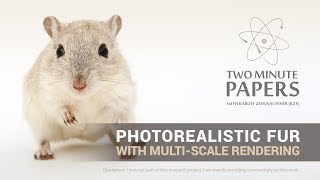
Károly Zsolnai-Fehér presents a rendering technique that simulates photorealistic fur by separating near and far light scattering. A 256 sample render matches quality that previously needed 1,500 samples. The method smoothly switches between scales and includes a free course on light simulation from Vienna's Technical University.
Questions this video answers
August 27, 2017.
Samples per pixel.
A 256 SPP render produces roughly equivalent quality to a previous technique using about six times as many samples.
Chapters
Dear fellow scholars, this is two minute papers with creating a photorealistic image with fur and hair is hard. It is typically done by using light simulation programs, where we use the laws of physics to simulate the path of millions and millions of light rays as they bounce off of different objects in the scene. This typically takes from minutes to hours if we are lucky. However, in the presence of materials like hair and fur, this problem becomes even more difficult, because fur fibers have inner scattering media. This means that we not only have to bounce these rays off of the surface of objects, but also have to simulate how light is transmitted between these inner layers. And initially, we start out with a noisy image, and this noise gets slowly eliminated as we compute more and more rays for the simulation. SPP means samples per pixel, which is the number of rays we compute for each pixel in our image. And you can see that with previous techniques, using 256 samples per pixel leads to a very noisy image. And we need to spend significantly more time to obtain a clear, converged image. And this new technique enables us to get the most out of our samples. And if we render an image with 256SPP, we get a roughly equivalent quality to a previous technique using around six times as many samples. If we had a film studio and someone walked up on us and said that we can render the next Guardians of the Galaxy film six times cheaper, we'd surely be all over it. This would save us millions of dollars. The main selling point is that this work introduces a multiscale model for rendering hair and fur. This means that it computes near and far field scattering separately. The far field scattering model contains simplifications, which means that it's way faster to compute. This simplification is sufficient if we look at a model from afar or we look closely at a hair model that is way thinner than human hair strands. The near field model is more faithful to reality, but also more expensive to compute. And the final, most important puzzle piece is stitching together the two. Whenever we can get away with it, we should use the far field model and compute the expensive near field model only when it makes a difference visually. And one more thing. As these hamsters get closer or further away from the camera, we need to make sure that there is no annoying jump when we are switching models. And as you can see, the animations are buttery smooth. And when we look at it, we see beautiful rendered images. And if we didn't know a bit about the theory, we would have no idea about the multiscale wizardry under the hood. Excellent work. The paper also contains a set of decompositions for different light paths. For instance, here you can see a fully rendered image on the left and different combinations of light reflection and transmission events. For instance R stands for one light reflection, tt for two transmission events and so on. The s in the superscript denotes light scattering events. Adding up all the possible combinations of these t's and R's we get the photorealistic image on the left. That's really cool. Loving it. If you would like to learn more about light simulations, I'm holding a full Master level course on it at the Technical University of Vienna and the entirety of this course is available free of charge for everyone. I got some feedback from you fellow scholars that you watched it and enjoyed it quite a bit. Give it a go. As always, the details are available in the video description. Thanks for watching and for your generous support and I'll see you next time.