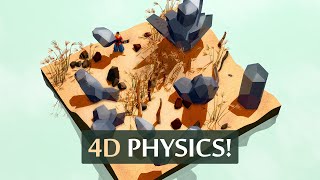
Dr. Zsolnai explains how to simulate physics in four dimensions by using lower-dimensional slices to show how objects appear, disappear, and change shape. A new paper extends rigid-body dynamics, collisions, and friction to arbitrary dimensions, with applications to 4D games and puzzles.
Questions this video answers
Marc Tanbosch.
SIGGRAPH (Siggraph).
Weights & Biases.
Chapters
Dear fellow scholars, this is two minute papers with Dr. Zsolnai. I recommend that you immediately start to hold on to your papers because this work is about creating physics simulations in higher than three spatial dimensions. The research in this paper is used to create this game that takes place in a 4D world, and it is just as beautiful as it is confusing. And I'll be honest, the more we look, the less this world seems to make sense for us. So let's try to understand what is happening here together. You see an example of a four dimensional simulation here. The footage seems very cool, but I can't help but notice that sometimes things just seem to disappear into the ether. In other cases, they suddenly appear from nowhere. Hmm. How can that happen? Let's decrease the dimensionality of the problem, and suddenly we will easily understand how this is possible. Here we take a 2D slice of our 3D world, start the simulation, and imagine that we only see what happens on this slice. We see nothing else, just the slice that sounds fine, Things move around freely, nothing crazy going on, and suddenly, hey, things slowly disappear. The key in this example is that luckily, we can also look at the corresponding 3D simulation on your display. We can see not only the 2D slice, but everything around it. So the playbook is as if something disappears, it means that it went back or forward in the third dimension. So what we see on the slice is not the object itself, but its intersection with the 3D object. The smaller the intersection, the more we see the side of the sphere and the object appears to be smaller or even better. Look, the ball is even floating in the air. When we look at the 3D world, we see that this only appears like that. But in reality, what happens is that we see the side of the sphere. Really cool. We now understand that colliding can create a mirage that seems as if objects were suddenly receding, disappearing, and even floating. Just imagine how confusing this would be if we were this 2D character. Actually, you don't even need to imagine that. Because this piece of research work was made to be able to create computer games where we are a 3D character in a 4D world, so we can experience all of these confusing phenomena. However, we get some help in decoding this situation. Because even though this example runs in 3D, when something disappears into the Aether, we can move along the fourth dimension and find it. So good floaty behavior can also happen. And now we know exactly why. But wait, in this 3D domain, even more confusing new things happen. As you see here in 3D cubes seem to be changing shape and the reason for this is the same. We just see a higher dimensional object's intersection with our lower dimensional space. But the paper does not only extend 3D rigid body dynamic simulations to not only 2D but to any higher dimension. You see, this kind of footage can only be simulated because it also proposes a way to compute collisions, static and kinetic friction and similar physical forces in arbitrary dimensions. And now hold on to your papers because this framework can also be used to make amazing mind bending game puzzles where we can miraculously unbind seemingly impossible configurations by reaching into the fourth dimension. This is one of those crazy research works that truly cannot be bothered by recent trends and hot topics. And I mean it in the best possible way. It creates its own little world and invites us to experience it and it truly is a sight to behold. I can only imagine how one of these soft body or fluid simulations would look in higher dimensions. And boy would I love to see some follow up papers perform something like this. If you wish to see more, make sure to have a look at the paper in the video description. And I also put a link to one 4D game that is under development and one that you can buy and play today. Huge congratulations to Marc Tanbosch who got this single author paper accepted to Siggraph, perhaps the most prestigious computer graphics conference. Not only that, but I am pretty sure that I have never seen a work from an indie game developer presented as a Siggraph technical paper. Bravo. This episode has been supported by Weights and Biases. In this post they show you how to use their system with tensorboard and visualize your results with it. You can even try an example in an interactive notebook through the link in the video description. Weights and Biases provides tools to track your experiments in your deep learning projects. Their system is designed to save you a ton of time and money and it is actively used in projects at prestigious labs such as OpenAI, Toyota Research, GitHub and more. And the best part is that if you have an open source, academic or personal project, you can use their tools for free. It really is as good as it gets. Make sure to Visit them through wnb.com papers or click the link in the video description to start tracking your experiments in five minutes. Our thanks to Weights and Biases for their long standing support and for helping us make better videos for you. Thanks for watching and for your generous support and I'll see you next time.