Pie & AI: Real-world AI Applications in Medicine
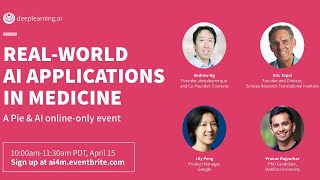
Ryan Keenan hosts Dr. Eric Topol, Lily Peng, Andrew Ng, and Pranav Rajpurkar discussing AI in medicine. They cover real applications in retinal imaging, chest X-rays, and pathology, plus deployment challenges like data scarcity, bias, and the need for clinician-computer science collaboration.
Chapters
Morning or good afternoon or good evening, depending on where you're tuning in from. And welcome. My name is Ryan Keenan and I'm the Director of content here at DeepLearning AI. Of course, I'm not actually in the office right now, but this is the view from my desk if I were in the office. We certainly appreciate you taking some time out to join us for this event, and I hope that all of you and your families are doing well. These are challenging times. Today's event is a live online PI and AI gathering focused on the future of AI in healthcare. AI is transforming the practice of medicine. In recent years, we've seen advances in AI applications for everything from diagnosis to new drug discovery. And with the current pandemic, individuals and teams of AI practitioners around the globe have been working on new ways of doing things, like identifying regional outbreaks as early as possible, or rapidly assessing a patient's condition through medical imaging, or providing database diagnosis when traditional testing methods might be unavailable. At DeepLearning AI, we think of our role as empowering our community of developers and business leaders, people changing their career trajectory, all of you to be part of the AI transformation that's happening across so many industries. In today's event, we'll learn from a panel of experts about how they see the state of AI in healthcare today and how it will transform the future. We'll also be celebrating the launch of our new AI for Medicine specialization, which went live just hours ago. The specialization is a three course series designed to give you, the AI practitioner, an introduction to some of the practical tools you'll need to start applying AI to healthcare scenarios. We'll be presenting a sneak peek into the courses and an exclusive mini demo with the instructors at the end of today's event, so stay tuned. Our agenda today will be an opening address by Dr. Eric Topol from Scripps Research, followed by a panel discussion and Q and a session with Dr. Topol, Dr. Lily Peng from Google Health, Dr. Andrew Ng from DeepLearning AI, and Pranav Rajpakar from Stanford and will then offer some closing remarks and we'll finish with the course demo. We are live streaming on YouTube and we encourage you to post your questions for the speakers in the chat window and we'll be selecting some of those for the Q and A sessions later this hour. Without further ado, let's welcome our first speaker today. We are honored to have Dr. Eric Topol with us. Dr. Topol is a professor of molecular medicine and is the founder and director of the Scripps Research Translational Institute. In addition to being a physician and a scientist, Dr. Topol is also a best selling author. His most recent book is called Deep How Artificial Intelligence Can Make Healthcare Human Again. And we strongly recommend this book if you haven't already read it. It's a great honor and a pleasure to welcome you to this forum today. Dr. Topol. I'll turn it over to you now.
Thanks so much Ryan and Andrew for inviting me to join you Deep Learning AI and plotting your efforts in this whole educational initiative. And especially now getting into the AI medicine healthcare realm. I'm going to try to do a brief, very brief overview of where things are. I'm going to just get the slides to go here and hopefully you can see them. Let's see. Okay. So are they, are they showing all right?
No.
Yes. Okay, good. So I wanted to get in as my assignment was Real world applications in medicine. And of course I'm only going to be about a 10 or 15 minute overview and if you want to go in much more depth, Ryan mentioned the book as well as a review paper ahead in Nature Medicine. And the first point about this is that the data for each individual, each human being is now overwhelming. And this of course is really tax the ability for any healthcare professional to get their arms around understanding any human being. It's not just of course the genome as was depicted by that nature cover, it's also the physio because we have sensors that are getting continuous data wearables from almost every system in the body. We also have the gut microbiome which has got the ability now for metagenomics to understand that we have private species that is sequenced of various Microsoft biota in each of us. So these are just some of the layers that make each of us unique, truly unique. And of course that pairs well with this whole drive towards individualized or precision medicine. So these many different layers that can be defined for each person generates an extraordinary amount of data. I only touched on a few of these layers and this is that deep phenotyping which will allow us to do far better than we do today in preventing illness as well as managing the illnesses that people get over time. And just to point out that we are now exceeding the 27 zeros of the yottabyte and there's still a contest to name what is the next unit. Hellovabytes has been nominated. I think that's probably a good one. But the point is that we're overwhelming data and healthcare medicine is a big part of the reason for That I want to summarize a whole body of data about why we need a new route. That is the AI route, because we have a problem with outcomes. Part of that is because of the data flood. It's very costly, not just in the US of course, but all over the world. There's a very substantial error rate. 12 million or more diagnostic errors in the US alone that are serious. Lots of waste, a lot of extra testing and procedures that are done unnecessarily, very little time with patients, and there is a lot of burnout. It's a global epidemic among healthcare professionals. The quick answer about how AI is going to affect medicine is that there's no specialty that's spared from potential benefit. And this includes not just the medical specialists, but nurses, pharmacists, paramedics, palliative care, everyone. And it also is across the entire health span from what we have today, which is a very crude selection of embryos that are used for in vitro fertilization, which is now being advanced through AI to understanding why people die suddenly unexplained or predicting their course in the hospital. It's across the entire human health span. Now we're talking about applications that are medically relevant. This one is not medically relevant, but it tells the whole story in a way of the exciting potential. It's work from Google, Lilly Peng's group, who you'll be hearing from in a few minutes. And the point about this is that if we show a retinal picture to experts, that is ophthalmologists, and we ask them, is this a male or a female retina picture, the chance of them getting that right is 50%. But a deep neural net can be trained to show 97 or 98% accuracy. There are indeed better ways to determine gender than a retinal picture. But your point is how the powerful way of using hundreds of thousands, if not millions of images to see things, if you will, that human experts can't, and that gets to a real world application is the chest X ray. Because a lot of work that's been done by Pranav and Andrew about the chest X ray. But the point being is many things are missed, as was shown in this paper, where there was a cancer that was missed in the review by the radiologist that was picked up by the convolutional Neural Network. Mammography is another big example. Mammograms have lots of false negatives and false positives. This is the largest study to date from nyu. Massive study of over a million images with A very good accuracy rate. And this is something that we welcome because so many women who are having mammograms done frequently are given the wrong results. And this hopefully will make a big difference. But beyond just the accuracy, it's also about getting the scans done with better quality, that is sharpening the quality in a much less time. And this is some practical advance that's already FDA cleared. There's now a few of these different companies that have taken images, whether it be cat scans or MRIs, and make that so much quicker and better quality images from using neural networks. An example just from yesterday this week is from cardiac magnetic resonance imaging. And the fact that this could be done so fast, almost in real time interpretation is astounding because normally this would take potentially hours to be able to process. Now, this perhaps is amusing. This is the smart toilet that was just published earlier this month from Stanford, and the smart toilet that has all sorts of cameras for stool and for urine. And a lot of people reacted to the anal print scan and another sign of our unique fingerprints, if you will. But I thought this was interesting because when I tweeted about this very impressive paper, the person who I thought was interesting to respond was Yann Lecun, who, as you know, invented the convolutional nets. And he wrote that they're going down the toilet for the good of humanity. Literally, not figuratively, but it's really interesting. The medical applications of that are not yet known, but the triumph of being able to have real time monitoring of urine and feces as they're being delivered in the toilet is pretty astounding. Now getting back to more common things are skin lesions, particularly those that could potentially be cancerous. And Andre Esteva and a group at Stanford did the first major work published in Nature. And the point that there's been many studies now that have shown that you can set up a neural net to have very high accuracy determination of skin cancer from photos and even smartphone photos. But there is no app yet available for consumers to be able to preempt the need to go to a dermatologist or know when they should go for having a biopsy. Hopefully that will be soon. Pathologists have had the potential for great advances because not only can neural networks be trained to recognize cancer, which is often debatable among expert pathologists, but even to be able to determine the driver mutations and the chromosomal abnormalities from the path slide. So this is really exciting to be as a boost for pathologists in getting high quality readings. Now, my favorite technology that I Use in every patient I see as a cardiologist is the smartphone, ultrasound, smartphone echo. And then I bring this up is it delivers exquisite images. What you see here is the heart. Within seconds of seeing a patient putting the probe on the chest, this is the image that appears on my smartphone. It's the heart, everything about the heart. You can see the chamber size, the thickness of the heart muscle, the valves and the everything. And you can even track the blood flow, which is quite striking right on the smartphone for the patient and share it with the patient. Now the reason this is so impressive is that now this can be done without any expertise. Recently I had my 6 year old grandson working on this. Anyone can do AI acquisition and then you can get interpretation through an algorithm. So there are now many companies that are doing this where as soon as you put the probe on the chest and rotate it with guidance, AI guidance, you get an image that is automatically captured, the video image and you get the results here. The ejection fraction measurement of the strength of the heart's contraction. Now why is this so important? Because AI then can be taken with a smartphone to image any part of the body except the brain anywhere in the world. And that's being done in fact in Africa. These are pictures of using smartphone ultrasound to diagnose pneumonia and many other conditions. Now this is especially striking because a lot of fine work that's been done in AI and medicine to date has been for colonoscopy picking up the lesions that are missed, the polyps, the flat, sessile, diminutive polyps that are frequently missed by gastroenterologists that can be cancerous. This video from Japan shows not only picking up the lesions, but also using neural nets that were trained to tell whether it's likely to be cancerous, which helps guide whether a biopsy should be done or not done. With every biopsy there's a small risk of perforation of the colon, so unnecessary biopsies need to be avoided. The eye has had intense work, as I mentioned, with the retina, but also all eye conditions with AI there's really no eye condition that there hasn't been some work at this point. It's really striking. The ophthalmologists have been very aggressive in pursuing AI application. The one from yesterday was in the New England Journal and it was about detecting a swollen optic disc, which is a very serious condition that could lead to blindness and can be missed. And here you see is that centers from all around the world data to find very high accuracy algorithmic determination of PAPILLEDEMA So that's exciting because that may help emergency room doctors in the future and non ophthalmologists in picking up a condition that otherwise could be missed. Now speaking of the eye, the work that Lily Peng and her team at Google eventually led in diabetic retinopathy to now have this available in supermarkets. This is the ability for a person with diabetes who normally half of them would never get screened for diabetic retinopathy, now can just have their system that's been approved by the fda. It's the subject of a randomized prospective trial to determine with high accuracy whether or not a person has diabetic retinopathy through an AI algorithm. Doesn't require an ophthalmologist, doesn't require even a doctor. So it's really a pretty nice advance then One other thing I wanted just to mention about the real world medical applications is related to intraoperative diagnosis of this is the case of brain tumor that is demeaning train. This is now multi center involving UCSF and many other centers in the U.S. but the fact that a diagnosis could be made in two and a half minutes rather than a frozen section having to be reviewed by pathologists in 30 minutes with very high accuracy. Also the ability to pick up kidney injury before it happens. This is work from DeepMind published in Nature. I had the accompanying editorial and while it's not prospective study, it has considerable promise to prevent the need for dialysis, kidney transplants and all sorts of other morbidity associated with not being preventing kidney injury. I did want to mention the use of voice processing of the conversation of a visit to avoid the keyboard for the clinician because this is a really important area, perhaps the most immediate transformative area because keyboard data clerk function is very much a burden for all clinicians and for so many different large tech companies and startups are working on this and making tremendous rapid Now I just want to close with the fact that there's very minimal seven randomized trials that have been completed and reported and as you see here, five of them are on colonoscopy. Six out of the seven were done in China. Only one has been done outside of China and was done in the Netherlands. A small study recently reported in JAMA for intraoperative blood pressure. So there's very positive data from the most rigorous type of clinical trials. The second most rigorous category are prospective trials which we embrace. I mentioned one of them which was the diabetic retinopathy that led to that ability to diagnosis in a supermarket or a drugstore but there are a limited number, even of those of prospective trials across, as you see, six different disciplines of medicine. So my colleagues and I reviewed this 81 studies of AI in medicine, only 10 randomized trials, of which many have not even yet been published. And a lot of bias was found. Very few prospective studies, as I mentioned. And so we need a lot more work on this. AI still in medicine is relatively early state. And as I'm sure Andrew will review subsequently, the last point is about the virtual medical assistant. We can do this, but it isn't possible really with what we do that the models, the algorithmic potential we have today, we need hybrid models. We need to go beyond deep neural nets to be able to bring all this data together in real time, giving feedback to the person, the individual, as well as to clinicians. So our last summary is the bottlenecks that we face first is we don't have very many large, diverse annotated data sets. We need more of those. Unless we are able to make a faster transition to self supervised learning, we don't have many prospective trials, as I've emphasized, we don't have enough deep collaborations between computer scientists and clinicians. And hopefully this is the sort of forum that will help foster that. We'd like to see a lot more implementation. And we also have to acknowledge that there has to be continuous surveillance because these algorithms, these neural nets are subject to nefarious interference, adversarial attacks, as well as just the usual kind of glitches that can occur in software. So these are a lot of people that could be potentially harmed if we don't keep tight surveillance. There needs to be new and hybrid models for this multidimensional data. So the last thing is a quote, which I hope is one that can leave you with for our further discussion. Machines are not going to replace physicians, but physicians using, and this is clinicians in general using AI will soon replace those not using it. So let me stop there and turn it back over to Ryan.
That was fantastic. Thank you very much, Dr. Topol. It makes me think that while people say AI for healthcare or AI for medicine and it sounds like a neat and tidy thing, it's actually this entire space that has so much, so much diversity, both in the kind of problems you're trying to solve, but also in the kind of solutions that might be possible. So thanks very much for that. At this point, we would like to continue the conversation by welcoming our other panelists for today. We have with us today Dr. Lily Peng, a physician, scientist and product manager for Google Health, we have Pranav Rajpurkar, who is a PhD candidate at Stanford University and one of the instructors, or rather the instructor of the Deep Learning AI's new AI for medicine specialization, and Dr. Andrew Ng, who is the founder of DeepLearning AI and co founder of Coursera. So to get started, I'd like to just ask those who haven't spoken yet to give a little introduction to themselves. But in addition to a brief introduction, any reaction or perspective on what we've heard so far? So I'd like to start with you, Lily Peng.
Hey everyone. So I'm Lily Peng. I'm a physician by training and product manager by day at Google. Thank you, Eric, for such a. It's actually I've been working in this space for a little bit and seen all the amazing things kind of summed up in 20 minutes. I don't even know how he did in 20 minutes, to be honest, because there are so many exciting things here. I did want to clarify one point, be a little sheepish about this, but our device actually does have approval in the eu, but not in the us. So the device that has been approved is by idx, another company. But I think the general frame of thought, which is there was a robust study behind that product that was prospective in nature and that AI is actually trying to make this transition from these really amazing research demonstrations to things that can actually impact patients right now. I think that is a really critical point and that that transition has been difficult for lots of these projects. And you know, we're learning why as we kind of stumble along or feel our way along here. And I think, you know, both the medical community as well as the machine learning community has kind of a lot of really interesting work ahead.
Thanks very much. Lilly Peng, Pranav Rajpurkar, could you give us a little introduction and perspective? Hey.
Hi.
Great to be here. So my name is Pranav and I am currently a 5th year PhD student at Stanford, where I'm advised by Professor Ng. And my work in my PhD has been at the intersection of artificial intelligence and medicine, which is a very exciting area, as Eric's presentation aptly summarized. And I couldn't agree more with the challenges that we're facing from both a perspective of translating a lot of these algorithms from the lab setting where we know they're doing really well, to the clinic where they'll have an impact on patients. And on the other side, we also have fundamental machine learning challenges that need to be overcome to make that transition possible. And I think one of the, One of the most, one of the most necessary changes that needs to happen to the field, which is already happening, is we need a lot more people to be, to be working on it.
All right, thanks very much for that perspective. Andrew Ng, could you give us an introduction and perspective?
Just a couple of quick thoughts. I think the world is going through trying times and I feel fortunate to be able to sit at my home, where I am now and where I see many of you are now, to listen to Eric and Lilian Pranav chat about healthcare. A couple of quick thoughts. I'm actually a huge fan of Eric's book. If you haven't read it yet, you'll heartily endorse it to anyone interested in AI. And that's a very humanistic approach to the problem while having a realistic eye on what the technology can and cannot do. I don't publicly endorse a lot of books, but this one I think is actually worth a lot of people to read. And I think we live in exciting times. Those of us that work in tech are fortunate that even while we're shouting at home, we can get online, listen to videos on YouTube, sit home and write code. And this is a moment even before the pandemic. I think many of us have felt that medicine needs more AI people to jump in and help. And maybe the pandemic has only punctuated that point. And I think working at medicine right now, a lot of the conversations I have in medicine remind me of the conversations in computer vision almost 10 years ago, or the conversations in speech recognition even a little bit before started working computer vision, where it feels like there's something there. A lot of papers that show a lot of promise. It's not as widely deployed yet as we wish, but it's really exciting. And the inside is maybe people like some of us on this call see enough of the progress to have conviction that it'll be huge. And maybe just leave you with one thought. To a lot of the AI community, there are a lot of things you could be working on. Hopefully you work on things that are meaningful and move the world forward. But if I look at the crazy amount of effort that some people, including me, have worked on advertising, the amount of completely insane systems were built to serve more relevant ads, it's not the most inspiring work I've done, but just the crazy data center hardware, the crazy complicated neural networks and other architectures, the custom databases. When I look back at some of the work I participated in, I feel it's just insane. The amount of effort we put in. And guess what? Healthcare is a much bigger piece of the world, much bigger human impact. Also much bigger piece of the economy than online advertising. And I think we're just in the early days of using machine learning, deep learning AI to help an even bigger piece of the economy and of society undergo that transformation. So these are very exciting times.
Thanks very much. Yeah, indeed. Very exciting times. What we'd like to do now is take the next 20, 25 minutes or so and I'll be asking some questions of our panelists. And while I will be directing my questions to a specific person each, I'd like to encourage any of you on the panel to jump in and offer your own input on the conversation. So I'd like to start with a question for you, Lily Peng. So I come from a family with a number of healthcare professionals, and I feel like I have some visibility into that world.
I've sort of.
I'm able to witness them talking shop. And now that I've been living in Silicon Valley for a while, I have friends and colleagues in the AI space. But I get the sense that there are relatively few people who can really exist in both spaces who sort of span that gap like you do. So clearly. So I'd like to get a perspective from you on being a physician and a scientist, as well as product manager at Google and author of many papers in the AI for healthcare space. For the audience we have gathered today, many of whom might be interested in finding their way into AI for healthcare, AI for medicine. What can you say about the current challenges in the field and really the opportunities that exist right now for someone looking to get into the space?
Oh, yes, that's a good question. Also somewhat loaded. Yeah. So I think one of the really interesting things, reflecting on being kind of, I think one way of framing my job is as someone who kind of can function in both worlds, right? And function in the tech world and also function in the healthcare world. Another way of framing it for me for a long time was feeling fish out of water in both worlds. And so the joke was I felt like I was a penguin waddling amongst other birds and feeling like, you know what, I can't fly like they do. And I, like, look ridiculous because I'm just waddling and then at some point realizing that I was in the wrong medium, that I, you know, you look at the fish and they're swimming and they're like, you know, awesome and, you know, having fun in the water and you're like, you know, I was actually in just in the wrong context. And that if I actually. If you ever see a penguin in a zoo and you see them swim underwater, it's amazing. They're majestic creatures underwater. They just look ridiculous on land. And so I think there are other folks who probably are a little bit like me, where they've grown up in one cultural context or like. Like, for me, growing up in medicine, but really think about connections connecting to other places. And I would imagine a lot of folks who are taking this course kind of maybe feel a little bit like that is that they have a strong, rich history and one discipline, but they have this curiosity and this idea that if you can pull or push innovation in another area, that you could actually do pretty amazing things by combining the two. There's like a meme, you know, why not both? And, you know, that's kind of how I think we kind of get started. I got started. And I think the other thing is that the more I've been kind of part of this. This journey, I guess if you want to call it that, is more. I found other penguins, actually, Dr. Penguin, but I found tons more other folks who kind of felt the same way. And I think that encouraging these other folks to actually, you know, dive in, literally, and. And really try to, you know, bridge these. These gaps and these differences culturally as well as, you know, linguistically and. And just even the way that we approach problems, I think bridging that is going to be pretty critical going forward.
Thanks very much. That is a really interesting metaphor. I can totally visualize what you're talking about with the penguin on land versus the penguin in water. A question for you, Eric Topol. You have been writing for quite some time about how the digital revolution will transform healthcare, and more recently, how AI will transform the field. I'd be curious. When did it first become apparent to you that this transformation was coming, and has it unfolded the way you expected, or are things already quite different from what you'd imagined?
Oh, that's a great one, Ryan. I think it's been clear over the past decade that medicine wasn't making the change from an analog to digital world. Anything that had occurred and which has been such an abject failure was the electronic health records. And so while that's been going on and seeing all these other ways to understand each person at levels that are unprecedented. And the problem we were seeing was accumulation of data that was basically being stored. And so now we have the ability to deal with that. And the problem that you're getting at is that the medical community is very Resistant to change. I've used the word sclerotic or ossified. And the problem we have is that here we need change and we haven't had that much. I mean, the implementation has been minimal. Mainly it's been about radiology algorithms that are helping images, but not very much. So hopefully the threat of the change, the loss of control, the willingness to embrace digital technology, even though the first foray of that with electronic health records has been so bad. But hopefully we can make it up now with the good things that digital and AI tools can bring to the clinical community.
Can I jump in? I know it's strange. Eric's a great doctor. I'm a computer scientist, not a doctor, but I feel like I want to defend the medical community a little bit almost. I know doctors can be resistant or often are resistant to change. I think a lot of people are, well meaning, doing the best they can. And I sometimes see the gaps in our work as computer scientists in not stepping in to manage the change management process. And if you look at the great AI companies like Google or Baidu, where I led teams or even others, all the great AI companies, frankly, Google was very resistant to deep learning 10 years ago and there was a big change management process that had to be. We implemented at Google where we ran pilot projects. When I was leading Google Brain, my first project was speech recognition. It wasn't web search advertising, and speech was a much smaller thing back then. And only by using deep learning to make speech recognition more accurate, then got to maps, use computer vision to read the house numbers, OCR to more accurately locate houses on Google Maps. And only after those first two successful projects, then we had enough internal momentum, enough allies for me to start a more serious conversation with the advertising team. So I feel like, yeah, people are resistant to change, but most people have forgotten, frankly, how hard it was even within Google to build up deep learning. And that's a pro and con. I think change management is hard, but when you could do it, you can actually get huge organizations with a lot of momentum and, and I feel that I, as a computer scientist, I want to try to make sure I do a better job with that change management process, even in the healthcare system.
If I could just come back because I enjoy the point that Andrew's making, but Andrew and Pranav are associated with one of the most progressive medical centers in the US at Stanford, probably the best imaging AI center. And so they may not see what's going on in some of the other places. Now I use the stethoscope as our marker. The stethoscope has been around for 206 years. It's a rubber tubes analog and, you know, no one can agree what anyone else is hearing. But it's used still today as the icon of medicine. Here we have a smartphone ultrasound, which hardly anyone uses. And the point is, is that the willingness to change now, sometimes it is tied to tradition, sometimes it's tied to reimbursement, loss of control, educational needs. But there has been a slowness that because Ryan's point was, did I expect more to occur in this decade and relatively little has changed. So I'm hoping your point, Andrew, about change management. I hope we can rev it up.
Yeah, very fair points. Yeah.
Yeah.
Fantastic. I'd like to, speaking of Stanford, ask you, Pranav Rajpakar, you're currently a PhD student at Stanford and you this is, as mentioned, the university, which is world famous for its healthcare departments and facilities, as well as the AI research being carried out there. You're sort of bridging the gap between these two areas at Stanford. I think it'd be exciting if you could talk a little bit about the kind of cutting edge stuff that you and your colleagues are working on at Stanford right now, like what's going on at the premier university in the space.
Sure.
It's a really exciting time for research in the space and we have a large group of both ML experts and clinicians that are hard at work solving a bunch of exciting research problems. And everyone's motivated by this goal of having these algorithms be used as part of clinical care. And that's driving a lot of research questions we're tackling right now. And to maybe share one particular example, one of the applications we've been working on is looking at the use of AI for interpretation of chest X rays. And we think a lot about the challenges to bring this technology in the hands of doctors. And of course, part of the challenge is logistical in working with data that is siloed off in IT infrastructure and in regulation, in rigorous quality control. But part of it is also on answering very fundamental technical research questions about medical AI. For example, our group and other groups have demonstrated that chest X ray algorithms can perform as well as human experts in control settings. But we're interested in how these algorithms are going to perform in new patient populations. As a very concrete example of that, chest X rays that are trained on American data sets are not typically trained to detect tuberculosis or tb. But that might be one of the top conditions that these models need to detect in countries like India, where The TB burden is high and chest X rays can be just a valuable tool for screening. This is just one in a long list of examples of these challenges we're facing in translating this technology going forward. I like to think of it as so much of medical AI technology is on training wheels and we've got to just remove the training wheels one by one. And we're trying to make it possible for others to build on a lot of work that we're doing by making the data sets we're building publicly available and getting the broader and growing community thinking about these top challenges around how we can reduce the labeling time and the expert time required for building these models, how we build machine learning methods that are not going to break, and how they're going to interact with clinicians going forward.
Thanks for that perspective. That's fantastic. I'd like to follow up again with you, Lilly Peng, about what you already started describing as this kind of communication bridge that the space that you've been working in in both healthcare and AI and tech. I've noticed that you published articles with titles like how to Develop Machine Learning Models for Healthcare or another one called how to Read Articles that Use Machine Learning. And it sounds like maybe the first one would be for people that are more in the AI space looking for how to apply those models to healthcare scenarios, and maybe the latter would be for people in the medical space trying to understand what. What it means to have a machine learning result in a paper. So I'd love it if you could just talk a little bit about what it means to bridge that communication gap and what are really the biggest challenges in facilitating effective communication between the two communities.
Yeah, yeah, absolutely. So kind of just riffing off of what Pranav said, you know, the critical. There's a very critical piece of, you know, translating AI into actually real inpatient impact, where clinicians and ML scientists have to actually work together and really work toward a common goal. And one of the things that I've noticed is that as I pointed out in the beginning, culturally we're very different in computer science versus medicine. I mean, they're both sciences, so to speak. But the way that we handle things are very different. It's almost like two different cultures, you know, France and China. Right. Because you know what, the way that we think about even scientific, let's say, scientific disclosure. Right. So let's say in computer science we leverage preprints a lot and then we do conferences. Right. And that's just normal. And having this discussion on Twitter and kind of public Forum is encouraged. And in medicine we don't do that. We say we do peer review ahead of time. We kind of have. The experts can talk about it before dissemination to the public. And in fact, dissemination to the public is actually before peer review is a huge. No, no. Right. And the way that we think about publishing has been so different on either side that it almost felt like I needed to write a guidebook in Chinese for people visiting France and people. And something in French, a guidebook for people visiting China from France. And so I think of those things as sort of like tour guides of like, hey, you know, if you wanted to bridge into this culture, what do you need to think about? Roughly? And vice versa. I think my team had also kind of saw this need. So really I kind of helped here. But it was really written by a couple of scientists that have also seen this big problem on my team. And so I think that bridging those things are actually pretty critical. But what's really important is the motivation for people to want to bridge that. Right. So I think going into another space is hard. You will feel like fish out of water or penguin out of water or whatever. And so the willingness to learn that and the willingness to be wrong and engage people when you're like, you know what? I don't have the full context here for this problem. You know, like the context for the chest X ray problem in the US Is very different in the context of that chest X ray problem in a different. Like, you know, in India, for example, and being willing to engage and have dialogue about how do you improve your models or. Or how this models might. How do these models might improve the way that you give care. I think is that motivation is actually key. And so we publish these guys to help people who are motivated. But I think events like this, courses like this actually really help with the motivation piece.
That's very interesting. I'm thinking about how I relate to this because I have a brother who's a pathologist actually. And I've, you know, since. Since I've gotten into the AI space, I've been asking him, so what, what are the data like that you're looking at? What, what? And he starts getting into jargon and stuff. I'm like, is it text, is it numbers? You know, I'm just missing some basic communication there.
But.
But I'm trying to understand better what he's working on and how it relates to kind of thing.
Yeah, I mean, it is. It's like a foreign language for most folks. Right. And I'm sure, if you explain what you're doing to him. He's like cnn. You mean like the news station, you know, so. Yeah, there's a lot of things that get missed, even between brothers.
Right.
Well, I'd like to follow up with you, Andrew Ng, on something you started talking about previously. But why, why is it that someone should jump into AI for healthcare? This is something that you've done yourself as an AI technology leader. Why did you jump into healthcare and why should someone else?
Yeah, so why did I do it? Many years ago, I looked at applications of AI and tried to pick what I thought would be meaningful sectors where we could make a lot of progress. And after listing a bunch of sectors, which includes climate change and a few other things, I decided to put a big effort into healthcare because with the digitization of society and Eric mentioned the rise of electronic health records in the United States because of the Affordable Care Act, a lot of your medical records are now more likely to be Digital compared to 20 years ago when it was a piece of paper in the United States. Your X ray is much more likely to be a digital image now rather than a physical piece of X ray film. This is actually less true in other countries in developing economies. But the data is there. And we see so much data just sitting around in all of these systems, EHRs and other systems, and the insights are ready to be mined, ready to be derived. We can help patients. The data is just sitting there and there's no human or piece of software looking at it. So in terms of being AI ready, healthcare feels like it's there. And so just from a macro societal trend level, this seemed like a good sector. And I think if you look at what the AI community has done, I think we've transformed the software Internet industry. All of the large consumer software Internet companies are using machine learning and deep learning in decently sophisticated ways ways. There's still more work to be done and so a lot of work to be done. But I think the biggest untapped opportunities for AI now actually lie outside the software Internet sector. Although. Although of course, large software Internet companies are also moving into these other industries. I think for us to continue to lead the way, we have to figure out applications of AI outside consumer software Internet. So that was the societal trend level. And I think those arguments apply equally well today as, as well. And then at the more micro level, I think in hindsight, I was really fortunate to have met some great doctors that were curious about AI and they were patient enough to answer my stupid questions about healthcare at Stanford. I remember we got together with some great collaborators like Kurt Langlot, Matt Lundgren, and they were kind enough to answer our really stupid questions about X rays, teach us how to do simple X rays, phrase working with a colleague at Irhythm, Masahak Pananini. And I read a couple books myself on how to be ECG. So today I can read ECGs really badly. You don't want me doing it, but I actually spent a bunch of time, again, I can look at the squiggle and kind of tell what's going on. So having great partners to help me bridge medicine and AI, as Lily was alluding to, was really useful. And the first few conversations we got together with Matt and Kerr in the coffee shop, we sat down over coffee, we introduced ourselves and said, what do you do? Oh, well, we have this crazy new technology called deep learning. And what do you do? Oh, we look at X rays. And it was those nascent collaborations that allowed us to learn about medicine. And over time, a lot of my collaborators. Recently one of my collaborators, Jeannie Shannon Perth, she is running around giving, teaching other people AI. And I thought it was great. I'm really proud that one of my doctor collaborators, a great pathologist at Stanford, she's now teaching other pathologists about AI. One thing I wish I had four or five years ago when doing this was I actually really wish if four or five years ago, if I wasn't searching online for a book on how to read ECGs and try to figure it out myself in a very raw way. Frankly, if the AI for medicine specialization had been around four or five years ago, I think my life would have been much easier. But I think I was fortunate to set up great collaborations and then start to write papers, gain momentum and then keep doing this back then. But I think it still feels very early. I think we all have conviction that this will be a big sector, maybe even larger than online advertising. I hope even larger than online advertising. But it is still much smaller today. But the future looks very exciting.
Wow. Yes indeed. Sounds very exciting to be in space right now. I'd like to follow up with you, Eric Topol, on your book. The subtitle is How AI Can Make Healthcare Human Again. And I think most people would probably assume that AI will actually make healthcare less human somehow by placing certain functions of a human doctor. So for anyone who hasn't read the book, what do you mean by that? And when did healthcare become inhuman? And what can AI do to bring.
Back the human element? Well, that's my favorite question. Ryan, so thanks for asking it. The key point I think that most people miss today is the degradation of the human element in healthcare and medicine. The point being is that in a few decades that we've gone, since the 80s, we've seen less and less time between a doctor and patient. Less of the laying of hands and human touch because of time constraints and the shift towards being a data clerk and being squeezed to see more patients and very much leading to this global epidemic of burnout and depression and even suicides among doctors and nurses. So to me, the greatest contribution that AI can make. While we want to see accuracy improved and speed and proficiency and efficiency and all those things, but what we can do is actually bring in the human, bring back the human side of medicine. It's been degraded terribly. But if we can get the gift of time, which I think is the most overarching goal here, if we can reestablish that, get medicine to where it should be, we will see a total different change in the morale of the medical community. And patients will feel that they're being looked after and they'll have that trust and presence and the bond that we used to, of course, was a precious part of our lives. So that I think is something we shouldn't lose touch with. And that I think it gets back to Andrew's point about the humanistic side of AI. This is a far reaching potential and it's extraordinary. And if we don't miss that, and that's why I encourage anyone in the field of AI to divert their attention to medicine and healthcare. It needs a rescue mission. And these other areas like finance and online advertising and you know, social media, all those things are trivial compared to what is at stake here. So I hope that we'll get, we need the talent, we need the human expertise to bring this to life.
That's very exciting. Hopefully a lot of people online are finding, getting a lot of great information and finding that inspiration to figure out how to, how to get connected to this field. I'd like to ask you, Pranav Rajpakar, we've mentioned the AI for Medicine specialization a couple times that is launching today. You designed it, you're the instructor. It seems like as we've heard, there are just so many things that you could be talking about when you're talking about AI for medicine. So how did you actually go about choosing what to focus on or what to use as the examples and assignments in the course?
Yeah, that's a great question. And we read a lot in Professor Ng's lab At Stanford, I was fortunate enough to spend my time as a PhD student studying AI for medicine and collaborating with many clinicians in the medical school and learning about and tackling research problems at this intersection. And when we were working on these research problems, it became clear that there were special ML toolkits that were necessary to successfully employ them to solve medical problems. But these were not covered as part of any machine learning course. And I had the opportunity to mentor students at Stanford and research coming out of many of these ML courses and through that experience got to see this the skill set which students would pick up or need to pick up over the period of time as we work through these challenges of medical tasks and data. And part of the motivation for the course was the realization that this learning could be systematic and enable a much larger set of machine learning practitioners to be able to apply their skillset to medical AI. And so when we were designing examples to include, we were selecting problems that were really representative of the skill set or the technique required for a certain problem setup, whether that's diagnosis, which we covered in course one, prognosis in course two, or treatment and information extraction that we covered in course three. And so we designed these learnings into the course, just making the exercises and content as close to the real world setup as possible. And so in the course, we're going through building models to identify disease from medical imaging, predicting the future course of a disease from lab values, looking at estimating the treatment effect on individuals, extract labels from text, among other things. In fact, some of the assignments that we have in the course would have been novel research projects not too many years ago. And so we believe that the skills that we're covering the course will be relevant and fundamental even as the field evolves and advances.
Excellent, thank you for that summary. At this point, we would like to turn to answering some questions that have come in online over the time that we've been speaking. And so we'll be going in no particular order, but some of the questions have been shared with me already. And so I'd like to take those questions and pass them to one of you. But also, again, other panelists, feel free to jump in, I think. One I would like to ask you, Lily Peng, the notion of explainable AI seems like it really is important in the field of AI for healthcare because people don't want an algorithm that's a black box making decisions about life and death or other very important things. So there's a question that came in about how can explainable AI be helpful in this Area.
Yeah, well, explainable AI is really critical to this concept of doctors working with AI. If you can't, it's like any of any team, teams that do not communicate. Two people who are trying to work together but do not communicate, thinking with each other, it means worse results for a patient, et cetera. Right. So if you have two physicians and they're tag teaming on a patient, you want them to be able to explain how they arrived at the conclusion to each other. And so it's not that different. I think in this case that I think the system, the AI system isn't off the hook. It should be a good partner and should be explaining. There are a few ways of doing this. One is to explicitly talk about how in a paper how something was trained, what was the training data. And that's why understanding how a algorithm was trained, that context for that algorithm is really important. But that being said, also being able to say, hey, here are the relevant pieces. Information that was used to arrive at this conclusion will help you kind of look at that chain of saying, okay, well this, well this was an artifact and so therefore it shouldn't have been used. And so yeah, this is I think critical in many ways. And even, even lab tests, like if you think about lab tests that we like let's say a pregnancy test right there. There's actually a lot of literature behind how these lab tests I know for some folks may feel like a black box, but there is a, like there's rationale behind how things work and why they work well. And that's actually freely available to people if they want to know. And so like any good test, I think that explanation portion is pretty critical.
Thank you for that. That makes a lot of sense.
Actually, can I tell a story about. Oh, quick story about expanded AI? I agree with everything Lily said. I've been very surprised at the needs of expanded AI. So quick example, I was once working with colleagues Anandavati Nigam Shar on on reading EHR for palliative care recommendations. So look at the electronic health record, see if a patient is at high risk of mortality and if so, recommend them for consideration for palliative care. So build a learning algorithm. And initially the doctor said, what is this? How can you tell me this patient has a high chance of mortality? I don't trust this algorithm. I need an explanation. So Onan generated an explanation based on the feature analysis and algorithm like line for those who familiar with that based on these features. This is why we think these patients should be important, should be considered. So the Doctors looked at, they go, oh, that's interesting. Okay. And then far as they can tell, they never looked at or cared again about any explanations and we just stopped bothering to print it out. So that was very interesting to me that they needed the explanation not for day to day decision making, but they want to look at it to just gain faith that whatever we were doing was reasonable enough. And then the doctors, Steffi Harmon and the collaborators just trusted their own judgment that they didn't really care why we recommended certain folders for them. So I think explanation is a very important sector. The discussion explanation sometimes gets really confusing when we lose sight of the purpose of the explanation. So when I built explainable AI, I often chat, step back and say, all right, what's the purpose of this? Who needs this information? And then that clarifies the path forward and the solutions. Explain something to machine learning engineer versus to just reassure someone we're being reasonable or to help us find that there's a problem or to help people make day to day decisions. Those techniques are actually very different and there's this huge bag of techniques that's gotten mushed together and explainable AI and I think we need more clarity separating them out for the different purposes.
Yeah, I agree, that's such a good point. I actually can even think of another thing to add to that, which was just finding new features that are relevant in the algorithms that we're making, showing that this is actually more accurate in Prognosis, for example, and then doing the explainable AI to actually figure out the features as a way of scientific discovery. Is it yet another way that we use external AI that's very distinct from the other ones? So yeah, I think being more clear about what we're using it for is. That's such a good point.
Thanks. That seems like it could be the topic of a much bigger discussion. I'd like to ask you, Eric Topol, the question seems to be at the top of a lot of people's minds right now, given that we're in the middle of a pandemic, is what are the advantages of AI in a time of a pandemic like this Covid situation we find ourselves in right now.
Yeah, I think it's actually extraordinary how AI could play a big role going forward. So firstly to point out that we're looking at at least a year and a half, if not two plus years of cycles of this pandemic where unpredictable places around the world will start with an outbreak. We already know it's been shown in the US that Having a smart thermometer can be a way to localize where an outbreak is going to happen before it starts to really spread. And there you can get in and start doing testing, isolation, contact tracing, all the things that are the best practices of prevention of an outbreak. So that is the first step, a smart thermometer. But also we launched an app detect study where smart watches, I.e. fitbit and Apple and all these smartwatches, we can capture their data and we've learned that resting heart rate can predict, we saw food better than the CDC model and we think it will work well for COVID 19. The other things, of course, is many digital ways for surveillance, which will help guide testing. Because right now the whole idea is, oh, we got to test everybody. Well, that's a little hard to do in countries like the US where there's, you know, 330 million people. We can't. We can. We can hardly test anyone for the first two months after this arrived in the US by community transmission. The other thing I'm really excited about with COVID 19 and AI is the whole idea that we keep people out of the hospital. And just yesterday in the Wall Street Journal, there was a report of hospitals in the country that are already keeping their patients at home on these devices that did continuous vital signs. And that sounds really good, but the problem is they don't really have algorithms yet to prove that it's safe. And we need to show that because we know that certain people with this virus can have sudden collapse and we don't really have it validated yet that you can use this as a way to keep people out of the hospital. We need to do that. Keep people out of hospital. People don't want to go in the hospital, but we also want to make sure it's safe. So these are the things that I think are extraordinary opportunities for us to. For the AI community to really help detection as well as management of patients.
That's very interesting. I don't think, at least I hadn't ever thought about the possible importance of not just convenience, of being able to stay home and monitor yourself rather than be at the hospital, but actually the critical importance of that in a situation like we're in right now. Pranav Rajpakar, I would love to follow up with you on a question that came in that is around what are the best resources to stay up to date on all this stuff? It seems like if you just from what we've heard so far in this forum, there are so many things going on, so many directions you could go. What could you recommend in terms of blogs, journals, other resources out there that would help you get up to date and stay up to date?
Well, I think there are a lot of resources and our panelists are excellent pioneers of a lot of this. So I think on the machine learning side, one great way to get started is doing the deep learning specialization and get acquainted with a lot of these methods that will really serve as the fundamentals for doing something in the intersection of AI and medicine on the side of what's going on in the cutting edge. For me, the way I started keeping up with it successfully after realizing there were many unsuccessful attempts to do so, was follow Eric's Twitter. And that's been a source, not just for me, but for everyone in my lab, of just keeping up to date with research and being able to parse through what's important and what's not. So that's been really important. And just about a year ago, I reached out to Eric and I asked whether he'd be open to making a platform where we would summarize a lot of the AI, the AI and healthcare work that's going on. And so we came up with a Dr. Penguin newsletter, which we used to send out a weekly newsletter on Monday morning highlighting some of the papers that we found that came out that week and just informing the community of what's going on. And I think that's important because on this note, of getting people from different backgrounds working together one way, I think it's really useful to get people working talking the same language is getting some exposure to what that language is. And I think having a newsletter or many newsletters which one subscribes to, just makes it easier to have someone understand at least what they don't know and at least build some of the toolkit to be able to communicate and ask interesting questions.
That's great. So Eric's Twitter and Dr. Penguin newsletter. And just to be clear, despite Lily Peng's references to penguins and the Dr. Penguins, there's no connection between Dr. Penguin Penguin in.
It was just pointed to me and I just realized earlier today that there's a connection. I think it's a fascinating one and I'm sure it can't just be a coincidence.
You want to add anything?
Lilly Peng, I take the fifth.
Fantastic. Well, I'd like to ask you, Andrew Ng, this question that came in that I think is probably at the top of a lot of people's minds out there. And it's how do I as an engineer or I as a practitioner of AI demonstrate competence to actually get hired to do this kind of work if I want to show the world that I know what I'm doing and I will be valuable to their team.
Yeah, you know, thanks for that question. Two things. I think the recruiting world, corporations have become pretty good at truly understanding someone's level of skill and your ability to do something. So, yeah, I think in some disciplines it's about who you know rather than what you know and what you can do. I think in AI, interview processes are actually pretty good that if you're really skilled, you know, subject to geography and visa and stuff like that, which is really unfortunate. But if I really skill, then on average you have much better opportunities. So I think recruiters look for two things. One is a broad base of technical skills. So things like the online courses, deep learning, machine learning and so on actually help get you that broad base of technical skills. And the second is concrete project work. Fortunately, unfortunately, there are sometimes people that are very good at taking tests and doing coursework, but don't have the skills to actually make stuff work. And so the second thing the recruiters look for is a concrete project work. So I find that I do my best work not when I'm just thinking about theory, but I'm also thinking about concrete applications such as, oh, this is really weird thing in chess X rays. Right. And Pranav was a real, real, real leader that worked with Pranav for a long time. And I figured, oh, maybe we should use this weird technique called CanMap to help visualize what's going on when you train a confnet. And it's often those really proud house work, but it's really these concrete applications that over the last many, many years has helped pull my own research forward. And so I would say, you know, take pauses to build foundational skills, but then also don't, don't be shy, don't hesitate to dive into the application area and build concrete working valuable AI systems because that will deepen your core technique skills and also is how you gain some of the most valuable skills that will help help you with your career, I think. And actually one of my friends, Kian Katan Farooq, who leads work Hera, has been very thoughtful in, you know, come up with standardized testing for AI or help this. But I hope we can keep on finding resources both to build foundational skills and the deep project work to help people find. Yeah, really learn what you need and then get great jobs in AI.
Yeah, so build projects that really demonstrate what you can do. Rather than say, a theoretical background that you would attempt to justify otherwise. That's great advice. At this point, we would like to wrap up the Q and A session and what we'll do next is invite Andrew Ng to wrap up this panel discussion portion of the program with some closing remarks on challenges in the field of AI for medicine. So at this point, I'll hand it over to you, Andrew Ng.
Thanks, Ryan, and it's really been great to be with you, Eric, Liddy and Pranav on this panel. So I think we all feel like there's a tremendous momentum in AI and healthcare experience. Exciting for you. What I want to do for this last portion is just do something a little bit different, which just focus on the challenges I see ahead. I think. Fortunately, unfortunately, some parts of the application of AI in medical applications has been tremendous optimism, but also challenges, but also problems that we need to solve. So let me. I thought I'd do a quick presentation on some of the. Of the challenges. Sorry. Oh, are you seeing my view or the.
Yeah, I think we're. Yeah, there we go.
So, you know, we've all seen people write papers like this, the 2 billion chest x ray procedures in the world. And several years ago working with, actually with Pranav and some of the great collaborators, Matt, Kurt, Barfik, others publish papers that say things like these. Deep learning achieves radiologist performance on 11 pathologies but not on three other pathologies. So the newspaper headline is often deep learning achieves expert level or doctor Radiologist level ability to diagnose strong chest X ray. So a lot of groups have been publishing papers like this and this is great. A lot of teams around the world are doing really nice work generating research results like these. But with all of this research progress, the question is why aren't these systems widely deployed in hospitals yet if there's so many newspapers headlines showing that people like us are surpassing radiologist performance. And these are often peer review. And then Eric just talked about some limitations in his presentation. But there are many good studies claiming results like these. So why are they widely deployed? I think these are some of the practical bottlenecks to more widespread applications of machine learning in medical applications. And I see this very clearly in medicine also in other sectors. But I think small data robustness in generalization and change management. And I want to highlight these as problems that I hope all of us in the AI community working with our partners in medicine can work on together. So small data. This is the table from that chest X ray paper where on the left column are different pathologies. This is radiologist performance, the algorithm performance with the error bars with confidence intervals and which algorithm or radiologist, which one does better? If you dive into details, you find that for a condition like effusion, where we have over 10,000 images, over 10,000 gene examples, we do very well. There's no statistical difference between the performance of the algorithm versus the performance of radiologists. But for a condition like hernia, where we have only 100 examples, we are actually not competitive with radiologists. So it turns out that deep learning, machine learning works great when the data distribution looks like this. If you have a thousand images per class like an imagenet, then today there are easily hundreds, maybe thousands of teams around the world that can get very good performance. But in the real world, data distributions look like they're right and our algorithms today don't work nearly as well. And I think if you look at average error, it turns out that you can ignore a rare condition like hernia and get away with it. Because while the number of cases of hernia is very small, you can just completely ignore it and your overall accuracy looks okay. But from a medical application perspective, it's probably not okay to completely ignore hernia. And Pranav also mentioned tuberculosis example just now where maybe it's not okay to ignore the rare condition in your data set because you may need to apply to data set where it's not so rare. So I think in the technical community they're exciting solutions. Everything from transfer learning to few shot one shot learning, self supervised learning, data augmentation. My team at Landing AI is getting really good results with synthetic data generation and data augmentation. But I think all of this is still cutting edge of AI applied to many sectors, especially outside consumer Internet. A lot of AI had grown up in large consumer Internet companies where if you have a billion users, you have very large data sets. But in medicine and other applications, there just isn't that much data. You may only have 100x rays of people with hernia and there's no way to get more in a reasonable cost. So we need better solutions that can work in these settings as well. Today, given an image and medical history, a radiologist can diagnose any of a large number of conditions. But today's learning algorithms can reliably diagnose maybe the top 10 or a small handful. So if you have 10,000 labeled images of pneumonia, we can detect. Right. Learning algorithms can do a good job there. But if you have a rare or the.
Yeah, I think we're. Yeah, there we Go.
So, you know, we've all seen people write papers like this, the 2 billion chest x ray procedures in the world. And several years ago, working with, actually with Pranav and some of the great collaborators, Matt, Kurt, Barfik, others publish papers that say things like these. Deep learning achieves radiologist performance on 11 pathologies, but not on three other pathologies. So the newspaper headline is often deep learning achieves expert level or doctor radiologist level ability to diagnose strong chest X ray. So a lot of groups have been publishing papers like this, and this is great. A lot of teams around the world are doing really nice work generating research results like these. But with all of this research progress, the question is, why aren't these systems widely deployed in hospitals yet? If there's so many newspapers headlines showing that people like us are surpassing radiologist performance, and these are often peer review. And then Eric just talked about some limitations in his presentation. But there are many good studies claiming results like these, so why aren't they widely deployed? I think these are some of the practical bottlenecks to more widespread applications of machine learning in medical applications. And I see this very clearly in medicine, also in other sectors. But I think small data robustness in generalization and change management, and I want to highlight these as problems that I hope all of us in the AI community, working with our partners in medicine can work on together. So small data. This is the table from that chest X ray paper where on the left column are different pathologies. This is radiologist performance, the algorithm performance with the error bars with confidence intervals and which algorithm or radiologist, which one does better? If you dive into details, you find that for a condition like effusion, where we have over 10,000 images, over 10,000 gene examples, we do very well. There's no statistical difference between the performance of the algorithm versus the performance of radiologists. But for a condition like hernia, where we have only 100 examples, we are actually not competitive with radiologists. So it turns out that deep learning machine learning works great when the data distribution looks like this. If you have a thousand images per class, like an imagenet, then today there are easily hundreds, maybe thousands of teams around the world that can get very good performance. But in the real world, data distributions look like they're right and our algorithms today don't work nearly as well. And I think if you look at average error, it turns out that you can ignore a rare condition like hernia and get away with it. Because while the number of cases of hernia is very small, you can Just completely ignore it and your overall accuracy looks okay. But from a medical application perspective it's probably not okay to completely ignore hernia. And Pranav also mentioned tuberculosis example just now where maybe it's not okay to ignore the rare condition in your data set because you may need to apply to data set where it's not so rare. So I think in the technical community they're exciting solutions. Everything from transfer learning to few shot one shot learning, self supervised learning, data optimization, augmentation. My team at Landing AI is getting really good results with synthetic data generation and data augmentation. But I think all of this is still cutting edge of AI applied to many sectors, especially outside consumer Internet. A lot of AI had grown up in large consumer Internet companies where if you have a billion users, you have very large data sets. But in medicine and other applications there just isn't that much data data. You may only have 100x rays of people Pernier, and there's no way to get more, you know, in a reasonable cost. So we need better solutions to that can work in these settings as well. So today, given an image and medical history, a radiologist can diagnose any of a large number of conditions. But today's learning algorithms can reliably diagnose maybe the top 10 or a small handful. So if you have 10,000 labeled images of pneumonia, yeah, we can, we can detect.
Right.
Learning algorithms can do a good job there. But if you have a rare condition and 10 images from medical textbook chapter, human radiologists can figure it out, but learning algorithms cannot. So I think despite all the newspaper headlines showing that we're sometimes comparable, I think we're actually realistically still not yet there in, in a broader context when compared to human doctors. A second place where we fall short is robustness and generalization. So if you go to a high end medical center, collect data from a good medical center with well trained technicians, and you train and test on data from the same hospital, then you may actually, actually get results where you can show you can get comparable or superior performance to human radiologists. And these are peer reviewed papers that various of us on this panel have published and these results I will stand behind. But it turns out that if you take that neural network that we just trained and just publish a paper on and walk that neural network down the street from the high end research medical center to maybe an older hospital down the street street where the technicians are a little bit less trained and maybe the X ray machine is a little bit older, image is a little bit blurrier. Or maybe the technician orients patients at a bit of an angle for some reason, right? And these rotations on the right are dramatized, they don't actually rotate it this much. But with these little changes to the data, to the test set data, the model often does not generalize well. So technical term for this is robustness. I think whereas any human radiologist can walk down the street to that older medical center and do just fine, our learning algorithms don't generalize nearly as well as human radiologists do. When the test set looks a little bit different than the training set. I've been a lot of conversations where the conversation goes like this. The machine learning person will say hey look, we did really well on the test set. And then the application owner, maybe the doctor says but look, your algorithm doesn't work. Look at these results on my X ray machine. These results are not acceptable. And the machine learning person says but look, I did really great on the test set. And the conversation ends there. I think we as a community have to go beyond can we do well on a test set and publish a paper. We have to go beyond that to solving the actual problem and delivering the performance that doctors and patients need need for us to have this work have an impact. So I think there are technical solutions to these many groups are working on. Lily has been working on this as well at Google, Prana is working on this. Eric thought leader than this. And I think there are solutions like start to human augmentation to therefore collect more data and let the AI system gradually get better. But this is a problem that I think all of us are still working on getting, getting better at. And then third, I briefly mentioned change management. As someone that's worked in AI applied to a few different sectors even today, I find that I sometimes underestimate and don't plan enough for change management. Take AI for radiology. If can automate or assist radiologists with the diagnosis task. This actually changes a lot of people's jobs. Maybe radiologists jobs will change. The attending physician, you know, they get this report from AI. What are they supposed to do? Nurses, medical coders, insurance regulators. How do you get everyone to understand and embrace and hopefully adopt a new workflow and if possible try to make everyone a little bit better off. Most important would be the patients. I think when we work in medicine, the patient has to be at the center of what everything we do. And when Eric mentioned sometimes doctors are resistant to change, I think it's challenging to identify all the people whose jobs are affected, reach out to them, understand what their needs and have conversations with them so that the system can move forward. And I think working with regulators as well to generate the data sets to show efficacy or at least lack of harm. I think all of these are very complicated problems that even today, despite having done this in a few sectors, I find that I still sometimes under plan for the complexity change management. I'm still trying to get better at that myself. But I hope that if a community can become better through technical, non technical solutions at these things, at working with small data, at working on robustness in generalization and exchange management, I think we can then help AI for medicine get many more systems to practical deployments. One thing a lot of people don't appreciate is that when you look at the machine learning system, only a small fraction of the work is the machine learning code. We often train supervised learning algorithm. Sure it gets great performance and we celebrate, and we should celebrate that because it's actually really hard to train a deep net that does well and then we need to keep learning to get better at that. But if that's the machine learning model, that little squares machine learning model, the system needed to actually deploy these things is much bigger and has a lot of other software. So I think there's often a huge gap between proof of concepts, the test set result you can publish and a practical production system. So I spent a lot of time these days thinking about how to bridge this gap and how to systematically do this. And I hope this is something that all of us as a community can become better at to build the platforms and systems to enable the bridging this gap from proof of concept to production more reliably. Let's just wrap up a couple personal thoughts. So my father's a doctor. One of the reasons I work in AI is because something like 20 years ago my father was working on the application of what were very, you know, frankly, pretty basic learning algorithms at the time to medical diagnosis. Sorry, more than 20 years ago. Closer to well published paper in 1989. So close to 30 years ago. Over 30 years ago. So I took this picture in Singapore over Christmas a few years ago when my father showed me these proceedings. And I want to show one quote from this paper that my father wrote in 1989. We said that very basic learning algorithm, basically fitting Gaussians learning algorithms of the day. But my father wrote 30 years ago, computer is not meant to replace a physician, but it's more correct interpretation of lab data. It could help sharpen the physician's clinical judgment. Therefore meant to aid the physicians in the diagnostic process. I find it really interesting that something like 30 years later, we're still having these debates about how much AI systems should replace or augment physicians. But I think we have made a lot of progress in these last 30 years. Maybe your personal story. I took this picture with this set of paper proceedings in Singapore a couple years ago with my father. This was in my father's medical practice in his office. Last year, this set of paper proceedings showed up in the physical mail. So he mailed it to me here in California in the United States, and that's when I knew something was up with my father. It turned out he had pneumonia and he was actually fearing for his life at the time, which is why he wanted to mail me these paper proceedings of his paper so that I could have it in case something happened to him. He's fine. He's recovered from his vulnerable pneumonia. But today, this set of physical proceedings is probably my single most treasured physical possession. And the first thing I did was scan my father's paper, mailed all of my family members so that we'd always have a digital copy. But I think the reason I work in healthcare, the reason I didn't work in AI, was because my father was doing this many decades ago. And so as a teenager, he started to talk to me about AI, and I was experimenting with neural networks and expert systems, and then was fortunate to get into AI when I was young. But I think to this day, I felt a debt of gratitude to the healthcare community for helping me get into AI in the first place. And so I feel privileged to be able to play a small role in contributing back, to use our skills in AI to help move medicine forward. And I hope many of you will do the same as well, because I think this is one of the places where we could help a lot of people. So with that, I hope that we need to work on projects to move the world forward, and I hope that medicine will be one of the places where the AI community helps move the world forward. And so with that, I think the next agenda item was we want to invite Bora, who's the wonderful head TA working with Pranav on the AI for Medicine specialization, to come online and do a demo for part of the specialization.
Hi, thank you for the introduction. I am Bora. I was the head TA in the course, and I was responsible for a lot of the programming assignments that you're going to be doing throughout the course. And so I just wanted to demo two of the models. One is coming from course one it's the X ray diagnostic model. And then one's coming from course three, which will come out later, later on. And it's part of the NLP extraction module of the course. So let me share my screen and then I'm going to narrate through some of the demo. Can we see my screen here? We see the video. Yep. Okay, so just a brief introduction. We're going to be demoing the checkspert X ray diagnostic model. This came out of Pranav's research actually and has been iterated on a bunch of times. And the machine learning group at Stanford recently came out with this UI for conveniently classifying X rays online. And so we'll just walk through some of the cases illustrating strengths and weaknesses of the model as well as some of the interpretation tools that we added to it and that you'll also be implementing in the course. So as a warm up here we have this example X ray. This is pretty similar to what the model would have seen in its training and test set. This is a pretty clear case of what's called pleural eff fusion, which is when fluid gets into the pleura, which is sort of casing around the lung. We can see the sort of cloudy areas, especially on the right side. So we're going to upload this up to a model and see if it agrees with that and then we'll see the end diagnosis afterwards. Now it's running, so let's talk a little bit about the output. So it outputs multiple cases. Sorry, multiple, multiple categories of pathology. We see plural effusion up there at the top and model outputs sort of probability. So it's extremely likely here. And it also outputs this class activation map which Andrew mentioned earlier. So it's trying to communicate where the model was paying attention when it made that observation. And so it seems to be looking at the correct area on the right side of the lung and me highlighting those things in the video. And then we can scroll down on the case to see what the actual diagnosis was and the model was correct. So this was kind of a softball, very much in distribution. What we'll move on to next is this new data set of coronavirus chest X ray cases crowdsourced by researchers at the University of Montreal. And I want to put a disclaimer, we're not with this demo recommending that checkspert be applied to Covid diagnosis. We're more using it as a demonstration tool and trying to see how the model generalizes to out of distribution data. So we'll See what it does on this completely new data set of patients exposed to this completely new pathology here. So I loaded up some of the cases, and the cases is actually pretty cool. They come with clinical notes as well. And so we can see some of what the doctor highlighted. In the X ray here we see bilateral parenchymal thickening. So parenchymal just means in the organ tissue, thickening is thickening of the tissue, which can make it hard to breathe sometimes. And then the bilateral here means that it's in both halves of the lung. So we'll test the model out also here, because the labels are only COVID positive or negative, we'll be paying attention to the abnormal category as opposed to the other labels. And here we say it's very likely. And it also highlights correctly both halves of the lung as well. And we can check out the diagnosis. And this patient was positive for COVID 19. The next case, we see that the lungs and pleural spaces are clear, so there's not as much going on. We'll see how the model handles this. So, interestingly, it disagrees here. It says it's very likely to be abnormal, actually. But now the interpretation tool, the class activation map, might help us a bit. So it's highlighting a somewhat odd area, which is. So, interestingly, it disagrees here. It says it's very likely to be abnormal, actually. But now the interpretation tool, the class activation map, might help us a bit. So it's highlighting a somewhat odd area, which is the upper part of the spinal cord. A doctor here might see this as a reason to cast doubt on the diagnosis. And here we see that what could be influencing the model output could be these surgical clips, if you see the tube there. And so it's important that this is an issue that really comes up in practice, is that you can't really control what kinds of artifacts are going to be in the X ray, which makes having these interpretation tools extremely important. And so let's just confirm what happened by looking at the diagnosis of the patient a minute. Yep, here I'm highlighting them again in the video. And yep, the model was incorrect here. So it was biased by these artifacts, we think. And now we'll move on to the last X ray case here. The description, it has a couple of terms here, but we see again the parenchymal thickening, and it highlights the middle upper right area of the lung. And we'll just see the model output again here, see if it agrees with the clinical notes. And here it says again that abnormal is extremely Likely. And it's highlighting the same area that had the doctor highlighted in the notes. And the patient is positive as well. So I hope this illustrated the generalizability of some of the features but also the importance of the interpretation tools. So now I'm going to move on to part two of the demo.
And.
So this is going to be highlighting the NLP question answering tool. Wait a minute. Okay, the NLP question answering tool that you'll build in course three. So this is using pre trained NLP models to extract info out of unstructured clinical notes here. I made this quickly put together ui. So you copy and paste your notes there, input your question and then click get answer to get your answer. So again we'll start out with a warm up here. We'll use a random example from the Stanford question answering data set. This one's about computational complexity theory and we'll be trying to answer this question here and hopefully it outputs the correct answer. So we'll input the passage into the notes section, copy and paste the question. And then get the answer. So this is going to take a few seconds to run here, but hopefully it gets the correct answer, which is computational complexity theory. And it does. So this was expected. This is very much sort of in distribution example. Now let's move on to something that is less likely to see in its data. So this is a sample of a clinical note from an echocardiogram consultation. Echocardiograms are basically ultrasounds of the heart. So we'll copy and paste this and then ask it some questions that could be relevant and see if it's able to extract that data. So the first question that we'll ask is does the patient have any complaints? And we see that the placement that the patient complains of shortness of breath and there's passage right there. This might seem unimpressive because complaint is sort of used in the question and in the passage. So you could just do string matching there. So we'll try a little bit of a harder example here. What is the reason for the patient's visit? So visit is not used anywhere in the passage. So it'll be interesting to see if it can extract this information. And see that the reason is evaluation of abdominal pain and bloody stools and it takes it from the passage here. So even though visit was not in the passage, the model was able to use context clues of abdominal pain and bloody stools and it takes it from the passage here. So to try to find the right passage to look at, showing that it's learned Something generalizable. The next question, what does her echocardiogram show? And severe mitral regurgitation and also large pleural effusion. Mitral regurgitation is a colorful term. It's basically when the blood goes in the reverse direction in the heart due to abnormality with the valves. And again, it extracts sort of the correct piece of information. Also note that it doesn't include the word echocardiogram in the answer. It tries to get the shortest correct piece of information, which is part of the optimization of these algorithms. Our last question, does the patient have any pre existing conditions? This is a relevant question and could be difficult to find the answer to given the buildup and disorganized and lack of organization of some clinical notes. It says the patient has colitis and diverticulitis, which are digestive pathologies. It misses some information at the end here. It says she has shortness of breath and the heart murmur as well. So this highlights also some of the limitations of these models that because the relevant info was sort of spaced out in the passage, it's hard for the model to get all of it. So next we'll try these on the clinical notes from the COVID19 data set. These should be especially challenging because they're sort of written in shorthand, have some spelling errors. So it should be harder for the model to get the correct information. But we'll again ask a important question. What are the patient's symptoms? Again, note that symptom is not anywhere actually in the passage. And it says cough, myalgias and fever. These are right at the beginning. So we see again that the model was able to model the long term dependencies and context clues just like a person would actually. Next we can ask, are there any abnormalities in the lungs? So trying to extract the information from the X ray by way of the clinical notes to create a summary. Lungs and pleural spaces are clear. It again extracts the correct information here. And now we'll move on to the last case and example. So we'll ask this the same question but a different way. Are there any abnormalities in the X ray? X ray is sort of not a common term that the model would have seen in the data set. And it correctly highlights information about the radiographic investigation. So it's a nice example to illustrate that the model is somewhat robust to the phrasing of your input. Next we can ask a question relevant to sort of present day issues. Does the patient know Anyone who is COVID 19 positive? We see that they deny contact with COVID 19 positive patients and people from risky areas. Again, this could just be due to string matching as well. So let's ask a slightly different question. Does the patient know anyone who's sick? See if it gets the same thing. Denied contact with COVID 19 positive patients again. Yep. So that's the end of that demo. Just hoping to highlight the fact that these are powerful models that can extract information in an ad hoc way and from completely unstructured text. We didn't have to build models per question, we could just sort of plug in what came to our mind and let me stop the share and hope you enjoyed the demo again. These are just two of the models you'll be building in the rest of the course. You'll also be exploring stuff like CT scan segmentation, a bunch of prognostic models, as well as a lot of model interpretation methods as well. Hope you enjoyed.
That's fantastic. Thank you so much Bora. I just want to point out that Bora is a researcher at Stanford and has put just a ton of work into building these phenomenal assignments and supporting materials around all this so that you, as a learner in this set of courses are working on stuff that's current, that's relevant, that's actually really quite powerful and applicable in real world scenarios. So thanks so much Bora. Right now we are coming to the end of our session. We have some just quick, frequently asked questions. Do you need any medical background to take these courses? No, you don't. Just be comfortable in Python and deep learning, particularly the convolutional neural nets. The specialization courses one and two are available now and course three will be coming out by the end of May. And you'll build amazing models for everything from diagnostic work on X rays and brain images to prognostic estimates on patient survival rates. And then as Bora demonstrated of course three of these text extraction or label extraction models. And so with that you can find more information on our website, Deeplearning AI and want to just thank all the speakers one more time. That was a fantastic panel. Really appreciate you taking the time to answer questions and we'll be sending out a follow up email to all the attendees today. Please keep an eye out for it and spend a few minutes to let us know your feedback. As a gesture of our appreciation, we'll send a 50% off discount code for any of our courses to the first 200 people who complete the survey. So thanks again to the speakers and to everyone else for joining today. Keep learning, stay safe and we'll see you next time.










