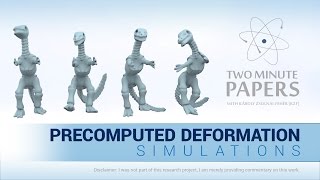
Researchers precompute elastic deformation simulations to speed up rendering from hours to seconds, achieving 20 to 2000 times faster results. The method trades memory and upfront training for dramatic runtime speedups using linear algebra techniques like Gram-Schmidt and Krylov methods.
Chapters
Dear fellow scholars, this is two minute papers with this piece of work is about reducing the time needed to simulate elastic deformations by means of precomputation. Okay, so what does the term precomputation mean? If we are at an open book exam and we are short on time, which is basically every time, it would be much better to do a precomputation step, namely studying at home for a few days before and then when we are there, we are endowed with quite a bit of knowledge and are guaranteed to do much better than trying to grasp the simplest concepts on the spot. This precomputation step we only have to do once and it almost doesn't matter how lengthy it is, because after that we can answer any question in this topic in the future. Well, sometimes passing exams is not as easy as described here, but a fair bit of precomputation often goes a long way.
Just saying.
The authors have identified three major bottlenecks in already existing precomputation techniques and proposed optimizations to speed them up considerably at the cost of higher memory consumption. For instance, the algorithm is trained on a relatively large set of training pose examples. If we don't have enough of these training examples, the quality of the animations will be unsatisfactory. But if we use too many, that's too resource intensive. We have to choose just the right amount and the right kinds of poses, which is a highly non trivial process. Note that this training is not the same kind of training we are used to see with neural networks. This work doesn't have anything to do with neural networks at all. The results of the new technique are clearly very close to the results we would obtain with standard methods. However, the computation time is 20 to 2000 times less. In the more favorable cases, computing deformations that would take several hours can take less than a second. That is one jaw dropping result and a hefty value proposition. Indeed, this example shows that after a short precomputation step we can start torturing this poor armadillo and expect high quality elastic deformations. And there is a lot of other things to be learned from the paper. Gramschmidt Orthogonalization, Augmented Krylov iterations, Newton PCG solvers. Essentially, if you pick up a dry textbook on linear algebra and for every technique you see there, you ask what on earth this is useful for. You wouldn't have to go through hundreds of works. You would find a ton of answers.
In just this one absolutely amazing paper.
Also, please don't forget that you fellow scholars make two minute papers happen if you wish to support the show and get access to cool perks like an exclusive early access program where you can watch these episodes 16 to 24 hours in advance.
Check out our page on Patreon.
Just click on the icon with the letter P at the end of this video or just have a look at the video description. Thanks for watching and for your generous.