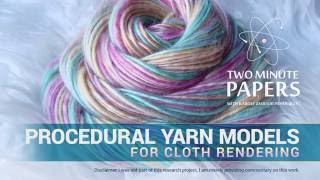
Short explainer video summarizing a research paper that introduces a procedural algorithm to generate realistic yarn geometry for cloth rendering. The hosts define procedural graphics (generating content on the fly), describe applications (textures, skies, procedural game levels), summarize the paper’s approach to modeling yarn parameters (twist, hairiness) and note validation against photographs and CT scans.
Chapters
Dear fellow scholars, this is two minute papers with Today we're going to talk.
About a procedural algorithm.
But first of all, what does procedural mean? Procedural graphics is an exciting subfield of computer graphics where instead of storing a lot of stuff, information is generated on the fly. For instance, in photorealistic rendering, we're trying to simulate how digital objects would look.
Like in real life.
We usually seek to involve some scratches on our digital models and perhaps add some pieces of bump or dirt on.
The surface of the model.
To obtain this, we can just ask the computer to not only generate them on the fly, but we can also edit them as we desire. We can also generate cloudy skies and many other things where only some statistical properties have to be satisfied, like how many clouds we wish to see and how puffy they should be, which would.
Otherwise be too laborious to draw by hand. We're scholars after all, we don't have time for that.
There are also computer games where the levels we can play through are not predetermined, but also generated on the fly according to some Given logical constraints, this can mean that the labyrinth should be solvable, or the level shouldn't contain too many enemies that would be impossible to defeat. The main selling point is that such a computer game has potentially an infinite amount of levels. In this paper, a technique is proposed to automatically generate procedural yarn geometry. A yarn is a piece of thread from which we can sew garments. The authors extensively studied parameters in physical pieces of yarns such as twisting and hairiness, and tried to match them with a procedural technique. So for instance, if in a sudden trepidation, we wish to obtain a realistic looking piece of cotton, rayon or silk, in our light simulation programs, we can easily get a unique sample of a chosen material which will be very close to the real deal in terms of these intuitive parameters like hairiness. And we can not only get as long or as many of these as we desire, but we can also edit.
Them according to our artistic vision.
The solutions are validated against photographs and even CT scans. I always emphasize that I really like these papers where the solutions have some.
Connection to the real world around us. This one is super fun indeed.
The paper is a majestic combination of.
Beautifully written mathematics and amazing looking results. Make sure to have a look.
And you know, we always hear this news where other YouTubers have problems with.
What is going on in their comment section. Well, not here with our fellow scholars. Have a look at the comments section of our previous episode.
Just absolutely beautiful. I don't even know what to say. It feels like a secret hideout of.
Respectful and scholarly conversations.
It's really amazing that we are building a community of fellow scholars, humble people who wish nothing else than to learn more. Thanks for watching and for your generous support. And I'll see you next time, Sam.