Programming Meme Review with George Hotz
Lex Fridman and George Hotz review programming memes and riff on developer culture. They discuss automation fetishism, testing practices like process replay systems, and Comma's hiring approach through micro-internships. Hotz is bullish on neural networks and questions what loss functions actually optimize for.
Chapters
This is a review of programming memes with George Hotz. Quick mention of two sponsors. Four Sigmatic, the maker of delicious mushroom coffee and public goods. My go to online store for minimalist household products and basic healthy food. Please check out these sponsors in the description to get a discount and to support this channel. And now on to the memes.
Let me ask you to do a meme review or inspect some printed black and white memes. Maybe give a rating of pass or fail, like binary. If this is a win or a lose. These are mostly from the programming subreddit. You don't like this one? This doesn't pass.
I mean, you ordered like I could do it straight up like PewDiePie. Meme review. Yeah, this, this, this, this meme gets a 1 out of 10.
This is too much text. I only half ass looked at already.
Already too much tech.
Are you gonna skip on the text?
Well, what about I. Yeah, yeah, I don't know about this. I think this, this, this plays on bad stereotypes.
Isn't that all of memes? I don't know.
No, I think, No, I think like.
Now this one, this meme's much better.
Okay.
Never spend six minutes doing something by hand when you can spend six hours failing to automate it.
Now this one I like cries in powershell. You doing a powershell? Do you do that yourself? Do you find yourself over automating?
Of course. But you learn so much trying to automate. You could spend six minutes just driving there instead of spending 10 years of.
Your life trying to solve self driving cars.
That's true. That's the programming spirit.
Of course.
I don't know what that is.
You know, it's like you're trying to overcome laziness and like you end up putting in way more effort to overcoming laziness than just overcoming it.
78,000 upvotes on that one. Jesus.
Okay, Mine doesn't have the. Oh, wow. Oh, that's up there. I say this just. Yeah, this is why I trust programmers a lot more than I trust doctors.
You like googling? You like doctors think they have some.
Like, like, like, some like divine wisdom because they went to med school for a few years. I'm like, yeah, dude, I understand. I didn't Google this on WebMD. I actually like, I read these three papers. Like, you know, Yeah, I think I.
I remember once when I was, let's say, drug shopping and one of the doctors referred to Adderall as a schedule B drug. And now I can't, you know, correct this guy. That's drug Seeking behavior to an extreme. Schedule two, it's not Schedule B. But you know, like your doctor, you don't, you don't know that the DEA.
Gave you a pad to prescribe and you don't know about the drug scheduling system. Like, like, yeah, yeah.
Programmers don't, don't have that. They just outsource. Do you think that becomes a problem if you outsource the entirety of your knowledge to stock overflow? You write stuff from scratch pretty well.
Yeah, yeah, yeah. They asked me, they asked me on Instagram.
They were like, what's the integral of.
2 to the x? And I'm like, they'll look it up. Well, the integral of E to the X is E to the X. So it's like something like that.
Yeah, the same with Wolfram Alpha. You just start looking it up.
Yeah, that's pretty good. That's funny.
That's the first funny one. You do testing. You do like user, not user. We give it a unit testing.
We do use that too. Yeah. Our regression testing has gotten a ton better in the last year. Now we're pretty confident if the tests pass that at least it's going to go into someone's car and do something. Versus in the past, sometimes we've merged stuff in and then one of the processes wouldn't start.
Right. So you think that kind of testing is still really useful for autonomous fee?
Not as much unit, but like some kind of God bad with words. Today holistic, like integration testing thing runs. Yeah, that it runs and that it runs in CI and that it doesn't output crazy values. And then actually we wrote this thing called process replay, which just runs the processes and checks that they give the exact same outputs. And you're like, this is a useless test because what if something changes? Then we update the process replay hash. This prevents you from. If you're doing something that you claim is a refactor, this will pretty much. It will check that it gives the exact same output every single time, which is good. And we run that over like, you know, 60 minutes of driving, but that.
One'S a win for you. Get past the 10.
That's 8 out of 10.
Can't give anything.
10 out of 10. That's. That's a good meme.
Breaks the rule.
Yeah, yeah. I mean, you know, this is why I don't use IDEs. That's just. This is true.
This is just true.
It's not.
I got to say, to me, it's kind of funny because it's. It's so annoying. It is so annoying with an idea. That's why I'm still using an Emacs. Because id, it's like clippy on steroids.
It is, it is. Of course they're going to make good ones though.
I still want to. This is a comfy idea I want to do. And I've trained language models on Python. You can train these big language models on Python and they'll do pretty good job like reading, checking for bugs and stuff.
So you hope for that. Machine learning approaches for improved IDs. That's very interesting.
Yeah, yeah, I think machine learning approaches for like improved like look at Google's auto suggestion in Gmail.
Yeah, like.
Oh yeah.
That even like the dumb thing that it does is already awesome. There's a lot of like basic applications of like GPT3 language model that might.
Be kind of cool.
Yeah.
I think that the idea that you're going to somehow get GPT3s to replace customer service agents, I mean really, this reflects so badly on customer service agents. And like why don't you just give me access to whatever API you have, you know, I don't know.
This, this one is.
Yeah.
I just saw a picture. I actually wondered if it works at all.
That's good, that's good. The last line is good.
Okay, thanks, bye.
No, I'd rather you mine cryptocurrency in my browser than use my speakers.
Yeah, I feel that way about pop ups too. Just anything, I mean those you could at least block.
It's like, you know what? The only thing I do want to AutoPlay is like YouTube.
What? Why do new sites start auto playing their news? I don't, I don't, I don't get.
I haven't, I haven't been to a news site in years.
True.
I do not read the news. Like, like people like, like I still hear about the news because people talk about it.
Yeah.
Like I've never been to a news.
Yeah. Who goes there?
In fact, even on hacker news, I'll.
Always avoid it if like the link is like a New York Times or CNN or I guess I've read a few things. But yeah, those like the pop up news sites.
Yeah. Those websites are broken. Somebody needs to fix it. That's at the core why journalism is broken actually is because like the, the revenue model is broken. But actually the interface, like it's just like I have to like I literally, I want to pay the New York Times and the Wall Street Journal. I want to pay the money but, but like they make it like to where I have to click, like, so many times. And they want to do.
Have to have a login and have a New York Times password.
Yes. And also they're doing the gym membership thing where they try to make you forget that you signed up for them.
God.
So that they charge you indefinitely. Like, just be up front and let it be five bucks. And then everybody would. It's your idea, which is like, just make it cheap, accessible to everyone. Don't try to do any tricks. Just make it a great product. And yeah, people, everybody will love it. Yeah.
Actually, what I want to see also I've seen them start to exist, is ad block that also blocks all the recommended I don't want trending topics on Twitter. Please get rid of it. These trending topics have zero relevance in my life. They're designed to outrage me and bait me. Nope, don't want it.
You know, one interesting thing I've used on Twitter I had to turn back on because it was tough, is there's. There's chrome extensions people could try is it turns off the display of all the likes and retweets and all that. So all numbers are gone. It's such a different. People should definitely try this. It's such a different experience because I've realized that I judge the quality of other people's tweets, of course, by the number of likes. Yeah. Like, it's not. You know, basically, if it has no likes, then I'll judge it versus one that has, like, several thousand likes. I'll just see it differently.
Yeah.
And when you turn those numbers off, I'm lost at first. I'm like, what am I supposed to think? It's a beautiful thing.
That's right. How much is it manipulated?
Yeah, it's. It totally is. But it's an interesting experience worth thinking about.
I found that. So actually I. Do I block you. Can I do it with AdBlock? I have like, like, trending topics. Anything that's global and applicable to everybody, I definitely do not want. I do not want to know what's trending in the United States right now. It's always some, like, political agit prop or, like, some. It's agit prop a lot. Lot of the times, but at the.
Same time, like, to push back slightly. For me, trending, like, if there's a nuclear war that breaks out, that's how they get you.
That's how they get you. And I just trust that if nuclear war breaks out, someone's going to come.
A friend will text you.
Friend will text me, like, you know.
Yo, hey, are you in a shelter or what? Yeah. So if it's bad enough, you'll know.
Yeah. I did also try turning off YouTube's recommendations, but I realized that they do provide value to me.
Like the tail customized to you.
Yeah. And. Yeah.
As opposed to a general one, like a trending one. Yeah, yeah, yeah. YouTube does a pretty good job. So this one is about how Stack overflow can be really rough. Asking a question of stack overflow.
Be like, no, no, I've never asked a question on Stack overflow.
You've never. It's rough.
I don't comment. Okay.
I'm never. If someone. If there's a comment on the Internet, I just want you to know that they probably do not reflect my values.
Well, I mean, there is some truth to that, too. One of the documents that I make, everyone, everyone, a comma, has to read it. It's linked from. The thing is, it's Eric Raymond, and it's how to ask Smart Questions. Yeah. And it's just like.
Well, you know, the quality of the.
Answer you get depends a lot on how you will phrase the question. To be fair. I think. Yeah, the. The auto keyword is not. Is a. I think Stack overflow likes it where it's like, there is an answer. There's not really an answer to that. Right. That's a. That's a great Reddit thread, but some.
Of the most interesting questions are a little bit ambiguous. Ambiguous. Yeah.
I do. I do this in interviews. I ask ambiguous questions. And I just see how I found that. That's so much more useful for gauging candidates than, like, to see how they.
Reason through things, to see just, like.
What they think of and, like, what language they use and whether they show familiarity or not.
What do you. By the way, just as a quick aside, is there any magic formula to a good candidate?
Intelligence and motivation.
Intelligence and motivation. Yeah, motivation. Passion. Yeah. And you can see it through just conversation. I always wish there was a test that you could just online, like a form they can fill out.
Well, okay, so there's the old problem of testing for intelligence is easy because, okay, smart people can lie and say they're dumb, but. But dumb people can't really lie and say they're smart. But testing for motivation is much harder. So we do this. We do this. We have a micro internship. We bring people in for two days, paid to come, you know, work on something real in our code base.
Nice.
And we see, like, you know, are you just doing this as, like, a job interview? If you're Doing this as like, okay, I gotta like, check this box. Then. Yeah, you're not a good fit.
That's awesome. That's a good idea. And then you see. And then you can be picky and see, like, if there's a. Is there a fire there? Like that?
Yeah, we see. And like, now we hire a lot of people, you know, who at least. Like, if you're coming to work at Comma, you're kind of expected to have read the open pilot code. Right. Like, the best candidates are the ones who like, read the code and ask questions about it.
Like, it's open source.
Right. The beauty of Comma is you don't need to be hired by us to start contributing. True.
Yeah. Are you obsessed about resource constraints?
Some. Not size. I don't care about bytes. But cpu.
Cpu.
Well, CPU is watts and watts is bad. Watts is going to pump them somewhere.
We're lowering the CPU temp.
People complain about the comma 2's overheating. We have a solution. We're lowering the CPU frequencies.
We're going to ship that in the next one. But don't worry, we've made the code more than efficient enough to cover.
Awesome. That's. Yeah, that's one way to. Cool. Beautiful.
This is good.
I mean, okay, five out of ten.
Which one?
My code doesn't work.
Let's change nothing.
I do that all the time.
That's the weird thing. And it often works. Just running stuff again. I don't get it. I don't get how this world, this universe, is programmed. But it seems to work. Just like restarting a computer, restarting the system. Like this audio setup. Sometimes it's just like not working. And then I'll just shut off and turn back on. And it just works.
I interpreted this beam totally differently. You interpret it as in.
Like, this is a good idea.
Yeah, I interpret it as in. I find myself doing this all.
And this is dumb.
I just run it again. I know it's going to give me the same answer and I'm not going.
To be happy with it.
But, like, you know, I found this.
I did Advent of code last December. It's. Advent of code's great. It's like, it's a programming challenge. Every night at midnight for December. Damn proud of myself.
Proud how I did on leaderboard.
Yeah, I found myself doing that all the time.
I'm like, this has to be right. I don't understand.
Yep.
This is like this kind of. You embody this in some sense. You've. You're able to. I Mean, at least I've seen you able to accomplish quite a lot in a very short amount of time, so.
Interesting.
Yeah.
Sometimes I don't know, some of them, like, people don't realize how much, like, I cheated at Twitch Slam, you know, like. Okay, to be fair, I did write that slam from scratch on there. I did not have like a copy of it written, but I also spent like the previous six months studying Slam. So like, you know, I had so much base there.
Sure.
Going into it. Whereas, like, with these other things, like, I don't have anything going into it. And people are like, why isn't it like Twitch Slam? Well, you know.
So this one is just. You find this to be true? Is this funny at all?
I find it three out of ten.
Yeah. Three out of ten. There's a lot of threes in there.
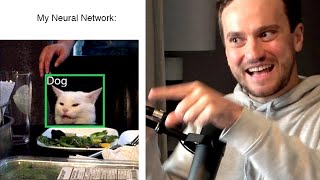
This is a machine learning.
Yeah, true.
Yeah. I mean, this is the tension. I get this. I mean, sometimes this meme pisses me off a little bit because people that learn machine learning for the first time and they're struggling with object detection and they think, how is this supposed to achieve general intelligence? That's because you're just doing a first intro to what? Software 2.0, as opposed to, like when you scale things, I mean, you can achieve incredible things. That would be very surprising.
I mean, it's the same thing with software 1.0. You know, they. They sit there and they write, hello world.
And they're like, how is this thing.
Supposed to fly rockets?
Right. And it does. The thing is, it does.
It just takes a whole lot more effort than you think. I don't know. But I'm very.
You're bullish on neural networks.
I'm bullish on neural networks. I think neural networks are definitely going to play a component. I'm bullish on what neural networks are, which is a beautiful generic way. I was. One of our. One of our screening questions is what's the complexity of matrix multiplication? And I was explaining this like, like, like why fundamentally this is true. And then I went a little further with. And I'm like, you know, this is. Neural networks is just like matrix modifications interspersed with non. Linearities. And there are something. So the fact that. That's such an expressive thing and it's also differentiable. It's also quasi con. Like it's convexy, but which means like convex optimizers work on it like. Yeah, well, this isn't going anywhere. Of course not.
Yeah. The question is, what are the limits of its surprising power?
But I think that we haven't seen the loss function yet. We haven't seen the right loss function. You know, it's going to be something fancy that looks, I think, like compression. And I haven't seen these things really applied. Maybe there was that one paper where they tried like surprise to solve Montezuma's Revenge.
But yeah, there's a lot, a lot of fun stuff in RL that reveals the power of these things that's yet to really be understood. I think. So that's kind of an exciting world. Thank you for putting up with this nonsense of a paper based meme review. George. Sam.










