Sam Altman FINALLY Reveals GPT-5 (GPT-5 Explained)
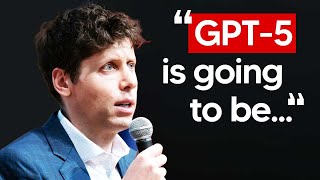
YouTube commentary (LARRUZ) summarizing OpenAI's announced roadmap for GPT-4.5 (internally "Orion") and GPT-5. Main points: OpenAI plans to simplify product offerings by unifying models into a routed system (Router/LLM) that absorbs O3 technology rather than shipping O3 standalone; GPT-4.5 (Orion) is expected in the coming weeks and GPT-5 is estimated by the speaker to arrive in Q2–Q3; access will be tiered (free/standard intelligence, Plus/higher intelligence, Pro/even higher intelligence with features like Voice Canvas, search, deep research); routing reduces cost and complexity and may enable a single unified system that delegates to submodels based on cost/latency/quality.
Chapters
So we actually finally got the roadmap for GPT5. And the reason I'm actually really excited to be recording this video is because for once we're actually not getting a bunch of random speculative information. We're actually getting the entire GPT5 roadmap laid out for us to completely understand. So let's not waste any time and dive into exactly how GPT5 will be deployed because it does offer us some rather interesting information that goes to show how these future AI systems will be. And I actually do agree with this, and I think this is how most AI systems will be when it comes to major chatbot providers. So you can see a few hours ago Sam Altman tweeted that this is going to be the official roadmap Update for GPT 4.5 and GPT 5. And he says that he wants to do a better job of sharing the intended roadmap and much better job at simplifying the product offerings. He said that he wants AI to just work for you and it realized how complicated the model and product offerings have gotten. So basically what they're talking about is the fact that if you've ever used ChatGPT before and you're someone that is using it and you've got a lot of money invested, and by that I mean let's say for example, you're paying for the highest tier, ChatGPT currently is a complete mess. Now I'm going to show you guys exactly what I mean by that. So when you come into ChatGPT it does seem pretty simple. But when you do this drop down menu right here, you can see that unfortunately as someone who has a different layout to you probably do. I have 1, 2, 3, 4, 5, 6, 7 GPT4 mini and 8, GPT4 and 9 if you include the temporary chat. Basically the problem with this is that this causes analysis paralysis. And what this does involve is that this involves users decisions. So for example, when someone comes to use the AI chatbot, they genuinely don't know which model is the best because You've got GPT 4.0 for questions, GPT 4O scheduled 0103 mini high O3 mini 01 pro mode. You've got basically too many choices. And one thing that they constantly say in product choices is that if you have too many choices your product is going to fail. And in this instance for ChatGPT, what they want to do is they actually want to simplify this entire thing here because. Because this is far too complex for the average person to use as someone that knows exactly what I'm going to be doing for every task. For me this is just fine, but for the average person this is actually a detriment and isn't actually a good thing. So they're actually going to change this in a really interesting way, which I will talk about later. And this is where they actually talk about how they hate the model picker as much as we do and want to return to magic unified intelligence. So I do think that one of the approaches that they're going to take to sort of return to, to this unified machine intelligence is through the Router LLM. So basically this was, I wouldn't say a framework, but this is basically how you set up LLMs in order to basically make things a lot easier. So you would have your single system prompt, your user prompt, actually, not the system prompt, your user prompt. So for example, you might put what's the weather today? And then there's basically a router that analyzes every single prompt that is put in. So this router will look at your question that you put in, it will analyze the cost, the latency, and basically it will look at your question and think, okay, does this question need to be routed to a really difficult model or does this question need to be routed to a super easy model that I can answer within two seconds? If it is a hard question, it's going to be put towards the most intensive LLM, the one that's going to think for very long periods of time. And if it's something very simple, like which came first, the chicken or the egg, it's going to be routed to a very simple model. And then of course, finally you get a system response. Now this is something that they have tested before. Maybe not OpenAI, but I do know other companies have tested something like Route LLM before and it has gone very well considering the fact that I think it dropped costs by around 85%. And you can read more about this at this blog post. RouteLLM, an open source framework for cost effective LLM routing. And and basically just talks about how in their routing setup they focused on the case where there are two models, a stronger, more expensive model and a weaker but cheaper model. And their aim was to minimize costs while achieving high quality between routing through two models. And you can see right here that they said a top goal for us is to unify the O series models and GPT series by creating systems that can use all our tools, know when to think for a long time or not, and generally be useful for a wide range of tasks. So, like I was talking about the previous framework route, LLM, it's quite likely that we will have a situation on our hands where we do get a system that is basically all in one. And it's quite likely that we're going to get future models as an all in one system. So whilst, yes, there might be parts of the system that are O3 mini and O3 high or whatever, it seems like we're basically moving towards one giant model or orchestrated set of LLMs that basically provide you with unified level of intelligence. And it's quite likely that, you know, depending on your tier, you will have access to, you know, those levels of intelligence. So maybe if you're paying $200 a month, you get access to the model's entire brain or the, you know, advanced reasoning capabilities. But if you're just a free user, you know, you can maybe query it about one or two things a day, maybe just 10 to 20 queries a day. And that is going to be how the model is probably deployed, because it's, you know, a lot easier to do that rather than having six different models. And then when, you know, different companies come out with different models, they're like, okay, this model is clearly better, but this is probably going to be a lot better for OpenAI in terms of their branding. And they also state that, you know, in the ChatGPT and, you know, in their API, they're actually going to release GPT5 as a system that integrates a lot of their technology, including O3. Okay. And they said that they're no longer going to ship O3 as a standalone model. So it's clear that GPT5 is probably going to absorb O3 as just part of its architecture and it's going to be, I guess you could say, part of that model for quite some time. So it's like GPT5 is probably going to be a system that compromises of maybe 0301 different parts for different questions, which is going to be super interesting to see how that entire system works. And something that they also said here that Sam Altman said that I think super interesting is that he said that GPT5 as a system, okay, he said it's going to integrate a lot of our technology. And I don't know if this includes everything that we currently have, because there was one time that Sam Altman said that this year they are going to be releasing something that nobody has even thought of yet. And I think that is going to be super interesting. So I'm guessing that GPT5 is probably going to be also a computer agent. I'm guessing that they're probably going to wrap the name underneath that because that is what makes sense. So that does intrigue me a lot because I'm thinking what on earth is the final version of GPT5 going to be? Because I know that the model is really smart. But they also did say that they're going to ship the next chip, GPT5. They also said that we will next ship GPT 4.5, the model we called Orion internally as our last non chain of thought model. So what they mean by this is that the last model that they basically did is the old method of training where you basically collect a bunch of data, put all that data in the model, train it, then have the post training, the fine tuning and all of those things that you have for a standard model output like a GPT4, a GPT4O, all of those things basically are going to go in the last model. So it's clear, like I said before, we are on a new paradigm of training these models and it's clear that the GPT 4.5 is probably going to be in my. This is just my best guess. It's probably going to be on the level of Claude 3.5 sonnet, but probably a lot better than that, probably not a lot better, probably marginally better because Claude 3.5 Sonic is just so good. But I'm guessing it's going to be qualitatively better because whilst other models do surpass Claude 3.5 on benchmarks internally, when you use a model like Claude, it just seems so much smarter and it just always seems like it actually knows what's going on. So I'm thinking the OpenAI's aim is to probably just edge out Claude 3.6 Sonnet and I think they will be able to do that with GPT 4.5, which is the model they called Orion internally, which they knew was smart. But I'm guessing the reason why they didn't deploy this before, which most people were wondering, and they actually spoke about this in a article before, was basically the fact that the model, it just cost too much in terms of inference, so they couldn't serve the model yet. But we do know that as time passes, inference consistently drops. If you remember yesterday's video, we spoke about how Sam Altman, he speaks about how literally every 12 months the price of LLMs drops by around 10x. So it's quite likely that in the past few months, since they've managed to train this model and do all the safety testing, the price of inference has dropped to the point where it's going to be reasonable so that they can release this model. Now, if we do talk about the estimated time of arrival, when is this model going to come? We have weeks and months. This is what Chubby said. Any eta for GPT 4.5 or GPT 5? So for GPT 4.5, it will be likely coming in the next coming weeks. So I'm suspecting by the end of March that we would have GPT 4.5. And for GPT 5, I'm guessing maybe by the end of Q2 or maybe by the end of Q3, but that is just my very best guess. So for that, in terms of time frames, if you want to think, okay, one of these next models coming out, that is going to be that aspect of that area. So for me, that's what I do think in terms of where that is going to be. Now, of course, for free users, they actually talk about, you know, the free tier of ChatGPT is going to get unlimited chat access to GPT5 at this standard intelligence setting note, standard intelligence. And this is of course not the high intelligence. So it isn't going to be, you know, like O3 mini high. So it's not going to be accessing the long chains of thought that are at the threshold of, you know, the most intelligence that we could currently access. But it does seem like this is a move because with deepseek, they basically just gave away crazy level intelligence at a fraction of the cost. And it basically made it more cost effective for people to use deepseek than anything else, which is really, really intriguing. So we can also see that they also talk about the fact that plus subscribers are going to be able to run GPT5 at a higher level of intelligence. I'm guessing having the model to think more and of course tap into those long chains of thought that provide you with deeper insights to your queries. And it says, pro subscribers will be able to run GPT5 at an even higher level of intelligence. And these models will incorporate Voice Canvas, search, deep research and more. So I think what OpenAI are doing are basically saying, look, if you want access to our free models, you are going to get that for free. But if you want access to, you know, voice canvas search and deep research, you're gonna have to probably play the highest, highest level, which is probably around $200 a month. And I know that does seem quite expensive, but I think what OpenAI are banking on is that Every single time they release something, they're basically just going to add it to GPT5 as a system. So overall, as the system gets smarter and smarter and smarter, what you're paying for essentially goes down and down and down, if that does make sense. So, yeah, it's going to be really interesting to see how the pricing works. OpenAI have discussed pay per usage pricing because of course, $200 a month is absolutely insane. I don't think anyone I know personally could get that much value out of the model, but it definitely is something that people will be doing. So I also do think that something that was super interesting was, will you be smarter than GPT5? And this is where Sam Altman actually talks about the fact that, you know, he doesn't even think he will be smarter than GPT5.
How many people feel smarter than GPT4? Okay, how many of you think you're still going to be smarter than GPT5?
I was expecting more hands here.
I don't think I'm going to be smarter than GPT5. And I don't feel sad about it because I think it just means that we'll be able to use it to do incredible things. And, you know, like, we want more science to get done. We want more. We want to enable researchers to do things they couldn't do before. This is the history of. This is like the long history of humanity. It does feel a little different this time because of what this can enable. But if scientists can do things because they have like a crazy high IQ tool and they can focus more on figuring out the right questions to ask, address things quicker, do their search space faster, that's just a win for all of us. So we're thrilled to get to any of.
So with all of that being said, what do you guys think about GPT5? Are you excited? I think I'm excited for the unified intelligence. I think this is something that actually makes sense. Unifying these models into one entire thing just makes so much sense in terms of the work you're trying to do and the simplicity of the model. And there was a famous example in marketing that you guys might not actually know about. But just take this as a business lesson where there was a JAM store, and basically with this JAM store, they had two stores. They had one that had 24 choices of jam, another one that had six choices of jam. And then in the 24 choices, you'd think that because there were more choices, more people would be buying because they're offering more services, but only 3% of people actually bought, but when they had six choices of jam, 30% of people bought. And basically this talks about when you have too many decisions, you don't actually pick anything. And it's the same thing with AI when users have ChatGPT and you have GPT4001O3 mini, O3 mini high. The problem is that you have too many choices. When we go over to Claude, we have maybe three models and we go over to Gemini, we have maybe one or two models that we're going to be using. And in fact, Gemini has probably too many models now. But the point is that Claude, everyone knows it's Claude 3.6 on it, that's the one model you use. And it's like with Deepseek, you have the thinking model, that's the basic model that everyone uses. So we. With this, you've basically got too many choices. So it's quite likely in the future these are going to be unified into one big model architecture. So, with that being said, hopefully you guys enjoyed the video and I will see you guys in the next video.










