Sam Altman Just REVEALED The Future Of AI..
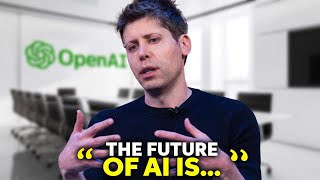
Sam Altman says OpenAI has the data it needs for next-generation models and discusses synthetic data experiments, new architectures to learn from less data, and interpretability research. He addresses his firing, the Scarlett Johansson voice controversy, and what happens to society and economics after AGI.
Chapters
So after a pretty rough week at OpenAI for Sam Altman, he actually did a interview where he actually responded to numerous different comments and numerous different interview questions that were pretty, pretty interesting. And I've got to be honest, this is probably one of the most insightful interviews that we do get because it actually reveals his opinions on some of the recent controversies that have been surrounding OpenAI and a decent amount on the future direction of some of the frontier models that we will be getting in the future. And now one of the first things that Sam Altman actually does talk about is that he does give subtle hints to a new architecture that they are potentially working on. Now, I do say potentially because that is a very, very, very big potentially. So we have synthetic data and potentially a new architecture or a new method of making these AI systems, I guess you could say, be more data efficient with their training. So I'm referencing this article here from, from the Information. This was an article that was released, I think sometime in the past few months. And this was actually around the time that Sam Altman was being fired from OpenAI. So this was November of last year. But we can see here that it clearly states that sucks. Over's breakthrough allowed OpenAI to overcome limitations on obtaining enough high quality data to train new models. So what I'm going to do is I'm going to show you guys the clip because once I play this clip from the interview, you'll then understand exactly what, what he's saying because the interviewer asked the question, how are you training these new models? And are you just simply generating large amounts of synthetic data? But Sam Altman reveals exactly what they are up to.
I think what you need is high quality data. There is low quality synthetic data, there's low quality human data. And as long as we can find enough quality data to train our models or ways. Another thing is ways to train, you know, get better at data efficiency and learn more from smaller amounts of data or any number of other techniques. Were, I think that's okay. And I'd say we feel like we have what we need for this next model.
Are you, have you created, and you.
Can see here that he literally says, you know, that we have what we need for this next model. So whatever it is that they are currently using to train the next model in terms of data efficiency, whether it be synthetic data or just, I guess you could say figuring out how to get a lot more high quality data from whatever sources they may use. I think one interesting trend that we've seen recently is that of Course data is very, very important. And with the Phi 3 series, we've seen that the smaller models are getting increasingly better. And that is a direct byproduct of the fact that we are realizing how much your high quality data actually matters. So the clip does continue.
We have what we need for this.
Next model are you, have you created massive amounts of synthetic data to train your model on? Have you self generated data for training?
We of course have done all sorts of experiments, including generating lots of synthetic data. My hope is that there will be, there'd be something like very strange if the best way to train a model was to just generate like a quadrillion tokens of synthetic data and feed that back in. You'd say that like somehow that seems inefficient and there ought to be something where you can just learn more from the data as you're training. And you know, I think we still have a lot to figure out. But yeah, of course we've generated lots of synthetic data to experiment training on that. But again, I think the real, the core of what you're asking is how can you learn more from less data? That's interesting.
I didn't know that.
So yeah, I think, I think what OpenAI are trying to not really tell us, but what we can infer from this very, very short segment is that OpenAI, Sam Altman, whatever you want to call it, they are focusing on of course getting these models to learn from whatever data that they do have, whether it be synthetic data, human generated data, whatever data it is. But I did want to include this because I know that a lot of people would forget this article where Saskova's breakthrough allowed OpenAI to overcome limitations on obtaining enough high quality data to train new models. And this was, I think this was around the time that GPT5 did start training, forgive me if that's wrong, but apparently this was the major obstacle for developing next generation models. And of course the research involved using computer generated rather than real world data like text or images pulled from the Internet to train new models. So it's clear that there was some kind of breakthrough before Sam Altman's firing and whatever kind of breakthrough that they've done, clearly, you know, Sam Altman gives a small hint about that and I'm guessing that they're using that to train these new models. And this kind of does really make me excited to see how the benchmarks of GPT5 will be. And like I said before, I think, you know, with the next frontier models, I think that probably with GPT5 there might even be some kind of benchmarks that I guess you could say aren't emergent, but just something that we can't even measure on other systems that just completely blow things out of the water. Now here is where Sam Altman actually talks about something that I would say is probably most concerning to most of us who are people who are going to be living in the society, I guess you could say in the normal tier. And I say that because this is where he discusses post AGI economics. So currently our economic model is one that is labor based. So you exchange your labor for I guess you could say money. I mean some people say it's value or time, whatever it is, the majority of people just exchange their labor for money. And of course if we are moving into a society where depending on whatever kind of work you do, whether it be physical, cognitive, white collar, blue collar at the end of the spectrum, over a long period of time, once that change does occur, you have to wonder how the society that we all live in is going to change. Because if the social contract is changed where you know, human value is no longer based on exchanging your labor for an income, you know, how does the social contract change? And this is what Sam Altman talks about.
I still expect, although I don't know what. And this is over a long period of time. This is not like next year or you know, the year after that kind of thing, but over a long period of time. I still expect that there will be some change required to the social contract given how powerful we expect this technology to be. I'm not a believer that there won't be any jobs. I think we always find new things to do. But I do think like the whole structure of society itself will be up for some degree of debate and reconfiguration.
And that reconfiguration of will be led by the large language model companies.
No, no, no. Just the way the whole economy works and what we like, what society decides we want to do. And this has been happening for a long time as the world gets, gets richer, social safety nets are a great example of this. I expect we will decide we want to do more there.
So yeah, I mean it's going to be really interesting because this is where you have the concept of ubi but and in some videos that are coming soon, I'm going to really be talking about how, I guess you could say you can prepare for what's coming because I think there are some hints with which as to what the social contract is going to be of course, there's this idea of universal basic compute, which Sam Altman has basically tinkered with before, where if there is like an ASI level system, you know, artificial super intelligent system that can do a lot, I guess you could say everyone gets a certain allocation and that resource is probably a lot more valuable than money because it can generate a lot of different things for every individual. And maybe it's going to be up to you to allocate how you want to use that resource. If AGI is here, you know, everyone gets like an hour a day or. I know it's pretty hard to kind of like explain how that works, but instead of exchanging money, I mean, there's going to be something else. And it's pretty hard to envision. That's the whole reason why this is very, very hard to talk about. It's because we're moving into, you know, a society that I guess you could say hasn't been done before. So it's going to be very interesting to see if we actually do get it right. And I guess probably the AI will even help us design how that society is even functional and how it works and how it's, you know, organized as.
As you train this next iteration. Let's, let's, let's stick with the next iteration of the model. As you train it, what level of improvement do you think we're likely to see? Are we likely to see kind of a linear improvement or are we likely to see asymptotic improvement, or are we likely to see any kind of exponential, very surprising improvement?
Great question. We don't expect that we're near an asymptote, but, you know, this is like a debate in the world. And I think the best thing for us to do is just show, not tell. You know, there's a lot of people making a lot of predictions, and I think what we'll try to do is just do the best research we can and then figure out how to responsibly release whatever, whatever we're able to create. I expect that it'll be hugely better in some areas and surprisingly not as much better in others, which has been the case with every previous model. But this feels like the conversation we've had every other model release. You know, when we are going from 3 to 3.5 and 3.5 to 4, there's a lot of debate about, well, is it really going to be that much better? If so, in what ways? And the answer is there still seems to be a lot of headroom. And I expect that we will make progress on some things that people didn't expect to be possible on the whole though, this.
So yeah, that was one of the kind of surprising things is that, you know, there's actually an area or areas of improvement that we didn't even think were completely possible. Which is why I'm stating that, you know, these next models, next iteration of models probably are not going to blow them out by our current standards. We're probably going to have to rethink about how we even use the systems. And I think that might be the biggest, I wouldn't say uproar, but the biggest shock to us because I think, you know, currently people just look at, you know, the standard benchmarks like the MMLU and yada yada yada and the other just standard like math and GSM 8K benchmarks, which whilst, yes, they're very, very useful on determining, like I guess you could say, on a quantitative basis of how the models are actually performing. I think, you know, the ELO arena, you know, those areas that are more like qualitative where you can actually talk to the model and realize how it actually works when it's actually with an actual user and not just, you know, trained potentially contaminations on the benchmarks which some of them even actually do have errors. But I think, you know, the fact that he's clearly stating here that, you know, there's a lot of headroom for a lot of growth and the fact that in previous interviews, if you haven't seen, he's basically said that GPT4 is very, very dumb. And I've said that before, that like that is a very, very bold statement considering the fact that many people have meaningfully used GPT4 within their lives to improve their workflows. I'm definitely someone that's been able to benefit from that because it's a very useful tool for brainstorming. But the fact that the tool is regarded to as dumb is, you know, it's kind of an eye opener to kind of show you possibly what is to come in these next iteration of models. And I'm really intrigued as to what areas that we're not even thinking about that are going to be improved upon that most people think that they really, really can't be. So that will be something that I'm going to be looking out for and the kind of growth, of course, there doesn't seem to be any kind of plateaus. So it seems that we're going to be getting a huge new increase in terms of the reliability, in terms of the overall reasoning capabilities. Now there was also something that Sam Altman did respond to and that was of course the fact that he decided to, to respond to Helen Toner. When your name is in the public and people are making pretty, pretty, you know, big statements on your name, especially when you're a public figure for one of the hottest AI companies, of course it's important to address them. Now if you're not familiar with this, essentially Helen Toner basically said that Sam Altman was fired for outright lying and she was on the board that made the decision to fire Sam Altman in November. So Sam Altman basically responds to Helen Toner and you know, he gives his kind of side to the story.
Look, I respectfully but very significantly disagree with her recollection of events. But I will say that I think Ms. Toner is, she genuinely cares about a good AGI outcome and I appreciate that about her. I wish her well AGI this Toner is she genuinely cares about a good AGI outcome and I appreciate that about her. I wish her well. I, yeah, probably don't want to get into like a line by line refutation here. When we released ChatGPT, we, it was, you know, at the time called a low key research preview. We did not expect what happened to happen, but we had of course talked a lot with our board about a kind of research plan that we were, a release plan that we were moving towards. We had at this point had, you know, 3.5, which ChatGPT was based on, available for I think about eight months or something like that. We had long since finished training GPT4 and we were figuring out a sort of gradual release plan to that. But yeah, like I, I disagree with her, her recollection of events.
Okay, that's where you're gonna.
So yeah, I think it's important to, you know, for some Altman to at least give his side of the story because I think it was probably one of the most incredible weeks and that's very incredible to say considering the fact that there was a week where there was all of this OpenAI board drama. So I mean, as they say, what would OpenAI be without its drama? And continuing on from the drama, there was of course the Scarlett Johansson fiasco in which there was a lot of drama with regards to the voices. And I'm not going to cover the entire fiasco again because I'm sure that everyone pretty much knows about it by now. But he does respond to this.
It's super good for that.
Let's talk about the Scarlett Johansson episode because there's something about it I don't understand. So you demonstrate these voices. She then puts out a statement which gets a lot of attention. Everybody here probably saw it saying, they asked me if I could use my voice. I said no. They came back two days before the product was released. I said no again. They released it anyway. OpenAI then put out a statement saying, not quite right. We had a whole bunch of actors come in and audition. We selected find voices. After that, we asked her whether she'd be part of it. She would have been the sixth voice. What I don't get about that is that one of the five voices sounds just like Scarlett Johansson. So it sounds almost like you are asking there to be six voices, two of which sound just like her. And I'm curious if you can explain that to me.
Yeah, it's not her voice. It's not supposed to be. Sorry for the confusion. Clearly you think it is voice, some people's voice. I mean, people are going to have different opinions about how much voices sound alike, but we don't. It's not our voice. And yeah, we don't think it's. Not sure what else to say.
All right, then, of course, we had something interesting. And I know this might not be interesting to everyone, but I think this is probably one of the most important things because this is interpretability research. And if you don't know what this is, this is basically where they try to kind of figure out what on earth is going on inside the AI's mind when it makes certain decisions. And he also kind of hints at the fact that OpenAI have, I guess, made some kind of breakthrough or some kind of finding that maybe has, you know, pointed them in the right direction. And the reason I think this is as well is because if you take a look at how OpenAI have acted, they don't seem particularly concerned in the fact that their, you know, Super Alignment Team has disbanded. So maybe before the Super Alignment Team had disbanded, they. There were meaningful research efforts going into, I guess you could say, interpretability. And I'm guessing that they figured out that they've got the majority of the basis covered. But you can listen to Sam Altman say that in this clip where he's basically saying that we've got most of the stuff covered, so maybe they're further along than we thought in that aspect.
I think that safety is going to require a whole package approach. But this question of interpretability does seem like a useful thing to understand, and there's many levels at which that could work. We certainly have not solved interpretability. There's a number of things going on I'm very excited about, but nothing close to where I would say, yeah, you know, everybody can go home, we've got this figured out. It does seem to me that the more we can understand what's happening in these models, the better. And I think that can be part of this cohesive package to, to how we can make and verify safety claims.
But if you don't understand what's happening, isn't that an argument to not keep releasing new, more powerful models?
Well, we don't understand what's happening in your brain at a neuron by neuron level and yet we know you can follow some rules and we can ask you to explain why you think something. There are other ways to understand a system.
And of course, if you've been paying attention in the community, there have actually been a lot of, I guess you could say, research efforts and one of those being the Golden Gate. Claude. So let me know what you guys thought about this interview. If you thought it was insightful, if you thought it was good, if you guys are excited about some of the new things that are going to be coming with the models, if you can simply wait, or you just are too excited for GPT5. With that being said, if there was anything that I did miss, don't forget to leave a comment down below and it will be interesting to see you on the next one comment.










