Sam Altman Reveals 10 Things Likely COMING In 2024 For CHATGPT!
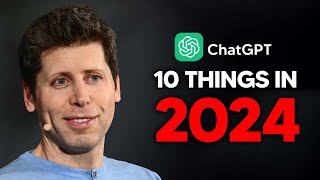
Sam Altman discusses what's coming to ChatGPT in 2024: better reasoning, GPT-5 development, enhanced voice mode, and potential open-source releases. The video covers his predictions for AI capabilities over the next year.
Chapters
This video is going to be taking a look at some of the things that are going to be coming in 2024 for OpenAI's Chat GPT platform. And I wanted to make this video because Sam Altman recently made a Twitter thread where he was talking about all of the things that people do want and some of the things that he's going to take into consideration. And he does talk about some of the features that won't be coming and what will be coming. And also I'm going to be showing you guys exactly what supporting evidence there is to show you exactly what is coming. So you can see right here that this is of course a Twitter thread, but, but let's get straight into this. Let's not waste any time. This one that we're going to be taking a look at is of course better reasoning. Now, on the right hand side here, what I've included is a screenshot from a research paper that was released earlier this year by Stanford researchers. And essentially they just talk about how GPT4 has gotten dumber over time. And although this is a claim that hasn't been peer reviewed just yet, it's definitely something that many of the users have experienced while using ChatGPT. So Sam Altman has actually talked about on the list of things that he's in considering taking a look at. And some of the most mentioned things is of course, better reasoning. And one of the reasons we know that better reasoning is likely to happen is because reasoning has really, really evolved since GPT4's launch date. For example, even regardless of this paper or not, there was a video released by AI Explained and basically it talks about how GPT4 is much smarter than you think. And essentially he introduces smart GPT. It's basically a video that talks about all of the different ways that you can prompt chat GPT gpt4 to get it to have better benchmarks. And this is something that is really crazy because there's Google Gemini's benchmarks, which are absolutely crazy because they just prompted it in different ways to make it have better reasoning capabilities. And the thing is, we know that the base level of GPT4's reasoning can be improved if those other reasoning steps, like I'm not entirely sure which one's the most effective right now, but things like tree of thoughts, chain of thought, prompting, and all these different ways that you can prompt an AI to make it give you a much better response than these things are evolving. And we do know that there's research being done behind the scenes. So whether or not the GPT4 model has been updated or downgraded. We do know that there is going to be some increase in the future because we do know that the version that we do have now, it just isn't as good as what we had before, but it is still pretty good. But we do know that better reasoning is going to be something that's going to be coming because of course as models do improve over time, this is definitely something that we can expect. And also open source models, surprisingly they're catching up. So I wouldn't be surprised if open source models do catch up to GPT4. And I know that does sound crazy, but there is going to be a video on GPT4 open source because if you haven't been paying attention to the open source community, trust me when I say it's pretty crazy stuff. Number two is of course GPT5. Now some people might be thinking that GPT5 isn't going to happen, but trust me when I say guys, I'm going to show you guys some of the clips from the article and basically GPT5 is officially in training. A lot of people did think that GPT5 isn't here yet and it isn't going to be for quite some time, but I'm pretty sure that we will get GPT5 in 2024 because of a few reasons. Number one, they did release Gemini, Google released Gemini and that is of course one of the biggest competitors to OpenAI. And we do know that being such a huge competitor to Gemini and of course OpenAI's GPT4 being dethroned apparently due to Gemini Ultra's capabilities. Of course we haven't got access to the model yet, we haven't been able to test it yet. But from what we've seen so far, people are really, really excited about Google and it seems like Google is back on top again and when they do release that model, it seems like GPT5 who will likely come sometime after. Now what's also interesting is that of course the trademark for GPT5 was actually filed. It was filed quite some time back. I'm not exactly sure remember, but I do remember that this trademark was filed and of course I'm going to show you guys some clips of the video where I talk about these things from the article right here because he actually does actually state this isn't speculation. He does talk about how sophisticated GPT5 is going to be and he does also mention that GPT5 actually isn't training and I think that was around two months ago. So I'm going to play you guys a clip from that video now and if you want to watch the full video, you can, it's on the channel. If I talk about GPT5, its abilities, you know, potential abilities and its projected capabilities on the fact that it is currently being in training to go. So if the model does come out in late to mid-2025, I think that that would be a very good accurate. Now, the article continues to state that while GPT5 is likely to be more sophisticated than its predecessors, Altman said it was technically hard to predict exactly what new capabilities and skills the model might have. Although this is good wording by some Altman, I don't think that this is entirely the case. We do know that it is going to have an LLM base and we do know that the image Capab going to be upgraded. Right now what we've seen from GPT4 in its current state as it's been evolving is definitely far more sophisticated than we initially got with GPT4. So what is likely to happen is that Almond is just saying that we can't say exactly what new capabilities and skills it might have because of course, as you know, these things can change if certain things don't work out too well. So he says until we go train that model, it's like a fun guessing game for us. We're trying to get better at it because I think it's important from a safety perspective to predict the capabilities. But I can't tell you exactly what it's going to do that GPT4 didn't. This is kind of true because in previous statements, Sam Altman in interviews has talked about GPT5 and what the future models are going to be like. So I'm going to show you a snippet from another video where we talked about how Sam Altman did talk about video for GPT5. So take a look at that because I think it's super interesting a law.
Here we can predictably say this much compute this big of a neural network, this training data, this will be the capabilities of the model. Now we can predict how it will score on some tests we're really interested in, which gets to the latter part of your question is can we predict the sort of the qualitative new things, just the new capabilities that didn't exist at all in GPT4 that do exist in future versions like GPT5? That seems important to figure out. But right now we can say here's how we predict it'll do on this eval or this. There are a lot of things about coding that I think are particularly great modality to train these models on.
But.
That won't be, of course, the last thing we train on. I'm very excited to see what happens when we can really do video. There's a lot of video content in the world. There's a lot of things that are, I think, much easier to learn with video than text. There's a huge debate in the field about whether a language model can get all the way to AGI. Can you represent everything that you need to know in language? Is language sufficient or do you have to have video? I personally think it's a dumb question because it probably is possible. But the fastest way to get there, the easiest way to get there will be to have these other representations like video in these models as well. Again, like text is not the best for everything, even if it's.
The third thing that we do have is of course a better voice mode. So I know that this is something that isn't spoken about quite as much, but I can promise you guys that this is absolutely incredible. Guys. Voice for ChatGPT is one of those things that you just can't get enough of once you start to use it, because it is one of those things I can promise you is very, very underrated. Earlier this year they essentially released voice for ChatGPT, which is basically, if you remember how Siri is, or Google's. I think it's. Is it Google's Alexa or, I don't know, it's Amazon's Alexa. And of course you've got Google Voice or whatever. And it's essentially like that, but it's much, much better. And it's really, really effective at allowing you to brainstorm hands free, allowing you to have a really decent conversation. And the thing is, is that your language is auto detected, so you don't need to speak in English. You can speak in whichever native tongue it is and then the software is going to automatically detect that. And the thing is they do use Whisper's API, so the text recognition, voice recognition or whatever it's using is really, really accurate. So I feel like it's a really, really effective way to interact with ChatGPT because some of the times you don't want to type out a prompt. You just want to, you know, brainstorm a session. You just want to do, you know, whatever it is you want to do with your hands. And this is something that I do think that once we get this updated, it's going to be so effective because we've seen now that, you know, there are APIs that are able to give us instant responses. So the only problem with Chat GPT is that, you know, it does, you know, take a while to generate that response and then of course, the AI does talk about it. But trust me, guys, if there's a feature on ChatGPT that you haven't used, I would recommend this so much because it's is something that is just so effective in terms of just having a conversation, whether you're in the car, whether you're just playing a game. You just want to talk to ChatGPT quickly to just ask a quick question. It's definitely something that I do think that if certain mobile companies or whatever just integrate this in, it just shows us the future, what we're going to have with Siri. And this is something that I'm really excited for in the future, if they do even make this better. So it's probably going to be faster, audio quality is going to sound better and there's probably going to be more voices to choose from, which I can't wait for. Then, of course, we do have better GPTs. Now, I did release an entire video on this and I'm going to include some tips from that. But basically the quick thing is that better GPTs essentially just means that what we're going to get is, of course, the upgraded GPT stores. There was not really a leak, but not many people watched the video. But essentially in that video, I talked about how if you look at the source code on OpenAI's page, you can see the exact features that we're going to be getting from OpenAI's new GPTs. And this is something that they've been promising for quite some time. The only problem that this is delayed is because of course there's, you know, these things, these problems with the systems in terms of data leakage. So, you know, people are doing like these injection attacks where they can extract all the data from the GPTs. And I think once we do solve that issue, I'm not sure when they're going to solve it, but once we do solve the issue, that's when this stuff is going to be released. But right now I do know that it is a huge vulnerability in OpenAI software. So take a look at some of the clips from that video because it's really interesting. Like I said, I'll leave a link to the full video, but we're going to be getting a lot of stuff from new GPTs and it's going to be a really cool upgraded version with special capabilities. So what do you think its special capabilities might be? Share your ideas. So around this time, nobody really had any sort of inkling what this version of ChatGPT might be. However, it's now come to light that this version of ChatGPT is going to be a new improvement on the existing version, with some really cool versions that aren't that crazy, but are definitely something that we do expect. So if we take a look here, you can see that that ChatGPT's Project Sunshine is actually ChatGPT with memory, and it's a new GPT store layout. This guy says that ChatGPT's Project Sunshine, which was initially discovered in August 2023 as a version of ChatGPT with special capabilities, is actually ChatGPT with memory. The current version of ChatGPT features a new personalization section in its settings. Now, you might be thinking, okay, this is just one person. On Twitter, this is the equivalent to one person like Jimmy Apples or Futurist flower, those previous OpenAI leakers. But this is a little different because you can actually check this out for yourself. So if you actually do check out OpenAI's JavaScript on the same web page where the GPTs are, you actually do see this information. You actually do see this information immediately. Now, there's actually several different tidbits that you can read here. And like I said, anyone can check the JavaScript themselves. I'm actually going to show you how you can actually check this when you go onto the GPTs page, because this is actually something that is currently on OpenAI's page and this is where the information is grabbed from. There's tons of of Reddit posts about this where people have themselves actually checked that this is a real thing. So even if this is some kind of secret file that OpenAI is hidden, it's still on their website and isn't just a screenshot from a random, you know, email or memo that supposedly leaked. This is definitely something that is on their server. So we can see here that it says memory onboarding modal.title or memory onboarding modal title. And it says your GPT can now learn from your chats. It also says keep the conversation going and your GPT will carry what it learns between the chats, allowing it to provide more relevant responses. And additionally it says improves over time. And it also does say as your GPT will become more helpful remembering details and preferences. So let's actually go over some of these and what exactly they mean. So the first One, your GPT and now learn from your chat actually means that, of course, like I said before, your GPTs and I'm guessing your custom GPTs are going to be able to learn from your previous chats. Now, we aren't exactly sure how they're going to implement this because we do know right now currently there are several issues with the custom GPTs, including prompt injection attacks that are currently working to perfection that allow users to extract data files, prompt information from that custom GPT. Which is why I'm pretty sure OpenAI hasn't pulled the trigger on the GPT Store just yet. Because boy, oh boy, there are some real confidentiality issues with with those things. Once those are ironed out, that's when we're going to get these features, I do hope, because as we know, privacy is a real concern. You can also see here it says that keep the conversation going. So I'm guessing these GPTs, after you have a conversation, what it might do is it might summarize what the conversation was about, add it to the memory bank of that GPT and then you can essentially have more relevant responses. And it says your GPT will carry what it learns between chats, allowing it to provide more relevant responses. Now this is something that has been done on some other versions in small scale scenarios, but nothing like this has truly been done before because as you do know, every time you open a new chat that you know previously, what you talked about was forgotten. So this is going to be something that is really, really, really effective if it does work. And it also does say that it does improves over time, which is going to be good because as you enter more and more information to the GPT, it's going to improve to know exactly what you want. Which means that custom GPTs in the future are going to be pretty crazy. And it does say as you chat, your GPT will become more helpful remembering details, preferences. So maybe where you work, maybe where you live, it's going to remember what you like, it's going to remember what you don't like. I think this is why also the GPT store is going to be delayed and rolling out because this is definitely something they are trying to add. Because without this, this definitely isn't going to be as good. But this is going to set OpenAI once again apart all of the other large language model companies, this is something that they don't have. So if this is something that does come out, it's going to be really, really cool and really, really interesting to see exactly how it works Then of course you can see there's another message that says manage what it remembers. And it does say your GPT has been designed to follow your instructions in chat and you can reset your GPT's memory or turn off these feature in settings. So it shows us that right here we do have a situation where we're going to be able to do this. Now, later on in the video I'm going to show you guys the guy actually accessing this feature in alpha or in beta. I'm not sure if some of you guys have this feature. I know it hasn't been rolled out worldwide, but I do know that it is something that is there, of course loading around Reddit maybe a month or two ago. And actually like I said, you can see it does say keep the conversation going, improves over time and of course manage what it remembers. Then of course you can see he goes over to chat GPT, he refreshes the page and then it says your GPT can now learn from your chat. So this is going to be something that is, you know, of course, really cool. Then of course you can see as well when you do have this feature, this is the temporary chat feature. So like I said, it seems what we are getting from OpenAI is going to be GPTs that constantly remember what we're talking about and constantly improve based on the information that we give it. Which means that over time this could potentially lead us to the personalized AI scenario where we have AIs that constantly are learning about this improve over time and, and become more and more personalized. And I know from my personal use that if my AI is able to constantly remember everything about my business, everything about my day to day, it's going to become a lot more useful because currently I have like 10 different chats open for certain things where you have to keep reminding it exactly what to do, the exact kind of prompts, where you're from, what you like, the tone, the style, the writing, everything. And of course GPTs was a kind of solution for that. I think what they're trying to do now on the back end is just make sure that this is more efficient, solve out the issues where there is the data leakage and privacy leakage. And of course number five is of course less woke. So I'm not sure if this is going to be ChatGPT's main focus because I know that they don't care as much about this kind of stuff. I mean, it doesn't really matter where you stand on the politics spectrum, but some people say that over half of questions or requests are denied and rejected as inappropriate and insensitive due to political correctness, DEI or some other ridiculous consideration. And we do know it's that this was kind of an issue with Claude 2.1 where the ability to reject questions went up from around like 10% to 20%. So basically double. They just refused to answer so many different questions, which kind of makes it somewhat useless. So I think what they're going to do is they're going to make it less woke. And woke just essentially means that it's less politically correct and just will answer any request across the board. So that's essentially what that means. I haven't had any issues from ChatGPT so far. The only ones I have had is with Copyright, images and Dall E3. So I guess we're going to have see, because some people have, you know, said that this is the reason that GROK was made. Of course, you know, see people tweeting about Grok saying it's less work about ChatGPT. And of course Grok is essentially Truth GPT. And if you remember earlier on in the year, that's when Elon Musk criticized ChatGPT for being very, very woke in terms of its political bias and where it was on the political spectrum. It's not something that I'm necessarily focused on because it is, of course, you know, politics, which is, you know, people are really divided on. But I would say that, you know, having a system that's able to answer all of your questions is definitely going to be useful, as long as it' isn't going to be, I guess you could say something that could potentially harm the public. So, yeah, this is something that I do hope is across the board, across all AI systems, does happen because Claude, if you've tried to use Claude to answer simple, it's like really, really simple stuff. Like, it's crazy. I should have some examples. But if you use Claude 2.1, you know exactly what I'm talking about. I wouldn't say Claude is woke, but I would say that it's just. It just refuses to answer questions. So that is definitely an issue with AI systems. But then of course there's something really interesting. Okay, so this one, I was going to make a video on this, but I decided against it because the information is just so speculative that we really don't know what's going on. So essentially the other day, you know, a couple of days, there was this link and you can see it says OpenAI.com vtest and then futurist flower a former slash, you know, or not former. Someone that continues to leak stuff about the, you know, future dates for OpenAI's, you know, future developments. Who's talking about how you know this link? So he tweeted this link and he said, sam has stopped trolling us. And then when you click this link, it actually did go to an OpenAI webpage that was there and on the page it just simply said vtest. Now if you do go to that page, it just says 404. There's nothing there. So it was clear that once he tweeted this page out, OpenAI for some reason removed the page. I'm not sure which is definitely a little bit weird, but essentially he was saying that this tweet or this webpage is essentially OpenAI working on video. Now there isn't really anything else to back up this claim other than there was a few articles from the information that talk about Project Arrakis and some other stuff which is very, very speculative. But we do know that with them working on Dall E3 and with Google's Video Poet coming out, we do know that Video Poet is absolutely crazy. By the way, there will be a video coming on that soon. But the point is that video has been developed quite surprisingly. Like video is making strides. Okay. And the reason that Video Poet we're going to make a video on that is because essentially this is crazy because Video Poet actually can do infinite video length. So I haven't actually tested this yet. Google hasn't. You know, I'm not sure, I'm not sure if they've given access just yet. But the point is, is that video is going crazy. And if you have been paying attention to the video side, you'll know that. Of course there is also this too. There is also PCOLLabs. So this is something that you should also be paying attention to because it looks to be very, very good because this is version one and if the trajectory is anything like mid journey, then we are going to be getting some very high level fidelity videos in 2024. So OpenAI hasn't released anything on video just yet, but the speculations are there that they might do that because if they do, they definitely could once again surprise everyone with that video model. And I'm pretty sure that that would change a lot of things. Like that would be so useful to just have video. And it would also be very, very interesting to see how OpenAI does it. Because one thing we know about OpenAI, they don't take the traditional route Whatever, whatever they do, they definitely have some kind of super, super secret sauce. So it will be interesting to see exactly how OpenAI does manage to do this. So I'm not sure how they're going to do it, but however they do do it, I will be excited to see how that does work out. So with video coming, I think, you know, OpenAI could do it, but like I said, I'm not sure if they're going to do it, but it will be interesting to see if they do take a crack at a video and if they are working on that. Now, of course, there is something else that I do want to talk about, and of course, something they talked about was rate limits. And this is something that has been there for quite some time. So rate limits are just that. When you see that we have OpenAI, you know, telling us that we can only send 40 messages every three hours, it is something that is very, very frustrating. Okay, so this is something that you largely experience if you use OpenAI's products. And this is something that, you know, people want to get rid of. Because you're not able to consistently have conversations with GPT4. You have to wait every three hours and then, boom, your messages get, you know, denied. It's like, you know, you know, you can't do it anymore. And sometimes the system just, just, it literally just craps out. Like, the text will go red and I'll just be like, sorry, we're doing an error right now. So this is something that I think they're definitely going to solve anyways, because if they want people to use this, then people are going to have to have higher rate limits. And essentially this just explains what rate limits are. It's basically like I said, you don't want to have too many requests. But I get their stance on this, because if they didn't have rate limits, people are going to abuse the API. People can flood the API with requests and attempt to overload the servers and cause disruption to the service, but by setting rate limits, they can prevent that. And of course, they ensure that everyone has fair access to the API, because someone could make an excessive number of requests, and then it could bog down the OpenAI for everyone else. So we do know that, like I said, OpenAI, GPT4 does require a ton of compute to run, and that's partially why GPT4 oftentimes is quite slow and they limit our rates. But hopefully they found a more efficient way to run this in the future. And then, of course, we're going to get lower rate limits. In fact, higher rate limits in the future because that would be so much more effective. Then, of course, we do have something that is going to be interesting and that is better browsing. So some people state that browsing isn't really good for them. I find browsing to be really good for me. But the only thing with browsing that I do think is going to be an issue is how slow it is sometimes, and sometimes it is a little bit inaccurate. So I think that browsing, if we do get better browsing, that is definitely going to be something that should come. I'm not sure when, but like I said, it's going to be one of those features that I'm pretty sure it's going to be at the top of their list because it's definitely something that does need to work. Because the problem is, is that there's other tools like Bard and other tools like Perplexity that are currently better than ChatGPT at browsing the Internet because they are faster and they are more accurate. So I'm pretty sure that this is going to be something that they're working on. And like I said here, there's other tweets of people not being able to use browsing effectively. But let me know what your things are on browsing, because I've had a pretty decent, decent run with it, although it isn't that accurate, but I've had a pretty decent run of this. So I wouldn't be surprised if they did increase browsing. Now, there's another that they did also potentially include, and I'm pretty sure this one is going to be easier as well, is sign in with OpenAI, which is going to make a lot of cool tools possible that are currently a huge pain. Because of course, the problem with signing with OpenAI is that when people don't sign in, they essentially have to use the other person's API. So, for example, if I make an AI software and I'm calling from, I guess you could say I'm using OpenAI's API through my account or whatever, it's going to be really expensive for me. But if we can sign in with OpenAI, that means the cost is on me and all of those users. And then if you want to build a product, it isn't as expensive because you're not using your own API and the cost isn't financially impossible where there's so many API requests, that makes it so much expensive. Whereas if someone uses the API request for themselves and then you get invoiced based on your account that's going to make a lot of different applications more financially viable. That would be really cool. So signing in with OpenAI, that would be a game changer, although it doesn't look like it, but that would be a complete game changer. Now number 11 is pretty crazy because this is open source and I don't think this is going to happen. I don't know why Sam Altman tweeted this that this is some something that they not that they might do, but he tweeted as something that on the list but OpenAI is just not open source at all. OpenAI is completely closed source. It did start as open source. So I don't really predict OpenAI going to open source. I mean, open source, funnily enough, is actually catching up to the levels of GPT 3.5. In fact, it's mainly surpassed them and some are trying to catch up to GPT4. But do I think that they're going to release any of their new models open source? No. Maybe they're going to open source GPT 3.5 so that people can build on that because it's no longer like the king. But I really don't see them doing that because there's no advantage. And plus this is an AI race and they really don't want anyone, you know, stealing their crown. But of course, last but not least is the things we can't predict because Sam Altman says I will keep reading and we will deliver on much as we can and plenty of other stuff that we're excited about and not mentioned here. So we know that with all the stuff that are on there, he's going to be delivering on loads of those things. But of course for ChatGPT as well, there's going to be loads of stuff that he can deliver on but we don't know about. So it's clear that there's some other features that are coming that we don't know about. I have no idea what those are. Definitely in the comment section below. Definitely have a conversation about what could be there because I'm intrigued to see what you all predict, but I'm not entirely sure what will be coming that isn't on that list. But I guess maybe AI Agents isn't on that list and I guess that's something that would likely be there. So with that being said, if you enjoy the video, we'll see you on the next one.










