Sam Altmans Statement On AGI Is Bigger Than You Think!
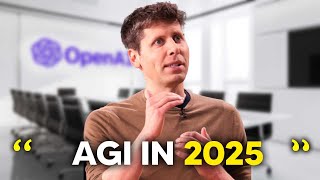
A YouTube commentary by LARRUZ analyzing Sam Altman’s interview remark "AGI... excited for that," interpreted as a prediction that AGI could arrive by 2025. The video cites supportive reactions from OpenAI staff (Noam Brown, AdamGPT), parallels Dario Amodei’s estimate (~2026), and discusses scaling laws, inference-time compute, model reasoning fragility (benchmarks like GSM8K and SimpleBench), and claims that the path to AGI is largely understood. The narrator highlights Altman’s further claim that superintelligence could arrive in "a few thousand days" if current progress compounds.
Chapters
So Sam Altman recently made a statement about 2025 that has a lot of people surprised and a lot of people are debating currently whether or not this statement is true or completely false. This is the statement in question.
What are you excited about in 2025? What's to come?
AGI. Yeah, excited for that.
So of course you can see there, Sam Altman clearly stated that in 2025 it's quite likely that we will have AGI. And I think this is one of probably the most profound statements that we've ever had in any interview from any OpenAI employee. Now, of course, this statement does warrant some skepticism because AGI has been a thing that is heralded as this incredible piece of technology that most of us can't even fathom due to the immense possibilities that happen if AGI becomes a reality. Now, one of the things that I found interesting was the fact that a lot of people who are actually working at OpenAI commented on this statement and their comments are actually supporting Sam Altman's statement that basically stating that, look, this statement isn't ridiculous, it's actually on par with what we're seeing inside the company. So someone that worked on the O1 model, this is Noam Brown. He worked on reasoning at OpenAI and has done a remarkable number of things to advance the state of reasoning in AI. He actually stated that. I've heard people claim that Sam Altman is just drumming up hype, but from what I've seen, everything he's saying matches the median view of OpenAI researchers on the ground. So this is where we actually get a look to what individuals are saying when that is going on inside the company. If Sam Altman is stating this, of course he does have an incentive to state the best about his company. After all, he is the CEO, and after all, he does have to maintain a good public image and drum up hype for his industry. But of course, if individual researchers at the company are saying, look, this is not hype and this is basically on par with what researchers are saying, then I think it gives us more confidence in that. Sam Altman's statement is not something that is completely ridiculous, but more in line with what these AI researchers are starting to think say. Now, someone else from OpenAI also shares the same view. Adam GPT, the GTM at OpenAI actually stated this. He said that it's not AI hype. He says, I've been intently listening to Sam for my three years at OpenAI and he is precise with his words and comments. I personally think the disconnect where he is viewed as hyping things up is that he speaks very transparently about where and when things are going trending, which with the pace and progress of AI, if things that are talked about down appear immediately, people often feel disappointed and it's a bit of a catch 22. And I personally love that he communicates outwardly and publicly about our progress. It's important we continue to accelerate on our path towards AGI. So you can see here that AdamGPT actually supports SAM Altman's statement and basically says that, look, this is just a disconnect because most people can't fathom how fast the company is moving and this is truly where they are. Now. One of the things that also intrigued me was the clear date 2025. So next year, as you know, it's going to be 2025. But I couldn't help but keep thinking that this date is a pretty significant one in question. Now, one of the Twitter accounts that I follow and engage with quite a lot is the Twitter account the Legendary Jimmy Apples. Now, for most of you probably don't know who this account is, but it is account that somehow manages to get early AI information months and years early before anyone else in the AI industry knows what's going on, of course, other than those at the company. Now, in his bio you can see he says 2025, which means that if his predictions hold true, it's quite likely that in 2025 something significant in the AI space is going to happen. Now, he did put this 2025 date in his bio a couple of months ago, so it's clear that he knew something, slash knows something that a lot of people don't. And I do remember that it was, I think around a year before we got any news about Orion, that he was actually tweeting about Orion and most people didn't even realize what he was tweeting about until we knew what was happening. Now, let's say this statement where Sam Altman clearly says AGI in 2025 and of course he's excited for that. Let's say you think it is a decent amount of hype. Whilst that might be your initial response to that monumental statement, take a look at this. And what I want to show you guys is something from Dario Amadei, who is the CEO of Anthropic, which produces the models Claude and is competing with OpenAI for market share. Now, I think it's clear to state that there are three companies at the frontier of the AI race currently OpenAI, Anthropic, and Google. And in this statement, he actually gives his date for when AGI is going to come. Now, it's important to note that in this article he doesn't state that AGI is AGI, but he refers to it as powerful machine intelligence. You can see here he says, I dislike the term AGI, but obviously many people are skeptical that powerful AI will be built soon. And some are skeptical that it will be built ever at all. And I think it could come as early as 2026. So if Sam Altman's statement that AGI is next year seems a little bit hypey, I don't think it is, when in the grand scheme of things, the CEOs of Frontier Labs are talking about the fact that advanced machine intelligence or powerful AI is going to come at 2026, which is only a year later than Sam Altman's prediction. Now, something interesting that Sam Altman also spoke about was of course, the very fascinating scaling laws when we started.
Yeah, the core beliefs were deep learning works and it gets better with scale. And I think those were both somewhat heretical beliefs at the time. We didn't know how predictably better it got with scale. That didn't come for a few years later.
It was a hunch first, and then you got the data to show how predictable it was.
But people already knew that if you made these neural networks bigger, they got better. Like that was. We were sure of that before we started. And what took the like word that keeps coming to mind is like religious level of belief was that that wasn't going to stop.
Now, of course, the scaling laws are infamous in AI for predicting the future trends. And what's interesting is that if you've been paying attention to the AI space, you'll know that there are of course, these new incredible scaling laws. Train time compute and test time compute. Basically, the fact that these models get predictably smarter at inference time, if you allocate more compute to the actual model's thinking, it's able to think for longer and harder about problems and come up with reasoning steps to be able to solve those same problems, but with a greater degree of accur on this graph, you can literally see that as train time compute goes up, the accuracy on the benchmarks continue to increase. And of course, for the test time compute, you can see that as more compute is applied, you can see that these models get predictably smarter every single time. And I do wonder, considering the fact that they've only applied a certain amount of compute once we get access to ridiculous Levels of compute where we have giant data centers that are spanning the size of entire cities. I do wonder what this graph will look like. Saint Markman also said that the future of O scaling is quite interesting. The CPO responded to this comment on Reddit that basically says, how will you influence scaling LLMs? Will you continue scaling LLMs as per the initial scaling laws? Or will inference compute time scaling mean smaller models with faster and longer inference will be the main focus. And they stated that it's not either or both. It's better base models plus more Strawberry scaling and inference time compute. Basically stating that, look, they're going to make the base model better. And on top of making that base model better, they they're also going to scale up the amount of compute that they use on inference time, meaning that overall you get a better base model to begin with, even if you don't use any compute on it. But with the added compute, it just becomes even better. Now, of course, some people had been skeptical of AI's reasoning.
Everybody had some reason of, oh, it's not really learning, it's not really reasoning, it can't really do this. It's, you know, it's like a parlor trick. And these were like the eminent leaders of the field. And more than just saying you're wrong, they were like, you're wrong. And this is like a bad thing to believe or a bad thing to say. It was that there's gotta, you know, this is like you're gonna perpetuate an AI winter. You're gonna do this, you're gonna do that. And we were just like looking at these results and saying, they keep getting better. Then we got the scaling results.
Now, whether or not LLMs can actually reason has been a widely debated topic for quite some time now, ever since the inception of LLMs. Some people just think that these things are statistical savants. They're just simply predicting the next token. And of course, some research basically suggests that LLMs don't actually reason, but rather mimic reasoning patterns from their training data. I'm not sure if you guys watched the video I made around three weeks ago that basically talks about how Apple showed that on certain benchmarks, when you change the names of certain individuals, it actually drops the respective results by around 10 to 15%. And that's even for Frontier models like 01 and GPT4, which is quite surprising considering that these models are supposed to be reasoning. And of course, an unrelated clause can decrease performance by up to 65%, basically stating that these LLMs are pretty fragile when it comes to their reasoning abilities. Now, this is not the only time that we've heard this narrative being spun in the AI community. One of the individuals that is famous for his stance on AI, well, I guess you could say against current LLM architectures is of course, Yann Lecun. Now, Yann Lecun, I do want to say, is of course one of the most notable figures in the AI industry, as he did win the Nobel Prize of Computing, which is basically the Turing Award. And one of the things that Yann Lecun clearly states is that large language models are not a sufficient path to AGI to because they miss essential capabilities for intelligent beings, such as understanding and reasoning about the physical world. Basically stating that, look, LLMs don't really understand where things go, and it's quite hard to infer this kind of physical data just from text. One of the benchmarks that was essentially trying to prove this was of course, simple bench, and this was a reasoning benchmark that was created with the sole goal of seeing if these models are actually able to reason about the physical world or standard problems quite like how humans do. I don't have any examples of the questions here, but some of them include things like if you put five ice cubes on the fire, how many ice cubes will be there in the next minute? And then having a multiple choice that has different numbers that the AI can pick from, and then seeing what reasoning steps they took to get to their answer. It's pretty fascinating considering the fact that the human baseline is 83.7%, where the LLM baseline is around 40%. And a lot of these questions don't really require advanced knowledge. You could ask them to any normal person and they would find out the answer pretty easily. Another thing that was actually really incredible from this interview was the fact that Sam Altman basically said that the path to AGI was solved.
This is the first time ever where I felt like we actually know what to do. Like, I think from here to building an AGI will still take a huge amount of work. There are some known unknowns, but I think we basically know what to go do. And it'll take a while, it'll be hard, but that's tremendously exciting.
So Sam Altman stating, look, I think we basically know what to go ahead and do is something that is really profound. Stating that, look, we know exactly the kind of steps we need to get to artificial general intelligence, the technology that's going to revolutionize the world as we know it, which is quite akin to basically inventing the steam engine, we know exactly where to go. And I think that is really important considering the fact that a lot of times what companies I wouldn't say waste time doing, but it's part of the natural AI ecosystem, is that they have to conduct research. Now research is very time intensive, it's very compute intensive and, and of course it costs a lot of money. And the problem with that is that you might spend months on a problem only for you to realize that this isn't something that will work. So them basically stating that look, the path to AGI is clear now. I think this is actually a really profound statement because it means that things are speeding up even more. And one of the craziest things that was said recently in the OpenAI AMA, where you had individuals asking OpenAI questions about the future of AI, was that they said basically they can look at the current hardware and understand that with the current AI systems they're going to be developing that AGI is possible, so there won't be any new architecture breakthroughs in terms of the hardware. So for those of you guys thinking that we're going to need quantum computing, neuromorphic chips or any of that kind of stuff, it seems that it's quite likely that we will be able to get to artificial general intelligence just by using the current hardware. The next thing that I also found super interesting that most people didn't really catch was of course the thing about level three to level four. And, and I think this is probably once again something that is really profound because this actually means society will change faster than we initially thought.
Well, I had been telling people for a while, I thought that the level 2 to level 3 jump was going to happen, but then the level 3 to level 4 jump was level 2, level 3 was going to happen quickly and then the level 3 to level 4 Jump was somehow going to be much harder and require some medium sized or larger new ideas.
So basically this is where Sammartmon is referring to the fact that we are currently at level 2, but the level 2 to 3 jump was basically where you have level 2 being the reasoners which are able to solve human level problems, which is kind of what 01 is. And of course level three being the systems that are agents. And basically what he's saying that look, we know exactly where we're going to be going with agent systems that can take actions. So essentially stating that, look, we know that the jump from level two to level three was pretty nice, but of course the jump from level three to level four was going to probably be a monumental jump considering the fact that we're looking for AI that can innovate. Level four is innovators and AI that can aid in invention. The reason this initially seems difficult because it means that AIs need to be able to generate novel ideas and be able to also evaluate those ideas and additionally do research. So Sam Altman basically stating that look, we are going to get to level four a lot faster because there's no crazy breakthroughs that are needed to get to innovators. It actually means that the O1 series of models are a lot smarter than we initially thought. If these systems are already able to show us that future versions of them are going to be able to aid in innovation, that means that getting to innovators is truly going to change things quicker than we initially thought. Now, of course I was looking around for some research and I found that there was also this research paper that basically looked to automating AI research and this is coming out of Stanford University and they basically said that look, automating AI research is exciting, but can LLMs actually produce novel expert level research ideas? After a year long study, we obtained the first statistically significant conclusion. LLM generated ideas are more novel than ideas written by human expert researchers. And of course there was also AI research that was basically from Sakana AI where you had automated AI research done. So quite likely that OpenAI may have built on top of that too. Now the crazy thing about this is that getting more out of the models is not something that is new news somewhat when in this clip basically says that look, if we manage to have some kind of framework around 01, we actually can get even more out of these models.
And that demo and a few others have convinced me that you can get a huge amount of innovation just by using these current models in really creative ways. I think things are going to go a lot faster than people are appreciating.
So there you have it. It seems that and what Sam Altman is basically referring to right here, basically stating that look, you can get a huge amount of innovation just by working with the models. And of course doing different things to them, is basically where you have different prompting strategies and you have different ways to interact with the model than we initially thought. Remember how when ChatGPT was first released, everyone would just input a prompt, get a response, and that's how you interact with the model. It wasn't until that people started interacting with the model in different ways that we got major improvements. For example, if you look at the GSM 8K benchmarks underneath the filters area. You can see that there are many different ways that you can actually evaluate the models. One of those is majority voting where you basically take 10 different responses and then the model votes which one it thinks is the best. Of course you've got chain of thought which is where you ask the model to think step by step. There are other things like self consistency and basically what I'm trying to highlight here guys, is that interacting with the model where you just simply input one piece of dialogue in and then you get a response out, that isn't how realistically you're going to push the frontier forward. You're always going to have to change how you interact with the model. That way you can figure out what is the most efficient way to get the smartest response. And interestingly enough, Sam Altman has also spoke about how O2 is get 105% on GPA, which is just simply unheard of. And I do wonder, and this is still playing on my mind, that is this due to the fact that there was another recent breakthrough at OpenAI? What was one thing that surprised you.
In the last month, Sam? It's a research result I can't talk about, but it is breathtakingly good.
Apparently the research result is breathtakingly good. Now Sam Altman also said something in a different blog post that he actually responded to here. One of the craziest things that Sam Altman actually said was that it is possible that we will have super intelligence in a few thousand days. It may take longer, but he's confident that we'll get there. Now superintelligence in a few thousand days is basically a lot more impactful than AGI. AGI is basically humans at scale. But super intelligent is basically where you have a God level AI that is able to do things to us that we would basically deem magic.
In the essay you actually say a really big thing, which is asi. Superintelligence is actually thousands of days away maybe.
I mean that's our hope, I guess. Whatever. But that's a very wild statement.
Yeah, tell us about it. I mean that's big. That is really big.
I can see a path where the work we are doing just keeps compounding. And the rate of progress we've made over the last three years continues for the next three or six or nine or whatever. You know, nine years would be like 3,500 days or whatever. If we can keep this rate of improvement or even increase it like that system will be quite capable of doing a lot of things. I think already even a system like O1 is capable of doing quite a lot of things from just like a raw cognitive IQ on a closed end, well defined task in a certain area. I'm like, O1 is like a very smart thing. And I think we're nowhere near the limit of progress.
So overall, it seems like 2025 is leading up to be one of the biggest years in AI that we may have seen. And it seems like OpenAI are once again very much ahead of the larger package.










