Scientists TELEPORT Smells with AI! (Worlds First) Osmo AI
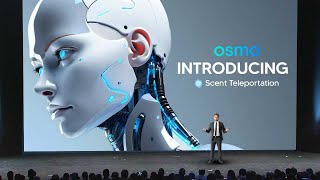
OSMO AI, led by former Google researcher Alex Wilchko, claims to digitize and recreate smells by analyzing volatile molecules, encoding them, and printing a liquid replica. The company uses graph neural networks to predict scent from molecular structure and design new molecules, with applications from mosquito repellents stronger than DEET to VR gaming and medical diagnostics.
Questions this video answers
November 1, 2024
Alex Wilchko (former Google Research)
Graph neural networks
Chapters
We used AI to digitize and rematerialize the essence of a plum. What we've done is we've cut a plum here and we're going to put it into a vial where the scent that's leaving the plum is being trapped inside of this vial. And then what we can do is take this vial to a machine which can suck the air outside of this vial which contains the smell of the plum, and then analyze those molecules one by one. And when we have that, we can then take that formula and then we, we print it. If we've done the whole process correctly. The thing that ends up reprinted, which is just going to look like a clear liquid, is the distilled essence of the scent of a plum you've just cut into. And if they smell the same, it means that we've actually given computers a new sense. And the sense of smell is effectively the way that we turn the air around us into data. What does it smell like?
So today we had OSMO AI debut their revolutionary technology that enables them to teleport scents. And those of you that are wondering, yes, I guess this means that Smell O Vision is finally happening. So this is a company which is surprising in the fact that I've never heard of it because I try to pay attention to many different AI companies and this is one that is founded by some former Google researcher. And I think the information about this product is one that is truly fascinating. Smell O Vision has large been a long sci fi fad which most people thought would never happen. But it seems like as we move onto the2030s, a lot of technology that seemed impossible before will seem like everyday use. So for this I think it's best to take a look at some of the things they're claiming on their website and also take a look at the monumental use cases that this technology has. Of course, I think we're still in the early days because this isn't baked into any products yet or any wide industry use cases yet, which I'll talk about in the latter parts of the video. But I think that this has some really wild scale usage applications. Now it does talk about how the fact that vision and hearing have been digitized, but not smell, which is our oldest and our deepest sense. And OSMO brings together the frontier AI and olfactory science to solve this historic challenge. And they're starting with the incredibly complex art of fragrance. And their ultimate goal is to improve the health and well being of human life through smell. Now you can see that this is coming out of the brains from Google. So before osmo, their team was led by Alex Wilchko at Google Research, where they used cutting edge machine learning to build the foundations of osmo's map of smell. And there's a constant trend that I'm seeing in the AI industry is that former Googlers consistently go on to create interesting, innovative, great and new companies that are quite remarkable. Now, first they say that they use graph neural networks to achieve a major breakthrough in predicting the smell of a molecule from its structure. Then they can create new molecules that no one has ever smelled before and predicting them with superhuman accuracy. And then of course, they can potentially design molecules that smell bad to mosquitoes, for example, insect repellents, and are more potent than DEET in human trials. One of the use cases that they're talking about here is the fact that they could capture and analyze exactly what makes DEET smell so bad to mosquitoes. DEET is basically a really, really horrible smell for mosquitoes, which basically smells like rotting fruit or rotting eggs to them. And basically with this new smell digitizing technology, they could capture and analyze what makes mosquito repellent smell so bad. Use their AI and smell map to understand exactly what parts of the smell mosquitoes hate the most, and then create variations of that smell recipe, making it even stronger or tweaking it to be more effective. And you could test these new variations quickly using their smell printer. And the really cool part is, you know how much faster smell this could make the whole process. Instead of physically making hundreds and thousands of different chemical combinations, they could digitally model new repellent molecules and use their AI to predict which ones would smell the worst mosquitoes and only physically create the most promising versions. And then of course, fine tune the formulas based on real results. It's like having a mosquito repellent design studio where you can tweak smells like you'd edit a photo in Photoshop. And of course you could also make sure that these smells aren't too bad for humans, since this kind of smell has a really bad chemical smell. So it's all about using this in a variety of different applications. Now I will talk about more applications in a moment, but they did mention that this is going to be coming soon. It says soon we will be opening selected demos to members of the public. Hopefully some of you will come by to experience the scent to teleportation firsthand. We will ask you to pick a flower or a fruit from an extensive bouquet and then let you reflect on its smell while we analyze a sample of it in our lab in A single sitting. We will recreate your special scent and diffuse it back to you. And then at the moment of truth, your review, how faithful was our reproduction? So for those of you who think that this isn't real, this technology might be fake. There's going to be select demos to members of the public, so potentially you might want to sign up to their website to see if you're going to be one of the early ones that's able to get in on this technology. I do think it will be really interesting to see what kind of smells they're going to be able to capture and then of course, re digitize those smells. Now, apparently they are stating that every month it gets even better. It says that in the six months since they've announced scent teleportation, they've made an astonishing amount of headway. Every month they make scent teleportation a little bit quicker, a little more automated, and challenge it to transmit more complex smells. And so we get a bit closer to the ideal that we're working towards. A world brought closer together in one of the most essential ways where a beautiful scent that you smell on the hike is easy to send as a picture or song. And I think this is going to be rather fascinating because smell is one of the most underrated things that most people don't really think about. When you think about your sensory inputs, the only time that you really think about smell is if there is a particularly bad smell and you can immediately smell it and you just start holding your nose. That is something that of course all humans do, but. But this is something that we do often take for granted. Many a times in environments we use our main ones which are, you know, our vision, which is of course what we are initially seeing, and then of course our physical sense of touch to interact with the physical environment. I think smell is going to be something that is quite niche, but definitely has a load of different use cases. Now they actually talk about some of their use cases where they state that applications of osmo's AI scent platform start in the sensory world of scent, but extend broadly to any domain in the physical world where small molecules hold value or information. And that we work with partners to develop and explore new experiences and solutions with our platform. So this got me thinking, what are some of the key areas that this could be applied? And I've written down a few that I think you should all be aware of. For example, what about the applications for OSMO Cosmo and its smell in virtual and augmented reality? Imagine you had virtual forest setting Users could smell pine trees, fresh rain. That would add a complete, deeper layer of immersion. And in augmented reality, scents could be used in educational settings, like experiencing the smell of ancient artifacts during a historical lesson. Or, of course, in certain lessons where you need to teach kids, hey, if you smell this kind of smoke, you. You might want to run the other way. Of course. For example, in gaming, adding scents to games for a more interactive experience, especially in genres like adventure, survival and exploration, imagine exploring a jungle in a survival game and being able to smell the damp earth, the flora, or even the smoke when there is danger nearby. I mean, this could really have some crazy implications for a horror experience. And imagine you're in a horror game and you start to smell a weird smell, and you're like, okay, I have no idea what's going on. Is this person behind me. This just basically adds a new sensory challenge and enhances the emotional engagement. Now, I think one of the largest things that is probably on the table that they didn't really mention was the fact that you could create a multisensory experience where scents accompany scenes in movies, which gives audience a richer experience. For instance, during a romantic scene in a flower garden, the audience could smell roses. Or in an action scene with explosions, the scent of gunpowder could be diffused, making the experience more vivid and engaging. I know that I certainly would enjoy that a lot more than the traditional movie experiences. Now, of course, we've got retail and marketing where you have these product demonstrations. You could allow customers to smell fragrances or food digitally before buying, especially for online retail. This could be particularly impactful for items like perfumes, where scent is a major factor in purchasing decisions or even food products, allowing customers to get a sense of the freshness or flavor before buying. And I think one of the craziest things is that, of course, you could provide customers the option to create their own scents digitally and have them recreated in store. This could involve an interactive experience where customers use a digital scent creation tool to create different aroma notes, finalize the personalized scent, and then, of course, it's formulated by the store for them to take home. Now, I think one of the things that this might be useful is, of course, quality control and assurance, ensuring the consistency of flavors by analyzing and recreating the scent profiles of food products. This can help food manufacturers maintain a uniform taste experience across different production batches, reducing variability and ensuring consistent quality for consumers. You can allow customers to smell a dish or product before ordering, especially useful in online grocery shopping or restaurant selections. And one of the craziest things is that we could of course, assist in food and beverage companies in analyzing the aroma profile of new products for enhanced flavor development. This could be really useful for creating new flavors or even improving existing ones, as understanding the exact scent profile can help in fine tuning the ingredients and the processes used in that information. There could also be applications in crop, soil and monitoring. You could analyze the scent profiles in the environment to monitor the health of crops or soil, detecting pests or diseases early. For instance, scent analysis can identify specific volatile organic compounds released by plants under stress, helping farmers to take early action to address issues like nutrient deficiencies, pest infantations or fungal infections. And this can lead to more precise and timely interventions, improving crop yields and reducing chemical usage. Now, with the supply chain, you could also use this. If you manage to get this technology into a really small size, you could use it to detect spoilage or contamination in perishable goods like fruits or meat during transport. This technology can help identify early signs of spoilage, such as the release of specific volatile organic compounds, enabling timely intervention to prevent waste. For instance, sensors could detect the onset of bacterial growth in meat products, allowing suppliers to take action before the goods reach the consumer. Then, of course, we have quality assurance, ensuring the freshness and quality of goods during transit by regularly analyzing the scent of shipments. By continuously monitoring the scent profile, companies can ensure that perishable goods like fruits, vegetables or dairy products remain in optimal condition throughout their journey. And this not only helps maintain product quality, but also reduces the likelihood of customer complaints or returns due to spoilage. I think one of the biggest applications for this, but this would be really difficult to do, and this is healthcare diagnosis and research. So you could potentially partner with medical research to create devices capable of replicating the diagnostic capabilities of trained animals, such as detecting diseases through scent. These electronic noses could be used in clinical settings to identify specific markers of diseases like cancer, diabetes, neurological conditions, potentially enabling earlier and more accurate diagnoses. Such devices could also be utilized in breath analysis, where sensors detect VOCs related to metabolic changes, providing non invasive diagnostic solutions. Now, of course, contributing to research into identifying specific volatile organic compounds associated with different health conditions could be a real application. By analyzing the unique VOC signatures of various diseases, researchers can develop a better understanding of their biochemical process. And this knowledge could lead to the development of new diagnostic tools that are faster, less invasive and more cost effective, potentially revolutionizing early disease detection and monitoring. Osmosent teleportation technology is a real innovative leap and has the potential for applications across entertainment, healthcare, retail, hospitality, food, beverage, cosmetics and many other industries. Its main contribution is the digitization, analysis and recreation of scent profiles, which can enhance user experience, provide quality control, and enable entirely new sensory applications in a variety of contexts. It will be interesting to see how this technology develops.










