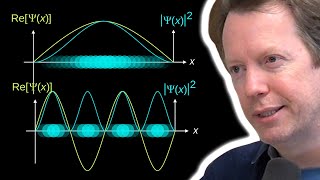
Sean Carroll explains why electrons can't orbit atoms like planets, and introduces the wave function as a single complex field that describes all particles at once. An orbiting electron would collapse in 10^-11 seconds, which is why quantum mechanics replaced the solar system model with waves.
Questions this video answers
About 10^-11 seconds (100 billionth of a second).
Chapters
So what's a wave function? You said it's an interesting detail, but in any interpretation, what is the wave function in quantum mechanics? Well, we had this idea from Rutherford that atoms look like little solar systems. But people very quickly realize that can't possibly be right, because if an electron is orbiting in a circle, it will give off light. All the light that we have in this room comes from electrons zooming up and down and wiggling. And that's what electromagnetic waves are. And you can calculate how long would it take for the electron just to spiral into the nucleus. And the answer is 10 to the minus 11 seconds. Okay, 100 billionth of a second. So that's not right. Meanwhile, people had realized that light, which we understood from the 1800s was a wave, had properties that were similar to that of particles. Right? This is Einstein and Planck and stuff like that. So if something that we agree was a wave had particle like properties, then maybe something we think is a particle, the electron, has wave like properties. Right. And so a bunch of people eventually came to the conclusion, don't think about the electron as a little point particle orbiting in like a solar system. Think of it as a wave that is spread out. They cleverly gave this the name the wave function, which is the dopiest name in the world for one of the most profound things in the, in the, in the universe, there's literally a number at every point in space which is the value of the electron's wave function at that point. And there's only one wave function. Yeah, they eventually figured that out. That took longer. But when you have two electrons, you do not have a wave function for electron one and a wave function for electron two. You have one combined wave function for both of them. And indeed, as you say, there's only one wave function for the entire universe at once.