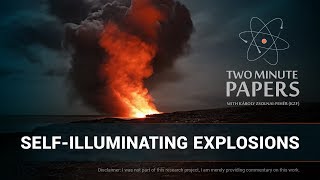
Researchers converted volumetric explosion simulations into point lights to render them 39 times faster. A 13-hour path-traced render took roughly 20 minutes instead, using multi-resolution grids to compute illumination and shadows efficiently.
Chapters
Dear fellow scholars, this is two minute papers with Today we are going to talk about explosions. To be precise, imagine that we already have the physics simulation data for an explosion on our computer, but we would like to visualize it on our screen. This requires a light simulation program that is able to create an image of this virtual scene that looks exactly the same as it would in reality. We have had plenty of earlier episodes on light transport, and as you know all too well, it is one of my favorite topics. I just can't get enough of it. I've put a link to these related episodes in the video Description if we wish to render a huge smoke plume, we perform something that computer graphics people call volumetric light transport. This means that a ray of light doesn't necessarily bounce off of the surface of materials, but it can penetrate their surfaces and scatter around inside of them. A technique that can deal with this is called volumetric path tracing. And if we wish to create an image of an explosion using that, we well better pack some fast food because it is likely going to take several hours. The explosion in this image took 13 hours and it is still not rendered perfectly. But this technique is able to solve this problem in 20 minutes, which is almost 40 times quicker. Unbelievable. The key idea is that this super complicated volumetric explosion data can be reimagined as a large batch of point light sources. If we solve this light transport problem between these point light sources, we get a solution that is remarkably similar to the original solution with path tracing. However, solving this new representation is much simpler. But that's only the first step. If we have a bunch of light sources, we can create a grid structure around them, and in these grid points we can compute shadows and illumination in a highly efficient manner. What's more, we can create multiple of these grid representations. They all work on the very same data, but some of them are finer and some of them are significantly sparser, more coarse. Another smart observation here is that even though sharp high frequency illumination details need to be computed on this fine grid, which takes quite a bit of computation time, it is sufficient to solve the coarse low frequency details on one of these parser grids. The results look indistinguishable from the ground truth solutions, but the overall computation time is significantly reduced. The paper contains detailed comparisons against other techniques as well. Most of these scenes are rendered using hundreds of thousands of these point light sources and as you can see, the results are unbelievable. If you would like to learn even more about light transport, I am holding a master level course on this at the Vienna University of Technology in Austria. I thought that the teachings should not only be available for those 30 people who sit in the room who can afford a university education, it should be available for everyone. So we made the entirety of the lecture available for everyone free of charge and I am so glad to see that thousands of people have watched it and to this day I get many messages that they enjoyed it and now they see the world differently. It was recorded live with the students in the room and it doesn't have the audio quality of two minute papers. However, what it does well is it conjures up the atmosphere of these lectures and you can almost feel like one of the students sitting there. And if you are interested, have a look. The link is available in the video description and make sure to read this paper too. It's incredible. Thanks for watching and for your generous support and I'll see you next time.