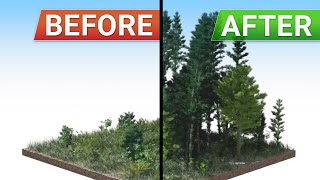
Dr. Károly Zsolnai-Fehér breaks down a 2019 paper that simulates how forests grow over centuries. A 400-year run shows shrubs becoming pines becoming spruces. The largest simulation tracked 500,000 plants across 1,400 years and grew a mixed-age forest shaped by temperature and rainfall.
Questions this video answers
2019
About 20
400 years with a few hundred plants
About 100,000 plants
About 500,000 plants and more than 1,000 years (1400 years highlighted)
Chapters
Dear fellow scholars, this is Two Minute Papers with Dr. Zsolnai. Today we are going to simulate thousands of years of vegetation in a virtual world. And I am telling you this paper is unbelievable. Now normally if we are building a virtual world, we don't really think about simulating a physics and biology based ecosystem. Let's be honest, it's more like yeah, just throw in some trees and we are done here. But in reality, the kinds of vegetation we have in a virtual world should be at the very least a function of precipitation and temperature. And here at this point we know that this paper means business. You see, if there is no rain and it's super cold, we get a tundra with no rain and high temperature, we get a desert. And if we keep the temperature high and add a ton of precipitation, we get a tropical rainforest. And this technique promises to be able to simulate these and everything in between. See these beautiful little worlds here? These are not illustrations. No, no. These are already the result of the simulation program. Nice. Now let's run a tiny simulation with 400 years and a few hundred plants. Step number one, the first few decades are dominated by these shrubs blocking away the sunlight from everyone else. But over time. Step two, watch these resilient pine trees slowly overtake them and deny them their precious sunlight. And what happens as a result? Look, their downfall brings forth a complete ecosystem change. And then step three, spruce trees start to appear. This changes the game. Why? Well, these are more shade tolerant and let's see. Yes, they take over the ecosystem from the pine trees. A beautifully done story in such a little simulation. I absolutely love it. Of course any self respecting virtual world will also contain other objects that not just the vegetation. And the simulator says no problem, just chuck em in there and will just react accordingly and grow around it. Now let's see a mid sized simulation. Look at that. Imagine the previous story with the pine trees, but with not a few hundred but 100,000 plants. This can simulate that too. And now comes the final boss. A large simulation. Half a million plants and more than a thousand years. Yes, really. Let's see the story here in images first and then you will see the full simulation. Yes, over the first hundred years fast growing shrubs dominate and start growing everywhere. And after a few hundred more years, the slower growing trees catch up and start overshadowing the shrubs at lower elevation levels. Then more kinds of trees appear at lower elevations. And slowly over 1400 years, a beautiful mixed age forest emerges. I shiver just thinking about the fact that through the power of computer graphics research works, we can simulate all this on a computer. What a time to be alive. And while we look at the full simulation, please note that there is more happening here. Make sure to have a look at the paper in the video description if you wish to know more details now about the paper. And here comes an additional interesting part as of the making of this video. This paper has been referred to 20 times. Yes, but this paper is from 2019, so it had years to soak up some citations which didn't really happen. Now note that 1 citations are not everything and 220 citations for a paper in the field of computer graphics is not bad at all. But every time I see an amazing paper I really wish that more people would hear about it. And always I find that almost nobody knows about them. And once again, this is why I started to make two minute papers. Thank you so much for coming on this amazing journey with me. Perceptilabs is a Visual API for TensorFlow, carefully designed to make machine learning and as intuitive as possible. This gives you a faster way to build out models with more transparency into how your model is architected, how it performs and how to debug it. And it even generates visualizations for all the model variables and gives you recommendations both during modeling and training, and does all this automatically. I only wish I had a tool like this when I was working on my neural networks during my PhD years. Visit perceptilabs.com papers and start using their system for free today. Our thanks to Perceptilabs for their support and for helping us make better videos for you. Thanks for watching and for your generous support and I'll see you next time.