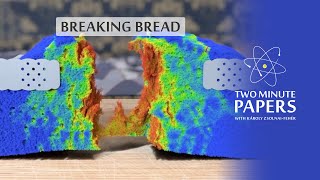
Károly Zsolnai-Fehér reviews a Siggraph paper on simulating bread, jelly, and Oreos tearing apart using an extended Material Point Method. The technique takes 17 seconds to 10 minutes per frame but makes previously impossible fracture effects feasible, with controllable parameters for hardness, cohesion, and crack speed.
Questions this video answers
February 4, 2020.
About 17 seconds to about 10 minutes per frame.
Siggraph.
Train ImageNet to 93% accuracy for less than $19.
Chapters
Dear fellow scholars, this is two minute papers with. In a recent video, we showcased a computer graphics technique that simulated the process of baking. And now it's time to discuss a paper that is about simulating how we can tear this loaf of bread apart. This paper aligns well with the favorite pastimes of a computer graphics researcher, which is of course destroying virtual objects in a spectacular fashion. Like the previous work, this new paper also builds on top of the Material Point method, a hybrid simulation technique that uses both particles and grids to create these beautiful animations. However, it traditionally does not support simulating cracking and tearing phenomena. Now have a look at this new work and marvel at how beautifully this phenomenon is simulated here. With this, we can smash Oreos, candy, crabs, pumpkins, and much, much more. This jelly fracture scene is my absolute favorite. Now, when an artist works with these simulations, the issue of artistic control often comes up. After all, this method is meant to compute these phenomena by simulating physics. And we can't just instruct physics to be more beautiful. Or can we? Well, this technique offers us plenty of parameters to tune the simulation to our liking. Two that we'll note today are the alpha, which means the hardening, and beta is the cohesion parameter. So what does that mean exactly? Well, beta was cohesion, which is the force that holds matter together. So as we go to the right, the objects stay more intact, and as we go down, the objects shatter into more and more pieces. The method offers us more parameters than these, but even with these two, we can really make the kind of simulation we are looking for. Ah, what the heck, let's do two more. We can even control the way the cracks form with the MC parameter, which is the speed of crack propagation. And G is the energy release which as we look to the right, increases the object's resistance to damage. So how long does this take? Well, the technique takes its sweet time. The execution timings range from 17 seconds to about 10 minutes per frame. This is one of those methods that does something that wasn't possible before. And it is about doing things correctly. And after a paper appears on something that makes the impossible possible, follow up research works get published later that further refine and optimize it. So as we say, two more papers down the line and this will run much faster. Now a word about the first author of the paper, Joshua Wolper. Strictly speaking, it is his third paper, but only the second within computer graphics. And my goodness, did he come back with guns blazing. This paper was accepted to the Siggraph conference, which is one of the biggest honors a computer graphics researcher can get, perhaps equivalent to the Olympic gold medal. For an athlete, it definitely is worthy of a gold medal. Make sure to have a look at the paper in the video Description it is an absolutely beautifully crafted piece of work. Congratulations Joshua. This episode has been supported by Lamda. If you're a researcher or a startup looking for cheap GPU compute to run these algorithms, check out Lambda GPU Cloud. I've talked about Lambda's GPU workstations in other videos and am happy to tell you that they are offering GPU Cloud services as well. The Lambda GPU Cloud can train ImageNet to 93% accuracy for less than $19. Lambda's web based IDE lets you easily access your instance right in your browser. And finally, hold on to your papers because the Lambda GPU Cloud costs less than half of AWS and Azure. Make sure to go to lambdalabs.compapers and sign up for one of their amazing GPU instances today. Our thanks to Lambda for helping us make better videos for you. Thanks for watching and for your generous support and I'll see you next time.