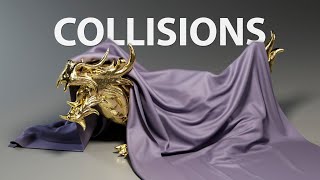
A new collision detection method for physics simulations fixes the problem where objects poke through cloth. The technique runs 30 times faster than the old approach, handling complex interactions like a dragon moving under fabric without glitching.
Questions this video answers
129,000 triangles.
15 milliseconds.
0.5 milliseconds (half a millisecond).
Approximately 30× faster.
Chapters
Dear fellow scholars, this is Two Minute Papers with Dr. Zsolnai. Today we are going to see a lot of physics simulations with many, many collisions. In particular you will see a lot of beautiful footage which contains contact between thin shells and rigid bodies. In this simulation program, at least one of these objects will always be represented as a signed distance field. This representation is useful because it helps us rapidly compute whether something is inside or or outside of this object. However, a collision here takes two objects of course, so the other object will be represented as a triangle mesh, which is perhaps the most common way of storing object geometry in computer graphics. However, with this we have a problem. Signed distance fields work great. Triangle meshes also work great for a number of applications. However, computing where they overlap when they collide is still slow and and difficult. If that does not sound bad enough, it gets even worse than that. How so? Let's have a look together. Experiment number one. Let's try to intersect this cone with this rubbery sheet using a traditional technique. And there is only one rule. No poking through is allowed. Well, guess what just happened? This earlier technique is called point sampling. And we either have to check too many points in the two geometries against each other, which takes way too long, or and still fails, or we skimp on some of them. But then this happens. Important contact points go missing. Not good. Let's see how this new method does with this case. Now that's what I'm talking about. No poking through anywhere to be seen. And let's have another look. Wait a second, are you seeing what I am seeing? Look at this part. After the first collision the contact points are moving ever so slightly, many many times and the new method is not missing any of them. Then things get a little out of hand and it still works perfectly. Amazing. I can only imagine how many of these interactions the previous point sampling technique would miss. But we won't know because it has already failed long ago. Lets do another one. Experiment number two. Dragon versus cloth sheet. This is the previous point sampling method. We now see that it can find some of the interactions but many others go missing. And due to the anomalies, we can't continue the animation by pulling the cloth sheet off the dragon because it is stuck. Let's see how the new method fared in this case. Oh yeah, nothing pokes through. And therefore now we can continue the animation by doing this. Excellent. Experiment three. Rope curtain point sampling. Oh no. This is a disaster. And now hold on to your papers and marvel at the new proposed method. Just look at how beautifully we can pull off the rope curtain through this fine geometry. Loving it. So of course if you are a seasoned fellow scholar, you probably want to know how much computation do we have to do with the old and new methods? How much longer do I have to wait for the new improve technique? Let's have a look together. Each rigid shell here is a mesh that uses 129,000 triangles and the old point sampling method took 15 milliseconds to compute the collisions and this time it has done reasonably well. What about the new one? How much more computation do we have to perform to make sure that the simulations are robust? Please stop the video and make a guess. I'll wait. All right, let's see. And the new one does it in half a millisecond. Half a millisecond. It is not slower at all. Quite the opposite. 30 times faster. My goodness. Huge congratulations on yet another masterpiece from scientists at Nvidia and the University of Copenhagen while we look at some more results. In case you are wondering, the authors used Nvidia's Omniverse platform to create these amazing rendered worlds. And now with this new method we can infuse our physics simulation programs with a robust and and blazing fast collision detector. And I truly can't wait to see where talented artists will take these tools. What a time to be alive. This episode has been supported by Weights and Biases. In this post they show you how to use their system to visualize how well people are doing in the drawtwatch benchmark. What's more, you can even try an example in an interactive notebook through the link in the video description. Weights and Biases provides tools to track your experiments in your deep learning projects. Their system is designed to save you a ton of time and money and it is actively used in projects at prestigious labs such as OpenAI, Toyota Research, GitHub and more. And the best part is that if you have an open source, academic or personal project, you can use their tools for free. It really is as good as it gets. Make sure to Visit them through wnb.com papers or click the link in the video description to start tracking your experiments in five minutes. Our thanks to Weights and Biases for their long standing support and for helping us make better videos for you. Thanks for watching and for your generous support and I'll see you next time.