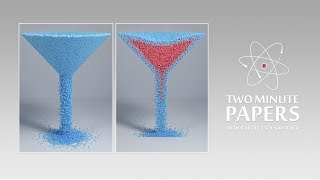
Károly Zsolnai-Fehér explains a new method for simulating sand and grains six times faster. The hybrid approach uses continuum physics for dense regions and discrete particles for sparse ones, cutting the particle count by 88% while maintaining accuracy.
Chapters
Dear fellow scholars, this is two minute papers with good news. Another fluid paper is coming up today, and this one is about simulating granular materials. Most techniques that can simulate these grains can be classified as either discrete or continuum methods. Discrete methods, as the name implies, simulate all of these particles one by one. As a result, the amount of detail we can get in our simulations is unmatched. However, you probably are immediately asking the question, doesn't simulating every single grain of sand take forever? Oh yes, yes it does indeed. The price to be paid for all this amazing detail comes in the form of a large computation time. To work around this limitation, continuum methods were invented which do the exact opposite. By simulating all of these particles as one block, where most of the individual particles within the block behave in a similar manner. This makes the computation times a lot friendlier. However, since we are not simulating these grains individually, we lose out on a lot of interesting effects such as clogging, bouncing and ballistic motions. So, in short, a discrete method gives us a proper simulation, but takes forever, while the continuum methods are approximate in nature, but execute quicker. And now from this exposition, the question naturally, can we produce a hybrid method that fuses together the advantages of both of these methods? This amazing paper proposes a technique to perform that by subdividing the simulation domain into an inside regime where the continuum methods work well, and an outside regime where we need to simulate every grain of sand individually with a discrete method. But that's not all, because the tricky part comes in the form of the reconciliation zone where a partially discrete and partially continuum simulation has to take place. The way to properly simulate this transition zone between the two regimes takes quite a bit of research effort to get right. And just think about the fact that we have to track and change these domains over time, because of course, the inside and outside of a block of particles changes rapidly over time. Throughout the video you will see the continuum zones denoted with red and the discrete zones with blue, which are typically on the outside regions. The ratio of these zones gives us an idea of how much speedup we could get compared to a purely discrete simulation. In most cases it means that 88% fewer discrete particles need to be simulated. And this can lead to a total speedup of six to seven times over that simulation. Basically, at least six all nighter simulations running now in one night. I'm in. Sign me up. Also, make sure to have a look at the paper because the level of execution of this work is just something else. Check it out in the video description. Beautiful work. My goodness, thanks for watching and for your generous support. And I'll see you next time.