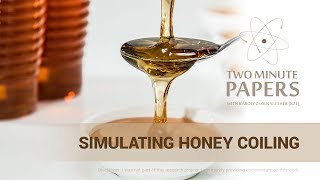
Researchers developed a new method to simulate how honey coils when poured, preserving the detailed buckling that standard simulators miss. A coupled-operator approach keeps the surface detail intact while handling collisions, and the math checks out.
Dear fellow scholars, this is two minute papers with this episode is about simulating a beautiful phenomenon in nature, the buckling and coiling effect of honey.
Mmm.
This effect is due to the high viscosity of materials like honey, which means that they are highly resistant against deformation. Water, however, is much less viscous as it is held together by weaker intermolecular forces. Therefore, it is easier to deform, making it so easy to pour it into a glass. We had an earlier episode on honey buckling, and as every seasoned fellow scholar already knows, the link is available in the video description. One key difference of this work is that the older solution was built upon a Lagrangian approach, which means that the simulation consists of computing the velocities and the pressure that acts on these particles. It is a particle based simulation. Here a solution is proposed for the Eulerian approach, which means that we do not compute these quantities everywhere in the continuum of space, but we use a fine 3D grid and we compute these quantities only in these grid points. No particles to be seen anywhere. There are mathematical techniques to try to guess what happens between these individual grid points and this process is referred to as interpolation. So normally in this grid based approach, if we wish to simulate such a buckling effect, we'll be sorely disappointed because what we will see is that the surface details rapidly disappear due to the inaccuracies in the simulation. The reason for this is that the classical grid based simulators utilize a technique that mathematicians like to call operator splitting. This means that we solve these fluid equations by taking care of advection, pressure and viscosity separately. Separate quantities, separate solutions. This is great because it eases the computational complexity of the problem. However, we have to pay a price for it in the form of newly introduced inaccuracies. For instance, some kinetic and shear forces are significantly dampened, which leads to a loss of detail for buckling effects with traditional techniques. This paper introduces a new way of efficiently solving these operators together in a way that these coupling effects are retained in the simulation. The final solution not only looks stable, but is mathematically proven to work well for a variety of cases. And it also takes into consideration collisions with other solid objects correctly. I absolutely love this. And anyone who is in the middle of creating a new movie with some fluid action going on has to be all over this new technique. And the paper is absolutely amazing. It contains crystal clear writing. Many paragraphs are so tight that I'd find it almost impossible to cut even one word from them. Yet it is still digestible and absolutely beautifully written. Make sure to have a look. As always, the link is available in the video. Description these amazing papers are stories that need to be told to everyone. Not only to experts, to everyone. And before creating these videos, I always try my best to be in contact with the authors of these works. And nowadays many of them are telling me that they were really surprised by the influx of views they got after they were showcased in the series. Writing papers that are featured in two minute papers takes a ridiculous amount of hard work. And after that the researchers make them available for everyone free of charge. And now I am so glad to see them get more and more recognition for their hard work. Absolutely amazing. Thanks for watching and for your generous support and I'll see you next time.