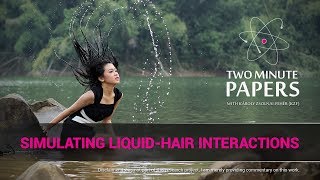
Researchers simulated wet hair by coupling large-scale fluid dynamics with small-scale strand simulations to model droplets, cohesion, and dripping. The paper includes 4K videos, executable code, datasets, and full source code.
Chapters
Dear fellow scholars, this is two minute papers with we already know that by using a computer we can simulate fluids and we can simulate hair. But what about simulating both of them at the same time? This paper is about liquid hair interaction and simulating the dynamics of wet hair. Our seasoned fellow scholars immediately know that this episode is going to be ample in amazing slow motion footage. I. I hope I didn't mess up with any of them. You will see soon if this is the case or not. Before we start talking about it, I'd like to note the following remarkable the authors uploaded a supplementary video in 4K resolution executable files for their technique for all three major operating systems data assets and they also freshly revealed the full source code of the project. Hell yeah. I feel in heaven. A big two minute paper style hat tip to the authors for this premium quality presentation. If this paper were a car, it would definitely be a Maserati or a Mercedes. This technique solves the equations for liquid motion along every single hair strand, computes the cohesion effect between the hairs, and it can also simulate the effect of water dripping off the hair. Feast your eyes on these absolutely incredible results. The main issue with such an idea is that the theory of large and small scale simulations are inherently different and in this case we need both. The large scale simulator would be a standard program that is able to compute how the velocity and pressure of the liquid evolves in time. However, we also wish to model the water droplets contained within one tiny hair strand with a large scale simulator. This would take a stupendously large amount of time and resources, so the key observation is that a small scale fluid simulator program would be introduced to take care of this. However, these two simulators cannot simply coexist without side effects as they are two separate programs that work on the very same scene. We have to make sure that as we pass different quantities between them, they will still remain intact. This means that a drop of water that gets trapped in a hair strand has to disappear from the large scale simulator and has to be re added to it when it rips out. This is a remarkably challenging problem, but but with this we only scratch the surface. Make sure to have a look at the paper that has so much more to offer. It is impossible to even enumerate the list of contributions within in such a short video. The quality of this paper simply left me speechless and I would encourage you to take a look as well. And while this amazing footage is rolling, I would like to let you know that two minute papers can exist because of your support through Patreon. Supporters of the series gain really cool perks like watching every single one of these episodes in Early Access. I am super happy to see how many of you decided to support the series and in return we are able to create better and better videos for you. Thank you again. You fellow scholars are the most amazing audience. Thanks for watching and for your generous support and I'll see you next time.