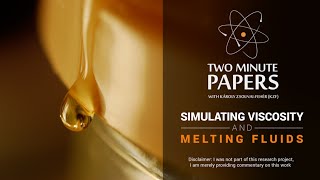
A simulation technique that models how fluids flow at different viscosities, from water to honey. It handles time-varying viscosity to create melting effects, lets objects interact with fluids, and runs multiple fluids with different densities in the same space without breaking down.
Chapters
Dear fellow scholars, this is two minute papers with in this series we have studied fluid simulations extensively, but we haven't talked about one important quantity that describes a fluid. And this quantity is none other than viscosity. Viscosity means the resistance of a fluid against deformation. The large viscosity of honey makes it highly resistant to deformation, and this is responsible for its famous and beautiful coiling effect. Water, however, does not have a lot of objections against deformations, making it so easy to pour it into a glass. With this piece of work, it is possible to efficiently simulate the motion of fluids. And not only that, but it also supports the simulation of a large range of viscosities. Viscosities can also change in time. For instance, physicists know that raising the temperature will make the viscosity of fluids decrease, which which leads to melting. Therefore, decreasing the viscosity in time will lead to a simulation result that looks exactly like melting. The technique also supports two way coupling where the objects have effects on the fluid and vice versa. One can also put multiple fluids with different densities and viscosities into the same domain and see how they duke it out. This is exactly what people need in the robust techniques that work for small and large scale simulations with multiple objects and material settings that can possibly change in time. Thanks for watching and for your generous support and I'll see you next time.