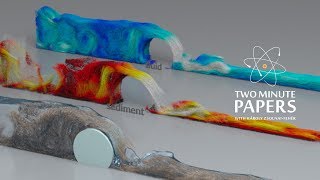
Károly Zsolnai-Fehér breaks down a new method for simulating water mixed with debris and sediment. The challenge: modeling how fluid and particles push back on each other without the simulation gaining fake mass. The result handles millions of fluid particles and hundreds of thousands of sediment particles, rendering frames in minutes instead of hours.
Chapters
Dear fellow scholars, this is two minute papers with. We recently talked about an amazing paper that uses mixture theory to simulate the interaction of liquids and fabrics. And this new work is about simulating fluid flows where we have some debris or other foreign particles in our liquids. This is really challenging. For example, one of the key challenges is incorporating two way coupling into this process. This means that the sand is allowed to have an effect on the fluid, but at the same time, as the fluid sloshes around, it also moves the sand particles within. Now, before you start wondering whether this is real footage or not, the fact that this is a simulation should become clear now, because what you see here in the background is where the movement of the two domains are shown in isolation. Just look at how much interaction there is between the two. Unbelievable. Beautiful simulation ice cream for your eyes. This new method also contains a novel density correction step. And if you watch closely here, you'll notice why. Got it. Let's watch it again. If we try to run this elastoplastic simulation for these two previous methods, they introduce here again in density or in other words, we end up with more stuff than we started with. These two rows show the number of particles in the simulation in the worst case scenario. And as you see, some of these incorporate millions of particles for the fluid and many hundreds of thousands for the sediment. Since this work uses the material point method, which is a hybrid simulation technique that uses both particles and grids, the delta X row denotes the resolution of the simulation grid. Now, since these grids are often used for 3D simulations, we need to raise the 256 and the 512 to the third power. And with that we get a simulation grid with up to hundreds of millions of points. And we haven't even talked about the particle representation yet. In the face of all of these challenges, the simulator is able to compute one frame in a matter of minutes and not hours or days, which is an incredible feat. With this, I think it is easy to see that computer graphics research is improving at a staggering pace. What a time to be alive. If you enjoyed this episode, please consider supporting us through Patreon. Our address is patreon.com twominutepapers or just click the link in the video description. With this we can make better videos for you. You can also get your name immortalized in the video description as a key supporter of or watch these videos earlier than others. Thanks for watching and for your generous support and I'll see you next time.