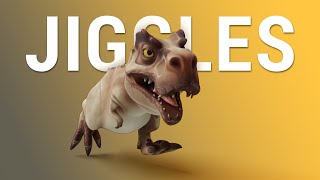
A new graphics technique adds realistic jiggling and deformation to animated characters without expensive physics simulations. It works on different rig types, responds to wind and other forces, and often runs in real time while keeping artists in control.
Chapters
Dear fellow scholars, this is two minute papers with Dr. Zsolnai. I hope you like wiggles and jiggles, because today we are going to see a lot of them. You see, this technique promises to imbue a rigged animation with elastoplastic secondary effects. Now, if you tell this to a computer graphics researcher, they will be extremely happy to hear that this is finally possible. But what does this really mean? This beautiful fish animation is one of the finest demonstrations of the new method. So what happened here? Well, the first part means that we modeled a piece of 3D geometry and we wish to make it move. But in order to make this movement believable, we have to specify where the bones and joints are located within the model. This process is called rigging, and this model will be the input for it. We can make it move with traditional methods? Well, kind of. You see that the bones and joints are working, but the model is still solid. For instance, look, the trunk and ears are both completely solid. This is not what we would expect to see from this kind of motion. So can we do better than this? Well, hold on to your papers and let's see how this new technique enhances these animations. Oh yes, floppy ears. Also, the trunk is dangling everywhere. What a lovely animation. Prepare for a lot more wiggles and jiggles now. I love how we can set up the material properties for this method. Of course, it cannot just make decisions by itself because it would compete with the artist's vision. The goal is always to enhance these animations in a way that gives artists more control over what happens. So what about more elaborate models? Do they work too? Let's have a look and find out together. This is the traditional animation method. No deformation on the belly. Nostrils are not moving too much. So now let's see the new method. Look at that. The face, ears, nose and the mouth now show elastic movement. So cool. Even the belly is deforming as the model is running about. So we already see that it can kind of deal with the forces that are present in the simulation. Let's give this aspect a closer look. This is the traditional method. We are moving up and down, up and down. Alright, but look at the vectors here. There is an external force field, or in simpler words, the wind is blowing. And. And unfortunately, not much is really happening to this model. But when we plug in this new technique, look, it finally responds to these external forces. And yes, as a reward, we get more wiggles. Aha. So what else can this do? A lot more. For instance, it does not require this particular kind of rig with the bones and joints. This hedgehog was instead rigged with two handles, which which is much simpler, but unfortunately when we start to move it with traditional techniques, well, the leg is kind of pinned to the ground where the remainder of the model moves. So how did the new technique deal with this? Oh yes, the animation is much more realistic and things are dangling around in a much more lively manner. The fact that it works on many different kinds of rigged models out there in the wild bolsters the usability of this technique a great deal. But we are not done yet. No, no. If you have been holding onto your paper so far, now squeeze that paper because we can take a scene, drop in a bunch of objects and expect a realistic output. But wait a second. If you have been watching the series for a while, you know for a fact that for this we need to run an elaborate physics simulator. For instance, just look at this muscle simulation from earlier and here's the this animation took over an hour for every second of video footage that you see here. The new method does not need to compute a full blown physics simulation to add this kind of elastic behavior and hence in many cases it runs in real time and it works for all kinds of rigs out there in the wild and we even have artistic control over the output. We don't need elaborate models and many hours of rigging and simulation to be able to create a beautiful animation anymore. What a time to be alive. This episode has been supported by Weights and Biases. In this post they show you how to debug and compare models by tracking predictions, hyper parameters, GPU usage, and more. During my PhD studies I trained a ton of neural networks which were used in our experiments. However, over time there was just too much data in our repositories and what I am looking for is not data but insight. And that's exactly how Weights and Biases helps you by organizing your experiments. It is used by more than 200 companies and research institutions including OpenAI, Toyota Research, GitHub and more. And get this Weights and Biases is free for all individuals, academics and open source projects. Make sure to Visit them through wnb.com papers or just click the link in the video description and you can get a free demo today. Our thanks to WeightsAndBiases for their long standing support and for helping us make better videos for you. Thanks for watching and for your generous support and I'll see you next time.