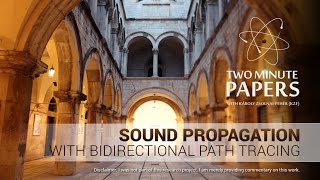
A short YouTube explainer by Károly Zsolnai-Fehér describing a research effort to apply bidirectional path tracing (a light-simulation technique) to sound propagation. The video highlights that this method simulates actual sound paths rather than approximate convolutions, improves efficiency and consistency (especially in indoor scenes), and runs at about 15–20 ms per frame on consumer-grade processors.
Questions this video answers
Between 15 to 20 milliseconds per frame (≈50–65 frames per second on a consumer-grade processor).
Chapters
Dear fellow scholars, this is two minute papers withSolnai. Imagine if we had an accurate algorithm to simulate how different sound effects would propagate in a virtual world. We would find computer games exhibiting gunfire in open areas or a pianist inside a castle courtyard to be way more immersive. And we've been waiting for efficient techniques for this for quite a while now. This is a research field where convolutions enjoy quite a bit of attention due to the fact that they are a reliable and efficient way to approximate how a given signal would sound in a room with given geometry and material properties. However, the keyword is approximate. This, however, is one of those path sampling techniques that gives us the real deal. So quite excited for that. So what about this path sampling thing? This means an actual simulation of sound waves. We have a vast literature and decades of experience in simulating how rays of light bounce and reflect around in a scene. And leaning on this knowledge, we, we can create beautiful photorealistic images. The first idea is to adapt the mathematical framework of light simulations to be able to do the very same with sound waves. Path tracing is a technique where we build light paths from the camera, bounce them around in a scene, and hope that we hit a light source with these rays. If this happens, then we compute the amount of energy that is transferred from the light source to the camera. Note that energy is a more popular and journalistic term here. What researchers actually measure here is a quantity called radiance. The main contribution of this work is adapting bidirectional path tracing to sound. This is a technique originally designed for light simulations that builds light paths from both the light source and the camera at the same time. And it is significantly more efficient than the classical path tracer on difficult indoor scenes. And of course, the main issue with these methods is that they have to simulate a large number of rays to obtain a satisfactory result. And many of these rays don't contribute anything to the final result. Only a small subset of them are responsible for most of the image we see or sound we hear. It is a bit like the Pareto principle or the 8020 rule on steroids.
In language, infinitely many words can be written with a small set of letters. In arithmetic, infinitely many numbers can be composed from just a few digits with the help of the symbol zero, the principle of position, and the concept of base. Pure Systems with base 5 and 6 are said to be very rare. But base 20 occurs in English when we use score, as in 4, score and 7. Eventually no system could keep.
This is ice cream for my ears. Love it. This work also introduces a metric to not only be able to compare similar sound synthesis techniques in the future, but but the proposed technique is built around minimizing this metric, which leads us to an idea on which rays carry important information and which ones we are better off discarding. I also like this minimap on the upper left that actually shows what we hear in this footage, exactly where the sound sources are and how they change their positions. Looking forward to seeing and listening to similar presentations in future papers in this area. Typical number for the execution time of the algorithm is between 15 to 20 milliseconds per frame. On a consumer grade processor that is about 50 to 65 frames per second. The position of the sound sources makes a great deal of difference for the classical path tracer. The bidirectional path tracer however, is not only more effective, but offers significantly more consistent results as well. This new method is especially useful in these cases. There are way more details explained in the paper. For instance, it also supports path caching and also borrows the all powerful multiple importance sampling from photorealistic rendering research. Have a look. Thanks for watching and for your generous support and I'll see you next time.