🤯 Spark of AGI? 🤯 AI Agents Behaving Like Humans
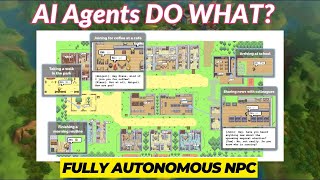
A YouTube explainer by LARRUZ summarizing a Stanford/Google paper on "generative agents" — language-model-driven software agents that simulate believable human behavior. The video describes a 25-agent Smallville sandbox, the agent architecture (memory stream, reflection, planning), how agents are seeded with one-paragraph identities, and a precomputed demo showing emergent social interactions. The narrator emphasizes applications for gaming (dynamic NPCs) and social-simulation use cases like interview practice.
Questions this video answers
25
Memory stream; Reflection; Planning
One-paragraph natural-language description of each agent's identity (occupation, relationships, personality)
Precomputed replay (not real-time)
Chapters
Imagine a world where computational software agents simulate believable human behavior. A world where AI artists paints and authors write. Where these AI agents form opinions and initiate conversations. Where memories are synthesized into higher level reflection to planned behavior. This is the world of generative agents. This groundbreaking paper introduces generative agents that wake up, cook breakfast and head to work. Agents that remember and reflect on their days. The future of gaming is here and it's powered by generative agents. In this video, I'm going to walk you through this amazing paper and show you some very cool demos of these AI agents abilities to replicate human behavior and form human like societies. So let's get started. There is a new fascinating paper from Stanford and Google. The paper is titled Generative Agents Interactive Similar Craft Human Behavior. This paper introduces generative agents which are computational software agents that simulate believable human behavior. It's a simulated world in which they place 25 generative agents. Each agent was given its own personality. So these agents wake up, cook breakfast, head to work and form opinion, just like humans. The fascinating part is that these agents remember and reflect on past days as they plan the next days. So with this memory, they have memory of all the interactions that they had. These agents have memory and personality. They remember and reflect on past days as they plan the next day. All these agents are driven by a large language model. And the architecture extends that large language model to store complex records of agents experiences. Using a natural language, the agents produce believable individual and emergent social behaviors just like humans. Think about the implications of this work now. Each and every NPCs or non playable characters in video games can have its own character and personality. And rather than narrating some predefined sentences, they will now be able to interact with players more naturally. The authors of this paper simulated a small sandbox wall called Smallville. This is a replica of a small town. So there are co living spaces, houses, cafe, bars, stores, parks, houses and there's a college, groceries and pharmacy as well. This is inspired from Sims. The idea is to explore how social behaviors can emerge among AI agents. For that, the author included three main components in the agent's architecture. So the first one is the memory stream which records agents experiences. Then there is a reflection component which synthesize memories into higher level inferences. And then there's planning which translate to those conclusions into action plans. These reflections and plan influence agents future behavior. And based on these three components, the agents are able to take actions independently. These generative agents can simplify the process of creating in games events and interactions. So for example, instead of manually scripting the behavior of multiple characters for a Valentine's Day party, in this case it is simply sufficient to tell one agent that she wants to throw a party. So just like humans, they showed that these agents can independently interact with each other. The agents in the environment succeeded in spreading the word about the party and showing up. One agent even asks another agent on a date to the party, all from a single user generated seed suggestion. Now how does it work? So the authors created a one paragraph natural language description of each agent's identity, including their occupation and relationship with other agents. These descriptions serve as seed memories for the agent. For example, John Lin is described as a pharmacy shopkeeper using the following description so John Lin is a pharmacy shopkeeper at the Velo Market and pharmacy who loves to help people. He is always looking for ways to make the process of getting medication easier for his customers. So, so that's kind of his personality. John Lin is living with his wife Me Lin, who is a college professor, and his son Eddie Lind who is a student studying music theory. So this description will simply drives the personality of John Lin. And same is the case for other agents. All the interactions of these agents with their world and among themselves is through natural language. At each timestamp, agents output a natural language statement describing their current action. This statement is translated into current movements and displayed on the Sandbox interface as a set of emojis. The system employs a language model to translate the actions into emojis. So for each action you will see emojis like these. These agents communicate with each other in full natural language and can engage in conversation with each others in their local areas. Here is an example of the conversation that is happening. So Azabel is saying, I am still weighing my options, but I have been discussing the election with Sam Moore. What are your thoughts on him? Then Tom responds, To be honest, I don't like Sam more. I think he's out of touch with the community and doesn't have our best interest at heart in the game. We are simply forming a society and these conversations are happening organically based on the current situation and environment of the society, which is also evolving over time. Now, although these AI agents are independent and the interactions are happening in organically, the user also has some control. So there are two ways you can interact with the game. Either you can communicate with the agent through conversation. So let's say you can pose like someone and interact with them, or by issuing directive to the agent in the form of inner voice and this inner voice really controls the behavior of your agent. So for instance, when you when told you're going to run against Sam in the upcoming election by a user as John's inner voice. So John's decided to run interaction and share his candidacy with his wife and son. Right. So that is a way of you can control and manipulate the environment and behavior of these agents. Before looking at the demo, let's see what a day in the life of an agent looks like. So the agent starts the day with a single paragraph description and their behavior evolves as they interact with each other and the world. For example, here John Lynn is the first to wake up around 7pm Then he brushes his teeth, take a shower, then goes and prepare and eats breakfast and checks the news at the dining table in the living room. His son Eddie wakes up and they have a brief conversation and then they go about their day. Now the behavior of the agent will change based on the interaction they have with other agents. Here is how this interaction could look like. So John Good morning Eddie. Did you sleep well? Eddie Good morning dad. Yeah, I slept great John. That's great. What are you working on today? And Eddie is saying, I'm working on a new music composition for my class. It's due this week. So these are kind of normal human interactions that you would expect. Each agent's behavior is controlled by this architecture. In simple terms, they perceive the environment and all the perceptions are stored in the memory stream. Whenever they need to perform another action, they simply retrieve information from the memory stream. Then based on the retrieve information, they plan their next action. And these stored memories are also used for changing the behavior of the agent. So they reflect on their past memories and accordingly adjust their interactions with both the environment as well as the other agents. The memory stream comprises a large number of observations that are relevant and irrelevant to the agent's current situation. So there is a retrieval step that identifies a subset of observations that should be passed to language model to condition its response to the current situation. The authors have added a component of reflection in their agent's architecture which really drives their personality. So all the actions are based on their past interactions and they reflect on those interactions and form their personality and self notion. Overall, it's a fascinating read and I would encourage everybody to read this paper. Apart from games and NPCs, it really has some real world applications. So for example, if you are preparing for an interview with a difficult person or personality, so you can use AI agents to stimulate their behavior and personality and interact with them, this will help you in preparing for the interview or in other social situations. So let's look at their online demo. It's not real time so it's a pre computed replay of simulation that has happened before. But you can here see the interactions the different agents are having. Right. So it's just one component or like a small area. And these agents you see they are coming in and out, talking to each other, doing different things and each thing is represented by this emoji. Right. So for example, I think this one is talking. Okay. Now if you come down here, you have all 25 different agents and then the emojis represents the current task they're performing right now you can select one of them. Let's say one we select this person and see what the agent is doing. Right. If you come down to the page, let me select somebody else. Let's see. I think it's Tom. Right. So it's this agent is in a different part of the sim world right now. For example, so it's Tom and the current action closing the Willow Market and pharmacy. So restocking shelves. Location is Harvey Oak Supply store. Right. And then you can actually go and see the details. So for example for Tom that's the current time and everything. Here's the personality. So his rule, aggressive and energetic. And this is the one paragraph description that they provided for each agent and they even give it a lifestyle. So this is pretty nice, really detailed. Right. And then like whatever the daily requirements are. Right. And if you go down to the page, so this is like all the interaction Tom has had so far. Right. So and that's based on the agent's memory. Right. So you can actually go till the end here. They would define the routine and then some different aspects of Tom's personality. So I really like this like Tom doesn't have a favorable opinion of Sam more so this is really like human behavior is they are trying to replicate, right. The human we as a human like some people or don't like some people. Right. So they are trying to replicate all those behaviors. You can also look at some other characters. But overall it's a fascinating work. It will really change our gaming industry and even I would say like the way we interact with these different AI agents. It's a brand new world. Hope you like this update on the latest that is happening in the world of AI. Thanks for watching. See you in the next one.










