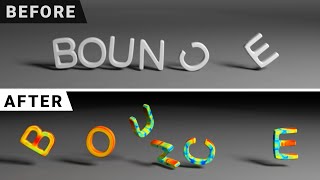
Stanford researchers built a simulator that lets you dial in exactly how bouncy something is, from baseballs to hockey sticks. The 2017 paper from Professor Doug James' group shows how to control bounciness in physics simulations for both art and engineering.
Dear fellow scholars, this is Two Minute Papers with Dr. Zsolnai.
Today we are going to design a crazy baseball bat, a hockey stick that's not working well, springs that won't stop bouncing, and letters that can kind of stop bouncing. And yes, you see it correctly. This is a paper from 2017. Why? Well, there are some good works that are timeless. This is one of them. You will see why in a moment. When I read this paper, I saw that it is from Professor Doug James group at Stanford University. And at this point I knew that crazy things are to be expected. Our seasoned fellow scholars know that these folks do some absolutely amazing things that shouldn't even be possible. For instance, one of their earlier papers takes an animation and the physics data for these bubbles. And impossible as it might appear, synthesizes the sound of these virtual bubbles. So video goes in, sound comes out, And hold on to your papers then, because that's nothing compared to their other work, which takes not the video but the sound that we recorded. So the sound goes in. That's easy enough. And what does it do? It creates a video animation that matches these sounds. That's a crazy paper that works exceptionally well. We love those around here. And to top it off, both of these were handcrafted techniques. No machine learning was applied. So what about today's paper? Well, today's paper is about designing things that don't work or things that work too well. What does that mean? Well, let me explain. Here is a map that shows the physical bounciness parameter for a not too exciting or old simulation. Everything and every part does the same. And here is the new method. Red means bouncy, blue means stiff. And now on to the simulation, the old one with the fixed parameters. Well, not bad, but it is not too exciting either. And here is the new one. Now that is a simulation that has some personality. So with this we can reimagine as if parts of things were made of rubber and other parts of wood or steel. Look here. The red color on the knob of the baseball bat means that this will be made bouncy while the end will be made stiff. What does this do? Well, let's see together. This is the reference simulation where every part has the same bounciness. And now let's see that bouncy knob. There we go. With this, we can unleash our artistic vision and get a simulation that works properly given these crazy material parameters. Now let's design a crazy hockey stick. This part of the hockey stick is very bouncy. This part too. However, this part will be the sweet spot, at least for this experiment. Let's hit that puck and see how it behaves. Yes, from the red bouncy regions. Indeed, the puck rebounds a great deal. And now let's see the sweet spot. Yes, it rebounds much less. Let's see all of them side by side. Now, creating such an algorithm is quite a challenge. Look, it has to work on smooth geometry built from hundreds of thousands of triangles. And one of the key challenges is that the duration of the contacts can be. What are you seeing? What I am seeing, the duration of some of these contacts is measured in the order of tens of microseconds and it still works well and it's still accurate. That is absolutely amazing. Now, of course, even though we can have detailed geometry made of crazy new materials, this is not only a great tool for artists, this could also help with contact analysis and other cool engineering applications where we manufacture things that hit each other. Glorious. So this is an amazing, timeless work from 2017 and I am worried that if we don't talk about it here on two minute papers, almost no one will talk about it. And these works are so good. People have to know.
Thank you very much for watching this.
And let's spread the word together.
This episode has been supported by Lambda GPU Cloud. If you're looking for inexpensive cloud GPUs for AI, check out Lambda GPU Cloud. They've recently launched Quadro RTX 6000, RTX 8000 and V100 instances. And hold on to your papers because Lambda GPU Cloud can cost less than half of AWS and Azure plus they are the only cloud service with 48 GB of RTX 8000. Join researchers at organizations like Apple, MIT and Caltech in using Lambda Cloud instances, workstations or servers. Make sure to go to lambdalabs.compapers to sign up for one of their amazing GPU instances today. Our thanks to Lambda for their long standing support and for helping us make better videos for you. Thanks for watching and for your generous.