STRAWBERRY: OpenAI's MOST POWERFULL AI Ever With Human-Level Reasoning
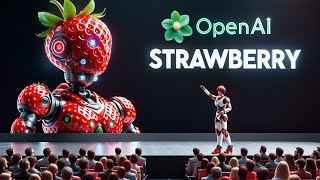
OpenAI's project Strawberry uses a new post-training method to give AI models human-level reasoning and autonomous research abilities, according to internal demos and leaked documents. The approach resembles Stanford's Self-Taught Reasoner and could let models improve themselves, raising questions about safety as AI labs race to build more capable systems.
Chapters
OpenAI is apparently working on some new and exciting technology. According to an inside source and some internal documents obtained by Reuters, OpenAI has a project codenamed Strawberry that's aiming to take their AI models to the next level. So what is Strawberry? Well, from what I can gather, it's a novel approach to how OpenAI's AI models work and it's focused on enhancing their reasoning capabilities. You see, one of the biggest challenges in AI right now is getting these models to not just spit out information but but to actually understand and reason about the world like humans do. Current AI models, as impressive as they are, still struggle with things that seem like common sense to us, like recognizing logical fallacies or playing simple games like Tic Tac Toe. They often hallucinate or make up information when faced with these kinds of problems. You know what I mean? Like they might be able to recite facts and figures, but putting that knowledge into practice in a reasoned, logical way is a whole different ballgame. But OpenAI is hoping that Strawberry will be a game changer in this regard. The details are being kept tightly under wraps, even within the company itself. But from what I can tell, Strawberry involves a specialized way of processing the AI models after they've been trained on massive data sets. Like after the models have learned from all this data, Strawberry is supposed to help them take that knowledge and use it in a more reasoned, human like way. The goal is to enable these models to plan ahead, understand how the physical world works, and reliably work through complex multi step problems. Essentially, they want their AI to be able to reason and think more like humans do, which is no easy feat. We're talking about replicating the kind of intuitive common sense reasoning that comes so naturally to us, but is incredibly difficult to encode into an AI system. Now this is a big deal because improved reasoning is seen as the key to unlocking the true potential of AI. With better reasoning capabilities, AI could potentially make major scientific discoveries, discoveries, plan and build new software applications, and who knows what else. The possibilities are kind of mind boggling, to be honest. Imagine an AI that can not only process and analyze data, but also use that data to formulate hypotheses, test them out and draw logical conclusions. That's the kind of thing we're talking about here. According to the sources and documents, OpenAI is specifically aiming for Strawberry to enable their AI models to perform what they call deep research. This means the models would be able to autonomously browse the Internet, gather information, and use that information to conduct research and solve problems. All on their own, like they wouldn't need human guidance or intervention. They'd be able to essentially teach themselves and explore new areas of knowledge. Kind of like how a human researcher would approach a new topic. They're even planning to test Strawberry's capabilities by having it do the work of software and machine learning engineers. And if Strawberry is successful, we might see AI systems that can not only crunch data and spit out code, but actually design and implement entire software applications from start to finish without any human involvement. I should also mention that OpenAI isn't the only company working on improving reasoning in AI. Tech giants like Google, Meta and Microsoft are also experimenting with different techniques to tackle this challenge. But Strawberry seems to be OpenAI's big bet in this area. Like their main focus when it comes to advancing AI reasoning. Now this AI has some similarities to a method developed at Stanford called Self Taught Reasoner or Star. This method, it's supposed to enable AI models to like, bootstrap themselves into higher intelligence levels by creating their own training data. Basically, the idea is that the model can learn and improve itself without needing humans to constantly feed it new data. One of the creators at Stanford said that if things keep going in that direction, we, we as humans have some serious things to think about. Like if AI systems can continually enhance their own reasoning abilities, who knows how advanced they could become? It's both exciting and a little bit scary to think about, if I'm being honest. Of course, the Strawberry project is still shrouded in mystery, and it's unclear exactly how close it is to being released or implemented in a real world setting. Now, OpenAI has been privately signaling to developers and other outside parties that they're on the cusp of releasing technology with significantly more advanced reasoning capabilities, which is likely referring to Strawberry. So we, we might be seeing something big from them pretty soon. Who knows? They actually showed a demo of some research project with new human like reasoning skills at an internal meeting recently, but it's unclear if that was Strawberry or something else entirely. Regardless, it seems like they're making some serious progress in this area. Oh, and get this. One of the sources said that they saw earlier demos of what staffers claimed was the project formerly known as Q Star, which was apparently already seen as a breakthrough within OpenAI. Another source even said that OpenAI has tested AI internally that scored over 90% on a math data set, which is like a benchmark of championship math problems. Crazy stuff, right? Now I know what you're probably thinking. If Strawberry is so groundbreaking, why haven't we heard More about it? Well, that's a great question. And the truth is, OpenAI is playing their cards pretty close to the chest on this one. They're notoriously secretive about their research and development, which makes sense when you're working on technology that could potentially be world changing. But at the same time, they've got to be careful not to overhype things too much. You know, we've seen the companies make grandiose claims about AI breakthroughs before, only for the reality to fall a little bit short. So it's understandable that OpenAI would want to keep things under wraps until they're absolutely sure they've got something game changing on their hands. That said, the fact that they're being so tight lipped about Strawberry is kind of telling in itself, don't you think? Like, if it was just another incremental improvement, they'd probably be a bit more open about it. But the secrecy surrounding this project suggests that they really believe they're onto something big, something that could fundamentally change the way we think about and interact with AI. And if anyone can deliver on the promise of truly reasoned human like AI, it's probably OpenAI. And if Strawberry is even half as revolutionary as it's being made out to be, well, it could usher in a whole new era of AI capabilities that we can scarcely imagine right now. Of course, as always, there are also potential downsides and risks to consider, as is always the case with powerful new technologies. As that Stanford professor said, if AI reasoning abilities continue to rapidly advance, we as humans might have some serious existential questions to grapple with. What does it mean for our place in the world if machines can outthink us in virtually every domain? But hey, those are conversations for another day, right? For now, let's just bask in the excitement and potential of what Strawberry could represent. All right. Now, on another note, there's a breakthrough in AI hardware that's particularly exciting for ChatGPT. A startup named Etched, founded by two Harvard dropouts, has introduced a new AI chip called called Sohu. They claim this chip can run models like ChatGPT up to 20 times faster than Nvidia's top H100 chip and 10 times faster than the more powerful B200. If true, this could drastically improve AI performance and capabilities. Nvidia's GPUs like the H100 and B200 have dominated the AI hardware industry, making them a leader with a market cap surpassing $3 trillion. However, Etch, based in California, aims to disrupt this with their specialized transformer asic application specific integrated circuits chip designed specifically for transformer AI models. This means SOHU excels in running models like ChatGPT, OpenAI's Sora and Google's Gemini, but it cannot handle other AI models like convolutional neural networks used for image recognition. Etched has already raised $120 million and secured pre orders worth tens of millions of dollars. They've also partnered with TSMC to manufacture the 4 nanometer chip which will help scale up production in their first year. While these advancements are still theoretical, the potential of Sohu could lead to exciting new AI products that were previously impossible due to GPU limitations. These new developments show just how fast AI is moving forward. OpenAI is trying to make AI think more like us, which could change how we use technology every day. Meanwhile, Etched is shaking things up with a new chip that could make AI run way faster than ever before, challenging big names like Nvidia. It's an exciting time because we might soon see AI that's both incredibly smart and super efficient. As we look to the future, it's thrilling to imagine all the new possibilities this technology will bring into our lives. Alright, if you found this interesting and want to stay updated on more AI insights like this, don't forget to subscribe. Subscribe to the channel. Thanks for watching and I'll see you in the next one.










