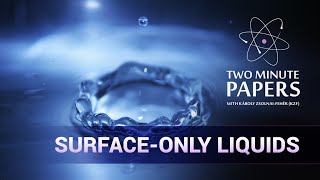
Károly Zsolnai-Fehér explains a faster way to simulate liquids by computing only on the surface instead of the entire volume. Surface-only methods run in seconds per image instead of minutes, and work best for phenomena like dripping, droplets, and splashes where surface area is small relative to volume.
Chapters
Dear fellow scholars, this is two minute papers with most of the techniques we've seen in previous fluid papers run the simulation inside the entire volume of the fluids. These traditional techniques scale poorly with the size of our simulation. But wait, as we haven't talked about scaling before, what does this scaling thing really mean? Favorable scaling means that if we have a bigger simulation, we don't have to wait longer for it. I our scaling is fairly normal. If we have a simulation twice as big and we need to wait about twice as much, poor scaling can give us extraordinarily bad deals, such as waiting 10 or more times as much for a simulation that is only twice as big. Fortunately, a new class of algorithms is slowly emerging that try to focus more resources on computing what happens near the surface of the liquid and try to get away with as little as possible inside of the volume. This piece of work shows that most of the time we can get away with not doing computations inside the volume of the fluid, but only on the surface. This surface only technique scales extremely well compared to traditional techniques that simulate the entire volume. If a piece of fluid were an apple, we'd only have to eat the peel and not the whole apple. It's a lot less chewing, right? As a result, the chewing, or the computation, if you will, typically takes seconds per image instead of minutes. A previous technique on narrowband fluid simulations computed the important physical properties near the surface. But in this case we compute not near the surface, but only on the surface. The difference sounds subtle, but it makes a completely different mathematical background. To make such a technique work, we have to make simplifications to the problem. For instance, one of the simplifications is to make the fluids incompressible. This means that the density of the fluid is not allowed to change. The resulting technique supports simulating a variety of cases such as dripping water, droplet and crown splashes, fluid chains and sheet flapping. I was spellbound by the mathematics written in the paper that is both crystal clear and beautiful in its flamboyancy. This one is such a spectacular paper. It is so good I had it on my tablet and couldn't wait to get on the train so I could finally read it. The main limitation of the technique is that it is not that useful if we have a large surface to volume ratio, simply because the peel is still a large amount compared to the volume of our apple. We need it the other way around for this technique to be useful, which is true in many cases. Thanks for watching and for your generous support, and I'll see you next time.