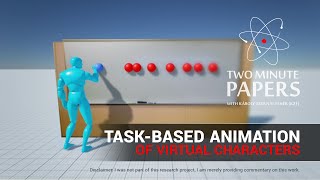
Researchers built an algorithm that breaks down tasks into subtasks, then automatically generates realistic footsteps and body movements for virtual characters. It handles everything from sidestepping to pivots, and knows when to use low-effort or high-effort movements. The system keeps animations smooth and immersive across tasks like writing at a whiteboard or moving boxes.
Chapters
Dear fellow scholars, this is two minute papers with in this piece of work.
You'Ll see wondrous little sequences of animations.
Where a virtual character is asked to write on a whiteboard, move boxes, and.
Perform different kinds of sitting behaviors. The emphasis is on synthesizing believable footstep patterns for this character. This sounds a bit mundane, but we'll quickly realize that the combination and blending of different footstep styles is absolutely essential for a realistic animation of these texts.
Tasks beyond simple locomotion walking if you will, for instance, side stepping, using toe and heel pivots, or partial turns and steps every now and then are essential.
In obtaining a proper posture for a number of different tasks.
A rich vocabulary of these movement types.
And proper transitions between them lead to really amazing animation sequences that you can see in the video. For instance, one of the most heinous examples of the lack of animating proper locomotion we can witness in older computer.
Games, and sometimes even today, is when.
A character is writing on a whiteboard.
Who suddenly runs out of space, turns away from it, walks a bit, turns.
Back towards the whiteboard, and continues writing there. Even if we have impeccable looking photorealistically.
Rendered characters, such robotic behaviors really ruin.
The immersion in reality. A simple sidestepping would do the job, and this is exactly what the algorithm tells the character to perform.
Very simple and smooth.
This technique works by decomposing a given.
Task to several subtasks, like starting to.
Sit on a box or getting up and choosing the appropriate footstep types and transitions for them.
One can also mark different tasks as being low or high effort that are.
Marked with green and blue. A low effort task could mean fixing a minor error on the whiteboard nearby.
Without moving there, and a high effort.
Task that we see marked with blue would be continuing our writing on a.
Different part of the whiteboard. For these tasks, the footsteps are planned accordingly.
Really cool.
This piece of work is a fine.
Example of the depth and complexity of computer graphics and animation research and how even the slightest failure in capturing fine scale details is enough to break the immersion of reality. It is also really amazing that we have so many people who are interested in watching these videos about research, and quite a few of you decided to.
Also support us on Patreon.
I feel really privileged to have such amazing supporters like you fellow scholars.
As always, I kindly thank you for.
This at the end of these videos, so here goes. Thanks for watching and for your generous.