Tech Billionaires On AI - " AI Will Kill Jobs for the Most Desperate People"
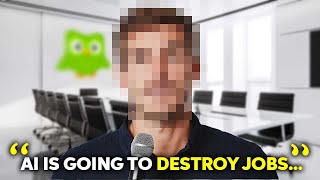
LARRUZ breaks down what tech billionaires are saying about AI and jobs. Louis von Ahn cut Duolingo contractors after deploying generative AI. Goldman Sachs estimates AI could displace hundreds of millions of workers, and autonomous agents arriving around late 2025 could hit vulnerable workers hardest.
Chapters
So in today's video I'm going to be discussing something rather interesting considering it talks about the future of AI and automation. This video will refer to an article in which a billionaire sips margaritas as he predicts how AI will kill jobs for the most desperate people. It's a tough situation that'll affect the poor and less educated. So today we're going to be taking a look at this article from the Bite and an article from Forbes in which they discuss how AI is and the future of jobs are going to be impacted with regards to how these companies are run. We can see here that this is the article that I saw. It was rather fascinating because the title reads rather harshly, but I do think there is a lot of information to unpack here because this is the kind of thing that I think will become more commonplace and isn't currently being talked about as widely as it should as the AI technology takes the majority of the consciousness. So I'm gonna read to you a part of this article and then I'm gonna dive into certain things that are just factually wrong because like I said before, it's rather fascinating to how there are so many individuals writing articles, but they seem to miss out certain key points of research as there is a lot happening in the AI space, especially in certain communities with certain companies that most people do miss. But I'll get into that later. So it says here the person running the popular language learning app Duolingo isn't afraid of job automation in the age of AI. In fact, CEO and founder Louis Von Ahn is willing to discuss the gloomy prospect of mass layoffs caused by the advent of AI tools while enjoying bites of Al pasta tacos and sips of margarita. As Forbes reports, the company has already cut contractors tasked with coming up with alternative ways to phrase translations in January. Unsurprisingly, the changes were in large part thanks to the advent of AI. Generative AI is advancing our workflow by helping us create new content dramatically faster than Von Ahn wrote in a November shareholder letter. And while a full time employee's job is very hard to automate, he told Forbes over a meal at Duolingo's Mexican restaurant, we've had some hourly contractors who are doing pretty rote stuff now, if you aren't familiar with the Duolingo situation, this is a company that has gone full in AI. They've gone all in on AI, and they aren't afraid to state that. One of the things that we know about AI is that more companies are starting to use this behind the scenes, but the problem is is that most people don't realize it as it's not being spoken about. The reason it's not spoken about is because unfortunately, if you are someone who owns a company and you publicly speak about how you're replacing employees with artificial intelligence, you will face a huge backlash. You can see here that a CEO has been slammed for replacing 90% of his company's support staff with an AI chatbot and then bragging about it on Twitter. You have to understand that brand image, all of these things for a company are remarkably important. And right now I don't think there's any moral support for business owners who are replacing individuals with AI. It's not something that reads off the tongue nicely, and especially since the majority of people do have a job or a career that could be threatened by AI, this is something that individuals are going to respond negatively to. I do think that there does need to be empathy from these business owners if they do want to also grow their companies with AI and maintain their brand image. Because this comment does have a decent point, it says it's unfortunate. I hope people choose wisely before working with founders who have zero empathy and like gloating about their layoffs. It's one thing to say you're using AI technology, it's another thing to gloat about laying off individuals. And this isn't just hearsay. A widely circulated Goldman Sachs study anticipates up to 300 million jobs worldwide being displaced by AI in the next decade. So coming back to this article from the Byte the main takeaway, which is why people are angry, is because how he speaks about the less fortunate. I think the title is a little bit clickbait, but there are a few things that I want to dive into. The billionaire tech founder also had some thoughts about how AI could affect the rest of the world. It's a tough situation that'll affect the poor, the less educated, he told Forbes. And not just in the United States, but also in poor countries. Von Ahn has been staunchly pro AI from the get go going as far as to say AI could eventually make computers better teachers than people. And this is something that I do agree with because in the future AI is going to have a lot more capabilities in the sense that it is more patient and it genuinely understands a lot more than humans do, you can see. More recently, his company released an AI powered video chat feature that allows users to converse with a mascot called Lilly to practice their language skills. And one of the things that he was willing to admit is that those layoffs won't be coming for other billionaire founders like him anytime soon. Instead, it'll be the far less privileged who are likely the first to be let go. I think this statement is really true considering the fact that when we look at how AI is being deployed, it isn't the average person that largely benefits from AI. When we look at how the future is going to be in terms of the AI agents, AI getting autonomy, being able to do tasks for long time horizons, we do realize that this is going to be something that benefits those who own the majority of businesses rather than those who are employed currently. There are a lot of discussions basically stating that yes, that yes, AI might just be a tool considering we have things like copilot to where the AI actually helps you perform certain tasks on a day to day basis. But we do know that AI is something that evolves quite rapidly. Whilst yes, AI can be a copilot right now, it can help you, it can create a social post, it can summarize the article that isn't the end game for AI. The end game for AI is the fact that it will replace individuals doing the majority of grunt work in a variety of different tasks. For those of you who don't understand this, remember OpenAI's levels to AGI. One of the things they actually spoke about was the fact that they recently reached level 2, which is of course the reasoners that have achieved human level problem solving. So we need to look at the future because of course that means that next is level three and this is going to be agents, which is going to be systems that can take actions on behalf of a user. I'm pretty sure that this phase of AI which is likely to debut in probably late 2025 is going to be a lot more impactful than what we have right now. Yes, systems like ChatGPT, GPT4 and other AI models can do a lot of work, but they're severely limited their autonomy which will change in the near future, which will also change how these systems are deployed and how they affect the labor market. You can see here that it says whether duoling goes all in on AI will result in tangible benefits to its users remains to be seen. And here's where we get into something that I don't think that is quite true. Take a look at this. It says that experts, and here's why I think they are wrong doubt that AI could ever replace human tutors with the University of Michigan's Marcel Family School of Education Dean Elizabeth Burr telling Forbes that AI cannot see. If a student is experiencing frustration, it cannot see body language, it cannot see joy. Now first glance, there is some truth to this statement. But as someone that has paid attention to almost every AI advancement, I can say that this isn't true. I'm going to show you guys a video that I covered around six months ago in which there is an AI that can see frustration, can see body language and can see joy. This is my video coverage of a stunning new AI model which was called eevee. This is an emotionally intelligent AI. What it does is it's able to look at your face and read certain things in terms of the emotions that you're feeling. You can see that there are many different detected expressions by this AI that's able to allow the AI to respond a lot more emotionally. I like this so much because it's a level ahead of what LLMs are doing currently. When you speak to certain systems like ChatGPT and Advanced Voice mode. Even as advanced as a system is, it can't detect certain inflections in your speech. If you are sad, it can only detect things that basically allow you to respond in a way that's dynamic. Having emotionally intelligent AI is going to be a remarkable game changer. In this video I'm going to show you guys what I did. I tested this with Sam Altman and on the right hand side you can see that live it's able to detect users emotions as they come into the system. You can see it has confusion, concentration and interest. And you can see that on the right hand side as well it has some expression levels. Now whilst this might not be at the forefront of AI research, the reason I wanted to include this in today's video is because it puts into perspective sometimes when you read certain articles about AI and the future of job automation, certain arguments just aren't factually true. And it's not that these individuals are purposefully leaving stuff out. You have to understand that the AI area is one in which there are so many developments. Unless you're actively paying attention to your specific space, it's quite easy to actually miss things that happen on a day to day basis. This is something that many people haven't really thought about because it's not in the front. There aren't these giant training runs about this. But I assume that in the future, once vision models get a lot more capable, once they become a lot more more powerful, you'll be able to see and use these models to engage in a much higher level of conversation with AI. This is going to respond to you in a much more emotionally intelligent way. It's going to open up a wide array of different use cases scenarios. But the point is, is that the article distinctively says that AI cannot read emotions. And yet here I am showing you something that shows it can. Overall, I think that the future is going to be one that is rather fascinating considering there are many unknown unknowns with relations to the job market and how future economics might actually work. But I think it's currently important to maintain an open view with as to what AI can do. Never underestimate the capabilities of these systems, and also think about your future in terms of the careers, because we know that there are many disruptions up ahead. If you enjoyed this video, I'll see you guys in the next one.










