Teslas New AUTONOMOUS Teslabot Update Silences Critics!
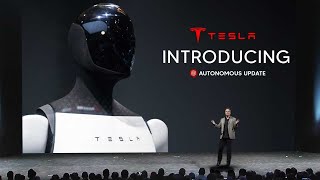
Tesla's Optimus robot now walks more smoothly, avoids obstacles on its own, maps spaces in real time, and climbs stairs without help. The update addresses earlier claims that demos were just remote-controlled.
Chapters
So Tesla have just released a new video in which they actually showcase the Tesla Optimus autonomous capabilities. This new video I think is directly in a response to what many were calling a somewhat scam, simply because of the fact that the Tesla Optimus bots at the WeRobot event weren't 100% autonomous. Now I'm going to dive into all of the autonomy and stuff that happened at the WeRobot event in a moment, but this video is focusing on the new and stunning autonomous update that we actually have from the Tesla team. Now this one is actually rather surprising considering the fact that the Tesla bot is doing a variety of different things that I didn't think it would do just yet. So one of the things that I think has gotten a decent upgrade is of course, the enhanced walking mechanics. One noticeable improvement in the Tesla's Optimus update is a more confident and fluid walk. This actually signals an advancement in the robot's bipedal locomotion system. Unlike early iterations where the movements actually seemed a bit too mechanical and too cautious. And I mean, for those of you that don't think we are moving quickly, you can see that at the start of this video that was released at the early 2023 stages, the Tesla Optimus Bot in this stage was actually so cautious and so mechanical looking in its movement. This goes to show that over the course of a year and a few months, the kinds of upgrades that Tesla have made are truly significant. And I think for those people who are like, okay, these robots aren't completely running yet, I think you need to understand the rate of development that Tesla is moving at and understand that in 10 years, what these robots could truly look like. And then when we look back at how Optimus now moves, we can see that Optimus now exhibits a much smoother and more human. Tesla's engineering team has likely refined the joint motor control algorithms, allowing for better balance and the ability to navigate diverse terrains. This improvement actually reflects Tesla's dedication to closing the gap between robotics and human mobility, which is of course key for real world applications and the environments like production lines. Now, the very best thing about Tesla's walking capabilities is isn't just the fact that it can now walk much smoother and a little bit faster. The autonomous exploration of unseen spaces is a new feature. So Optimus now has the ability to autonomously explore new spaces, relying on its AI driven perception system. With this update, the robot is not merely following a pre programmed path, but it's actively mapping out the surroundings in reality, real time. The Ability opens up vast potential, especially environments where human presence might be limited, hazardous, or unnecessary. For example, Optimus could be deployed in factories to carry out tasks in areas that may have been previously inaccessible without human involvement. And the implications for the industrial automation industry are huge, particularly in the automotive and electronics manufacturing sectors, particularly where efficiency and safety are completely critical. I think this update is game changing, considering the fact that being able to autonomously explore new spaces is something that is extraordinarily hard to do. And one of the biggest things that robotics companies really do suffer with is navigating unseen examples, which is why the Tesla team has been collecting data for a really long time. If you've ever been paying attention to any of these robotics companies, you'll know that one of the largest, largest bottlenecks to scaling robotics is, of course, the data solution. And if we can get a robot that is able to overcome this by navigating unseen environments autonomously, that is going to truly speed up the timeline like never before. Now, we also have neural net obstacle avoidance. In this update, Optimus now incorporates advanced neural networks to avoid people and obstacles seamlessly. This is actually a important safety feature, especially in environments where the robot will be operating alongside humans. Using neural nets allows the robot to make quick, real time decisions on navigation, ensuring it doesn't collide with objects or interfere with human activities. And this feature slowly but subtly brings Optimus closer to functioning in a human collaborative robot environment, which is increasingly important as automation moves into spaces traditionally occupied by manual labor. Navigating these spaces and avoiding humans is something that we will expect from these systems in the future. And this level of safety is something that is ought to be warranted if Optimus is going to be in many different environments where humans are, including the homes. Now, one of the things that I really did like was the fact that Optimus now has environmental awareness through its vision systems. So I'm not exactly sure which vision system they are using, but it's clear that being able to process visual information about its environment autonomously, you know, the sensor inputs, likely powered by cameras and other vision recognition technologies, allow Optimus to better understand the dimensions and layout of spaces, whether they are in rooms, in a factory, in an office, it can recognize and differentiate between objects, doors, and even people, which play a crucial role in navigating its decisions. Now, what is futuristic, which is where people were saying that this is like the IROBOT movie, is that the Optimus robot has the update where its ability to work collaboratively with other robots build a shared understanding of its surroundings. So this feature is demonstrated in the 3D mapping visuals where Optimus units generate a detailed spatial map of their environment. This type of collaborative AI allows for more efficient navigation as robots can pull their information to better understand the complex layouts. And in practice, this basically means that as more Optimus units work together, they become more capable of operating large scale or unfamiliar environments. This is some kind of collective intelligence that brings a whole new level of operational efficiency and a step towards creating intelligent robotic systems capable of handling vast spaces, such as large factories or logistics centers, with minimal human input. And I can't wait to see this kind of thing scaled up even more to to see how these individual robots can work together as a team to understand certain environments. Now, one of the craziest things that this robot has achieved in terms of being able to operate autonomously for a longer period of time is of course the autonomous charging navigation. So Optimus has achieved a level of autonomy with its ability to locate and navigate to the nearest charging station without human intervention. Although this does sound a little bit scary and dystopian, I think this feat is essential because it means that Optimus can now manage its own power needs automatically without having a human to charge them. So using its rear camera, Optimus can precisely dock itself at a station, adding another layer of autonomy to its operations. This feature is particularly significant for use cases where long hours of continuous work are required, such as large scale production environments, reducing downtime and of course maximizing the efficiency of the entire team. Now another thing that it also does, which was rather surprising, was that it's able to now autonomously pick up and transport significant weights, as seen with the 11kg battery tray it lifts and carries with precision. This is a crucial advancement in Optimus's practical utility for industrial environments. This ability to actually handle larger payloads opens up more possibilities for the robot to assist in different ascendry lines, even retail stocking for example. And what's impressive is that they can actually perform these tasks without overheating, which again ensures continuous operation for longer duration. And Tesla's focus on optimizing the motor torque, the cooling systems and AI driven manipulation ensures that Optimus can engage in repetitive, strenuous tasks that would be physically taxing for most humans. Those robots are going to be able to work longer and harder than us in a variety of different environments in a more efficient way. Now, one of the largest things that I think is truly incredible is, is navigating non flat terrain. The new update for the Tesla Optimus showcases its improved ability to traverse non flat terrain, including staircases, which is a major leap forward in its mobility capabilities. As seen in the video, you can see that Optimus is confidently going up some stairs, something that requires complex balancing abilities and of course, precise foot placement. This kind of movement signifies that the robot is not only designed for a floor factory and but is now capable of navigating more challenging environments. And once again, it opens up the potential for Optimus to be utilized in a variety of settings, including construction sites, multi level warehouses and even home environments. And remember, it has the ability to handle uneven terrain and obstacles, meaning that it's progressing more towards greater versatility and functionality, making it even more robust for for more solutions and domestic applications. Now we also have the human interaction and the safety response. One of the standout features is its enhanced ability to interact with people safely and efficiently. As seen in the video, you can see that the robot is interacting with many different humans and it can now understand gestures, take requests and even respond to potentially unsafe human behaviors. So for those of you that are thinking about doing anything strange to the robot or potentially detrimental or don't ever try that, because I'm sure that by the time these things are released, they're going to truly understand all the range of dangerous activities and it's likely to report you immediately. I think this level of autonomy is going to allow us to have a different level of increased human interaction and I think it's going to be fascinating to see how they program this robot to interact with humans in certain environments. I'm not sure how it's going to be different in different environments, but this is the kind of thing that we truly haven't seen yet because it's running real time on an embedded computer. Which means that, you know, unlike the previous Cybercap event which I spoke about two days ago, this is fully autonomous, meaning that nothing here is scripted and the Tesla bot truly understands exactly what is going on and can make the adjustments needed. So overall, for those of you that are Tesla supporters, or on the other hand, for those of you that are Tesla haters, do you think that this new update vindicates Elon Musk and the Tesla engineering team when it comes to Tesla's Optimus robot? Recently many people were stating that haha, these robots are just VR teleoperated by humans. I can't believe people are falling for this quote unquote vaporware. But with today's update, we can clearly see that Tesla have made significant advancements with regards to their robots and it looks like the future of humanoid robotics is clearly accelerating.










