The AI News You Missed - A Crazy Week For AI Art!
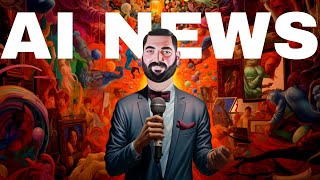
A narrated YouTube news roundup (posted Aug 25, 2023) covering a busy week in AI—with emphasis on AI art developments (Midjourney inpainting/remix, Ideogram AI’s superior text-in-image, Leonardo AI’s Anime Pastel model, Unity plugin for asset generation) and related legal nuances (a US federal ruling that purely machine-generated images lack copyright). The video also surveys AI integrations across industries: marketing (HubSpot report), music and YouTube features, speech/translation advances (11Labs multilingual v2, Meta’s seamless M4T demo), developer tooling and models (OpenAI fine-tuning for GPT-3.5 Turbo, Meta Code Llama, Hugging Face SafeCoder and Series D funding), and healthcare breakthroughs (Microsoft–Epic partnership, brain‑implant voice avatar). The tone is upbeat and pragmatic about continued AI investment despite some hype-cycle cooling and legal challenges.
Questions this video answers
"The AI News You Missed - A Crazy Week For AI Art!" — August 25, 2023.
$4.5 billion valuation.
$13.5 billion in revenue and about $6 billion in pre-tax profit (reported Q2 2024).
Meta's seamless M4T (demo referenced at 'seamless.mea demolab.com' in the transcript and model available on Hugging Face and GitHub).
11Labs released 11-multilingual version 2 (text-to-speech model for nearly 30 languages).
Chapters
There's actually been a ton of news in the AI world this week, and if you haven't been paying attention, you probably missed a lot of it. It's especially been a big week for the AI art world, so let's dig in. This week, Midjourney rolled out their inpainting feature. I actually did an entire dedicated video around this new inpainting feature. The video looks like this, but here's the real quick breakdown. When you generate and upscale a new image inside of Midjourney, you, you're gonna get this new button that says Vary region. If you go to your Mid Journey settings and make sure Remix mode is on, you can actually steer what gets changed inside of the image. So if I click on Vary region, I could select this guy's head like this and say long blonde hair. Click submit and you can see everything about the image stayed the same, except now it generated an image with long blonde hair. And apparently it seems to associate women with long blonde hair. Here's another little use case example that I posted on Twitter where I sel selected just the clothing of this person and I used the prompt Superman. I used the prompt the Joker. I used the prompt a flowery dress, a rockstar wearing leather, and then I inpainted the eyes to add sunglasses by typing wearing sunglasses. And that's what we got. I also created this animation using Runway ML's frame interpolation feature where it switched between all of the different clothing. And at the very end of this video, I. I actually had the character change the expression on their face. And then somebody that you should be following on Twitter, Javi Lopez here made a discovery that if you click vary and then select the entire image and leave the exact same prompt, you actually get a higher quality, more detailed image. And then my friend Ali Jules here, who I recently met at the artificial conference, actually confirmed this, she said. During the Mid Journey office hours today, David, the founder of Midjourney, said that the inpainting uses a different system and that a keen eye may notice it being slightly better. Speaking of Alley Jules, she shared her weekly Midjourney office hours recap with us. And here's some of the things that we can expect from Midjourney. It sounds like a possibility that they may be shipping some more Inpainting features. And it looks like they're making version 6 a priority with more controllability, more knowledge, better text understanding, more styles, more diversity, ability to generate text, and better resolution. So they're putting a lot of effort into this. But still no estimated release date. It also sounds like they are prioritizing the website. They want to have a super high quality user interface and user experience. They're adding a bunch of features, but there's still no estimated release date on that either. One thing that I found really interesting, and I think this would be absolutely awesome, is that they are working on 3D and they're also working on video. Excited to see how those things play out. But midjourney inpainting isn't the only AI Art News we got this week. This week saw the release of Ideogram AI. Ideogram AI was actually put together by a rockstar team of people from Google Brain, UC Berkeley, CMU and the University University of Toronto, including the people who worked on image in Google's Text to Image model that we actually haven't had a chance to play with ourselves yet. Now, probably the biggest standout feature of Ideogram AI is the ability to add text to your AI generated images. And it does it better than any of the other platforms we've seen so far. Now, Ideogram is actually a platform I've had access to for a little while now, but I was sworn to secrecy until they actually made their announcement. So I'm excited to finally show off what this can do. So if I put something like a logo design with a wolf that has the words Matt Wol on it and click Generate, I actually get a couple fairly decent images. This one nailed it. And this one at least put my last name right, which is a pretty cool logo. Just skimming through some of the examples here. There's an image of Bigfoot with the words Hike. An image with a jack o' lantern that says Spooky Season. Here's one that looks like a logo sticker that says Archer Air. Here's one that says Nature Loves Courage. You could learn more over at Ideogram AI and play around with it. See what you can generate. Also in AI Art News this week Leonardo AI added a new model to their platform called Anime Pastel. To access the model, just log into the Leonardo app and up at the top right now under Featured Models, you can see Anime Pastel Dream. Click on the model and you can see some of the really cool images that were generated with that model. Also this week it was announced that Microsoft wants to add AI into more of their tools like Microsoft Paint. This image is an internal mockup from Microsoft of what that could look like. Also an AI Art News scenario. A company that's known for helping you create AI generated game assets now has a Unity plugin. So now you can generate your game assets with text prompts directly inside of the Unity platform if you're a game designer or developer now finally, in AI art news, it's not all good news. Late last week it was decided that AI generated art cannot be copyrighted, according to a US Federal judge. However, if you read more about the ruling, the work that was trying to be copyrighted in this case was generated with a Creativity Machine algorithm. This wasn't a midjourney type image where a prompt was entered and some human touch was added to the image. This was referring to a case where a machine just generated an image without any human touch other than the creation of the algorithm. So there are other AI image copyright cases that are still ongoing where the creator actually prompted the images and kept on creating new prompts over and over and over again until they got dialed in on the exact image they were looking for. So there was a lot of human touch in those cases. But in the cases where a machine just generated an image without a prompt or a human touch, those can't be copyrighted. So there's some nuances there with these copyright laws, but this isn't necessarily referring to an image that was generated with like Midjourney Leonardo Stable Diffusion or something like that. All right, now let's talk about AI in your marketing. Whether you're a content creator like me, a business owner, or someone who just wants to get more reach online, it's important to keep up with the latest trends in marketing. And right now, now, everything is trending in the direction of AI. Not only is leveraging AI one of the best ways to get reach, it's also one of the most in demand marketing skills that companies are looking for right now. So for this video, I partnered with HubSpot to get another one of their free resources into your hands. It's called AI trends for marketers in 2023 how AI is changing marketing and Driving Rapid Business Growth. With this free report, you'll learn how leading marketers are using AI tools to create content 10 times faster, analyze data instantly, and increase ROI. You'll also get a competitive edge by learning about the latest AI marketing tech. Personally, I was especially interested in the section all about how you can leverage AI to repurpose your existing content. As a content creator, I want to make sure I'm reaching the maximum amount of eyeballs whenever I spend the time to create a new piece of content. So I really think you'll find this free resource super helpful as well. I put the link to this report down in the description. Thanks so much to HubSpot for sponsoring this video and providing you with this free resource. Also this week, YouTube announced that they are partnering with Universal Music Group to work on the overlap of AI and the music industry. YouTube wants to embrace AI responsibly, and they want to work with artists to figure out ethical and responsible ways to allow creators to use music, but make sure that artists and record labels are compensated appropriately. Speaking of YouTube, this week they also announced that they are testing a new search feature which will allow you to hum a song and it will find the song based on you humming it. As of now, it looks like the new experiment's just going to be on Android devices, and it says users who have access to the experiment can toggle from YouTube Voice Search to the new song search feature and hum, sing or record a song for three or more seconds. The platform then identifies the tune and directs the users to relevant YouTube videos featuring the search song, whether that be the official music video, user generated content or shorts. This feature is built on a machine learning model that can match a person's hum to a song's fingerprint or signature melody. And while we're on the topic of using your voice, 11Labs rolled out a new version 2 of their 11 multilingual, which is a foundational AI speech model for nearly 30 languages. If you have an 11Labs account and you log in, you should see under the Settings a dropdown that allows you to select the model you'd like to use, and they now have 11 multilingual version 2. As of right now, it just does text to speech, so if you want it to speak in Indonesian, you need to type something in Indonesian. But it does say that voice conversion is coming soon, so I imagine we'll likely be able to enter text in our native language, have it translate that text, and then speak out that text for us in the language that we selected. But for right now, if you wanted to, you could always type it in English, take it to Google Translate, have it translate to whatever language you want it to speak in, for example Japanese. Grab the new text, paste this into 11 labs and have it generate that. Now, I don't speak Japanese, so the output I have no clue how well it's performing, honestly. Konnichiwa watashi no namai wanamatou watashi no youchubu Chandler ni toro ksurichiyogarimas. So if you do understand Japanese, you can let me know if that made sense or not. Now, on that exact same day Meta also rolled out their seamless M4T model, which allows you to speak something out or enter text and then get an output of speech to speech translation, speech to text translation, text to speech translation, text to text translation or automatic speech recognition. And this seamless M4T model, if we scroll down here, is actually available on hugging face and GitHub. So if you know what you're doing, you can actually install this locally and run it on your own machine or run it in the cloud on Hugging Face. However, they did make available a demo that anybody can use over@seamless.mea demolab.com, and you can speak anything in English. So for example, hello, my name is Matt Wolf. I really think you should subscribe to my YouTube channel, click the like button and press that bell. Now I can actually select any language that I want here. For example Spanish click Translate. It actually did a text translation right here as well as a speech translation. Hola minombre Smart Wolf. Real mente creoe de variasos. Now my Spanish isn't great, but I think it got pret close. Unlike Eleven Labs, this isn't actually reading it back in my voice. OpenAI had a little bit of news this week as well. Users can Now Fine Tune GPT 3.5 Turbo for their own use cases. If you're not familiar with fine tuning, it's basically where you dial in the model to work exactly for your use case. So, for example, improves steerability, it allows businesses to make the model follow instructions better, it improves the model's ability to consistently format responses, and you can actually create your own custom tone with how you like the model to respond. Now, one thing to keep in mind about fine tuning, though, is it's a lot more expensive than just using the base model without fine tuning. And Rachel woods here on Twitter made some excellent points about how what most people would want to do with fine tuning you can actually just do with prompting, she says. LLMs are remarkably good at picking up tasks and behaviors from just a good prompt, he says. One way to think about this if it would take someone a few weeks doing a task to master it, instead of being able to read training materials and get the picture, this may be a use case for fine tuning, she says. If you're wondering where the heck to invest in fine tuning, my answer at the moment for most businesses is still make sure you can't do it with prompts. And to be honest, there's still not a whole lot you can't do with prompts that requires fine tuning. Speaking of OpenAI, we recently talked about how the New York Times is suing ChatGPT for training on their data. If they do sue them and they win, the result could be devastating, including the destruction of ChatGPT's data set and fines of up to $150,000 per infringing piece of content. Now, considering how much data ChatGPT was originally trained on, it's hard to believe that if this was true and it actually played out in this way, that ChatGPT and OpenAI would actually survive it. Now, do I actually think it's going to play out this way? Probably not. I think some sort of more reasonable resolution will come about. Headlines like Potential New York Times lawsuit could force OpenAI to wipe ChatGPT and start over is a headline that'll get clicks Staying in the Negative world of AI for just a moment here this article was released this week about the ugly numbers from Microsoft and ChatGPT reveal that AI demand is already shrinking. And to be fair, there was a bit of a hype cycle where ChatGPT and all the AI hype was just at a maximum. And a lot of that hype has died down. Some of it has been because of summer and schools being out as well as no real new like massive, massive advancement like we saw with the GPT4, or like we saw with a new version of Mid Journey or new versions of stable diffusion. The news has sort of been more incremental and not insanely groundbreaking lately, which is why I think some of the hype has died down a little bit. But this article will lead you to believe that AI is only good for scamming, spamming and shamming. I think this article is a little over the top because they definitely cherry picked a whole bunch of articles that show some of the negatives around AI without pulling articles about how AI has massively improved lives, improved advancements in health care, increased productivity among workers, and all sorts of other benefits that have been coming out in the AI world. But again, doom and gloom sells just as well as excitement. And if you really, really think that AI is going to just die off because a handful of articles here say so, let's take a look at Nvidia's earnings and this article from the Verge that says Nvidia just made $6 billion in peer profit over the AI boom, and that was on a staggering 13.5 billion in re. This $13.5 billion is from its Q2 2024 earnings and because of the unprecedented demand for its generative AI chips and they're forecasting 16 billion in revenue next quarter, again due to AI. So yes, there's a handful of lawsuits, yes, OpenAI might have a few struggles ahead of them, but AI isn't going anywhere. And the companies that are finding new ways to leverage AI, they're still investing in it, they're still buying up these chips and they're still going in heavier and heavier. The hype in the mainstream awareness may die down a little bit, but the technological advances and all of the use cases for all of this AI technology, it's only going on an upward trend. If you're in Europe, you may be getting an AI off switch on Meta related apps like Facebook and Instagram. The European Union has what's called the Digital Services act and as part of that act, it requires larger platforms and search engines to provide users in the region with with the ability to switch off AI Dr. Personalization. And as you and I likely already know, pretty much all the algorithms from all the social media companies and all of the search engines use AI to try to present you with better results. In my opinion, this is going to dramatically lower the user experience on these platforms. I think a lot of these algorithms do a really good job of putting content in front of me that I want to see. And if you take that away, it'll probably make for a less enjoyable user experience. But hey, you'll probably also break your addiction to whatever those platforms are as well because the AI is also designed to keep you coming back and keep you using the platform. Speaking of Meta, if you're a coder, Meta just introduced Code Llama. Now if you remember, Meta released the open source Llama large language model fairly recently. Well now they have a model that is designed specifically for coding code. Llama is free for research and commercial use. It's built on top of llama 2 and you can access it and download it and install it however you want locally or in the cloud because they've got it available on their GitHub repository right now. This week Hugging Face also introduced a coding assistant called safecoder. Now they say Safecoder is not a model but a complete end to end commercial solution. It's built with security and privacy and it's designed for self hosting by the customer on their own infrastructure, similar to what we just saw with Code Llama. Now Safecoder is actually designed to be trained on your specific use case for the coding model. So it's not like llama 2 where it's a one size fits all coding solution. This one you actually work with Hugging Face to kind of fine tune it to your exact needs. And speaking of Hugging Face, this week Hugging Face announced that they did a Series D raise at a $4.5 billion valuation. Some of the new investors include Salesforce, Google, Amazon, Nvidia, amd, Intel, Qualcomm, IBM and Sound Ventures. Now, if that's not a rockstar set of investors to have behind you, I don't know what is. Here's some fun news that came out this week. Amazon's bringing new AI driven features to Thursday Night Football. They're actually going to start putting AI generated stats and details about the game that you're watching on the screen while you're watching the game. Now, when it comes to AI, I think one of the next big revolutions we're going to see in the AI world is advancements in AI with healthcare. And we've already seen so many amazing pieces of news about how AI is advancing the healthcare space as far as like the mainstream consciousness is concerned. I really think that's where we're going to see the next big boom and hype cycle around AI. And this week Microsoft and Epic expanded their AI collaboration to accelerate generative AI's impact in healthcare. They're doing things like enhancing clinician productivity with note summarization, enhancing productivity with embedded ambient clinical documentation, driving administrative efficiencies through reduction in manual labor intensive processes, and advancing medicine for better patient outcomes. Speaking of which, check out this news article. This week, a novel brain implant helped a paralyzed woman speak using a digital avatar. Researchers developed an implantable AI powered device that for the first time translates brain signals into modulated speech and facial expressions. As a result, a woman who lost the ability to speak due to a stroke was able to speak and convey emotion using a talking digital avatar. And as AI advances, I just think we're going to see more and more of this type of thing in the healthcare world where disabilities are going to be overcome, diseases are going to be overcome, doctors and clinicians are going to be more productive and actually free up their time to work on the things that really matter to them. Personally, I'm really, really excited about seeing AI and the advancements in the healthcare world as much as I am in the worlds of visual effects and art and speech recognition and all of that kind of stuff. AI and healthcare, I think is going to be that next big revolution that everybody gets excited about. Totally here for it. I'm so excited about that and that's what I got for you today. Thank you so much for tuning into this video. I really, really appreciate you. There's one last quick thing I want to shout out. I do have a Discord community. We just passed 10,000 members and we're actually running some really, really cool contests inside of the Discord community. You can find it over at FutureTools IE Discord. That'll redirect you right into the community and you can enter some of our cool AI art competitions that we've got going on right now where you can win cash and prizes by submitting art and getting voted on by the community. So head on over to the disc, check that out and if you haven't already, also check out the Future Tools website where I curate all the latest cool tools that I come across and I keep you in the loop with all the latest AI news on a daily basis. You can find it over at FutureTools IO. Once again, thank you so much for tuning in. I really, really appreciate you. And thanks again to HubSpot for sponsoring this video. You guys rock. Appreciate you. See you in the next one. Bye. By. Sam.










