The AI Revolution: From Turing to GPT-4 and AGI
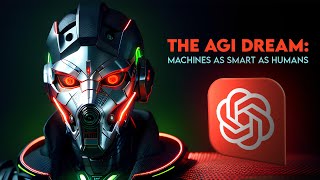
A short narrated YouTube video tracing the history and implications of artificial intelligence. The opening frames introduce Alan Turing and the 1950 Turing Test as the origin story, signal the 1956 birth of AI as a field, and foreshadow AI’s societal transformations through mobile and internet technologies.
It all started with Alan Turing, a mathematician who had a crazy idea of creating a machine that could think like a human. He proposed the famous turing test in 1950, which asked, can machines think? If a machine could fool a human into thinking it's another human during a conversation, it had achieved some level of intelligence. But AI was still a pipe dream until 1956.
To answer these questions, we embarked on an exciting journey to meet artificial intelligence potential to revolutionize every aspect of daily Germany.
Today, people are expressing their opinions and habits through mobile and Internet technologies.
When a group of researchers at Dartmouth College in New Hampshire coined the term artificial intelligence and launched the field as we know it today. The Dartmouth conference brought together experts from various fields to discuss the possibilities of machines that could think and reason like humans. Foreign McCarthy was one of the key figures at the conference, and he believed that the key to creating intelligent machines was to teach them to reason logically. He developed the programming language Lisp, which became a key tool for AI research in the years that followed. In 1964, Joseph Weizenbaum developed Eliza, the first AI psychotherapist. This chatbot managed to fool people by responding to their problems with pre written scripts. While Eliza didn't win any Oscars, it paved the way for future AI developments. Unfortunately, progress in AI was slow in the decades that followed, due to a lack of powerful hardware to support the kinds of algorithms needed to create intelligent machines. But researchers persisted, and soon enough, a new technique emerged that would revolutionize the field. Machine learning. As the 1960s rolled along, the AI community was all about learning. Machine learning, to be exact. Arthur Samuel's checkers playing program showed that computers could learn from experience, and in doing so, he inadvertently named the field. The era also saw the creation of Sherdliu, a program that could understand and manipulate objects in a virtual world. A major breakthrough in natural language understanding. The AI Chess Challenge took off in the 70s and 80s, with computers battling it out against grandmasters. In 1997, IBM's Deep Blue made history by defeating world chess champion Garry Kasparov. Chess enthusiasts mourned, but AI enthusiasts celebrated this milestone. As if that wasn't enough, the 80s also brought us the birth of neural networks inspired by the human brain's structure. With great progress comes great disappointment. The AI winter of the 1980s, a period of reduced funding and skepticism, led to a shift in focus. AI researchers turned their attention to expert systems, programs that could mimic the decision making of human experts. Mycin, an early expert system, helped doctors diagnose bacterial infections. However, these systems had limitations and the hype started to cool down. But lo and behold, AI would not be defeated. During the AI winter, the groundwork was laid for what would become a new era of AI research. Actually, one of the most important breakthroughs in machine Learning came in 1986, when a researcher named Geoffrey Hinton invented a technique called backpropagation. Backpropagation is a way of training neural networks, which are algorithms that mimic the structure of the human brain. Hinton's breakthrough was a game changer for machine learning. But that's not all that went down. In the 80s, the CIC project also emerged. Basically, the idea was to teach machines how to reason and answer questions like us humans do. Led by Doug Lanot, the CIC project faced a lot of challenges, but it managed to create a pretty impressive knowledge base that has helped in the development of AI systems. Turns out machines need a little bit of common sense too. 90s when the AI community experienced a neural network renaissance. Inspired by the human brain, researchers developed algorithms that could learn from vast amounts of data, giving birth to deep learning. Yann LeCun's Lenet 5, a pioneering neural network revolutionized handwriting recognition. And the world hasn't looked back since. In 1998, the support vector machine SVM algorithm emerged as a powerful tool for solving complex classification problems. Around the same time, reinforcement learning made waves, with AI researchers developing algorithms that could learn from trial and error, just like humans do. The 21st century saw the rise of big data, which fueled AI's growth even more. In 2009, a game changing dataset called ImageNet was developed, containing millions of labeled images that could be used to train computer vision systems. This dataset was a major catalyst for the development of deep learning algorithms for image recognition and led to the creation of systems like Google's inception. The availability of massive labeled Data sets like ImageNet was a critical factor in the success of deep learning, paving the way for the development of more advanced and accurate computer vision systems. From IBM's Watson dominating Jeopardy in 2011 to the birth of Siri, AI became a household name. Google's AlphaGo conquered the ancient game of Go in 2016, defeating world champion Lee Sedol and making headlines around the globe. OpenAI's GPT models started writing text so human like that it made Shakespeare look like a rookie. And computer vision systems began to outperform humans in image recognition tasks. And AI was no exception. As AI systems became more powerful, concerns about fairness, transparency and privacy skyrocketed. From biased facial recognition systems to deepfakes. Society started questioning the impact of AI on our lives. Cue the AI Ethics movement, which aimed to ensure AI technology was developed and deployed responsibly. This movement led to the creation of AI ethics guidelines and principles. With organizations like OpenAI pledging to develop AI in the best interests of humanity, researchers began to explore ways to make AI systems more interpretable and accountable, ensuring that they aligned with human values and and respected our privacy. Today we find ourselves on the cusp of Artificial General Intelligence AGI, where AI systems can perform any intellectual task that a human can do. Companies like OpenAI are pushing the boundaries of AI research and the world watches with bated breath. Efforts to create AGI have led to the development of more advanced AI models like GPT4, capable of generating highly sophisticated text and understanding complex concepts. One of the main challenges is developing AI that is transparent and understandable so that humans can trust and rely on it. It's no wonder that so many companies are investing heavily in AI research. Take OpenAI for example. This non profit organization was founded by some of the brightest minds in AI, including Elon Musk and Sam Altman. They have been working tirelessly to create machines that can perform tasks that were previously thought to be impossible. So the big question on everyone's mind is should we even be trying to create AGI? Will it have a positive impact on society or will it end up controlling us? With the rapid advancements in AI, we may get the answer sooner than we think. If you enjoyed this video, be sure to subscribe. Subscribe and give it a thumbs up. It really means a lot to us. Thanks for watching and we'll catch you in the next one.










